Information
- Location
- Zhambyl Region, Jambyl District
- Period
- 901 – 0
- Category
- Historical and cultural monuments of republican significance
- Type
- Mausoleum
- Kind
- Monuments of urban planning and architecture
Sources
- Қазақстанның киелі орындарының географиясы: Табиғат, археология, этнография және діни сәулет өнері нысандарының тізілімі / Жалпы редакциясын басқарған ҚР ҰҒА академигі Байтанаев Б.Ә. – Алматы: Ә.Х. Марғұлан атындағы Археология институты, 2017. – 1-шығарылым. – 904 б.
Description
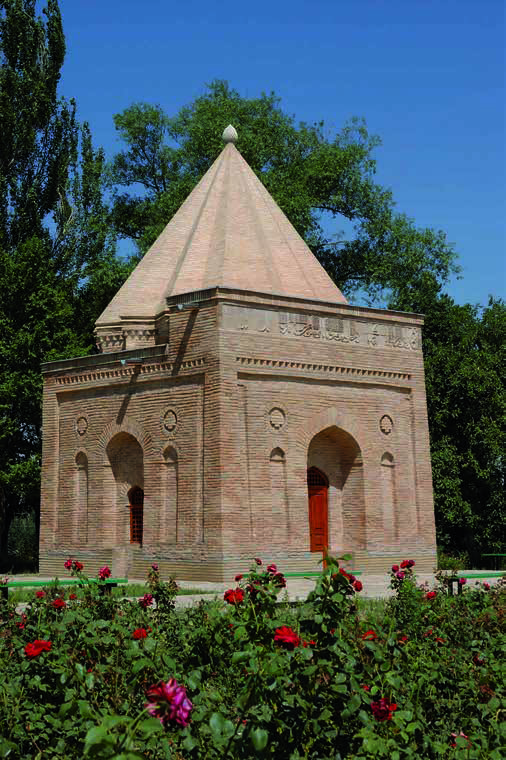
It is located 18 km away from Taraz city (Zhambyl district, Zhambyl region). The mausoleum is located near the Aisha-Bibi mausoleum and is a unique architectural monument of the ХІ-ХІІ centuries.
Babaja-Khatun Mausoleum has a unique historical and cultural significance as one of the most significant monuments of Turkic-Muslim architecture on the territory of South-Eastern Kazakhstan. Muslim culture is the result of synthesis of ethno-cultural impulses of many peoples, including Central Asian ones. The integration of Central Asia into the system of socio-cultural relations of the Caliphate contributed to the expansion of contacts between different peoples, as a result of which there was a cultural synthesis in Central Asia and the Middle East in the IX-X centuries. According to academician N.I. Konrad, "Renaissance" is a process that is characteristic not only for Europe, but also represents a "manifestation of the general regularity of the historical process", which is activated at one moment or another in the historical development of peoples "with a long, constantly developing and continuing nowadays historical life and culture" [cited in Conrad, 1963].
Existing in historical memory together with the Aisha-Bibi mausoleum, Babaja-Khatun mausoleum complements the system of legends and history surrounding these sacred monuments. In every civilization there are such "twins", being an organic part of each other and creating a sacred space of culture. The history of the Babaja-Khatun Mausoleum is linked to the legend of the construction of the Aisha-Bibi mausoleum. About 28 versions of this legend are widespread. According to one of them, Babacha-Khatun was a companion of Aisha-Bibi, the daughter of the famous scientist and poet of XI century Hakim Suleiman Bakyrgani. After the tragic death of Aisha-Bibi, her faithful companion Babaja-Khatun became the keeper of hr mausoleum and was buried 20 steps away from Aisha-Bibi in the mausoleum.
The mausoleum was studied by V. Kallaur in 1897, by A. N. Bernstam in 1938-1939, and by T. Basenov in 1953. Babaja-Khatun Mausoleum is interesting as an embodiment of its architectural composition. Unported mausoleum with a cubic base of baked bricks with dimensions of 0.24×0.24×0.05 m. The length of the sides is 6.90×6×94 m, i.e. square, with a ribbed pointed dome, the top of which is deformed. All walls, except the western one, are the same. They contain two elongated arched windows, deep niches to the ground between them, and an entrance from the east side. The main facade is highlighted by a parapet wall with an epigraphic frieze. A part of the text made in "naskh" handwriting in the technique of carved terracotta is preserved: "This high tomb of Babaja-Khatun". The inscription is relief, easy to read, handwriting is strict and simple, without ornamentation among the letters. The facade is completed by a strip of figured masonry made of widely arranged bricks, enclosed in the last two rows of walls.
Since the X century, the Arabic script has been penetrating more and more into the culture and life of the population of Zhetysu. Texts from the Koran and Muslim maxims began to decorate monumental buildings: in Arabic the worship in mosques and madrassas was conducted; Arabic script was used for epitaphs on the burial grounds of Muslims; Sogdian legend on coins was replaced by Arabic legend. Epigraphic ornament began to decorate the dishes and interior of the house. Islamization, which lasted until the XIII century, allowed the rulers to solve a number of problems related to the political consolidation of society, its unification under the banner of a new religion, which successfully eliminated political extremism. Islam was able to set a common complex of views and ideas, on the basis of which it became possible to carry out a common for nomadic people domestic and foreign policy of unified education and enlightenment, which created a new scale of moral values.
The mausoleum belongs not only to cultural and historical monuments created by human hands, but also to a special type of natural and cultural landscape. The monument is one of the most visited cultural and historical objects of our country. Since 1982 it has been under the protection of the state. Every day, pilgrims from all over Kazakhstan and neighboring countries visit Babaja-Khatun Mausoleum.