Information
- Location
- West Kazakhstan Region, Bokeyorda District
- Period
- 1801 – 1900
- Category
- Historical and cultural monuments of republican significance
- Type
- Сomplex
- Kind
- Ensembles and complexes
- Authors
- Сдыков Мұрат Наурызғалиұлы
Sources
- Қазақстанның киелі орындарының географиясы: Табиғат, археология, этнография және діни сәулет өнері нысандарының тізілімі / Жалпы редакциясын басқарған ҚР ҰҒА академигі Байтанаев Б.Ә. – Алматы: Ә.Х. Марғұлан атындағы Археология институты, 2017. – 1-шығарылым. – 904 б.
Description
Monument of history, town planning and monumental architecture of republican importance. XIX century. (Bokeyorda district, West Kazakhstan region).
In 1801 between the Urals and the Volga was formed the Bokey Khanate (or the Inner Horde). It was governed by sultans and khans and was named after the first of them - sultan Bokey Nuraliev, who ruled the Horde from 1801 to 1815. If at the moment of formation in khanate there were 5 000 families of natives from the Junior Zhuz, by 1850 in Bokey Horde lived almost 300 000 people (50 000 kibits).
The Khan's institution of power existed in the Bokey Khanate for about 45 years, including the periods of rule of two khans: Bokey and his son Zhangir. The Bokey Khanate served as a major supplier of cattle, meat and wool to Russia. The khanate was located in the "inner side" of Russia, so in the historical literature of that time there was a second name - the Internal Horde.
The development of the Bokey Khanate was influenced by the growing influence of the Russian economy and culture - here this process was more active than in other regions of Kazakhstan. Besides, there was a strict system of taxation of the population in favor of the Khan's treasury.
On May 21, 1815 Khan Bokey died as a result of a long illness. According to the oral testament of the deceased khan, set forth by the second wife of Bokey Atan-khanym in a letter to Emperor Alexander I dated June 8, 1815, his son, Sultan Zhangir, was proclaimed the lawful heir of the khan's power in the Internal Horde. Till the coming of age of the last one, the duties of managing the khanate were temporarily transferred to the guardian of the young sultan, the younger brother of Bokey khan, Sultan Shigay Nuraliyevich (1815-1824).
In 1824-1845 the Bokey Khanate was governed by the son of Bokey Zhangir. On June 24, 1824 in Uralsk in the presence of the highest ranks of the Orenburg administration a solemn ceremony of confirmation of Zhangir in khans took place. From that moment on, a new era in the history of the Bokey Khanate began, characterized by the development of processes of centralization of power and certain innovative changes in the economic and socio-cultural life of the Inner Horde. It was a period full of transformations and reforms aimed at adapting the society to the new historical realities and therefore of great importance for the Kazakhs.
Khan Zhangir received his primary education from a mullah-home teacher. Then, at the age of about 7-8 years old, he was brought up in the house of a highly educated royal official, a prominent cultural figure of Southern Russia in the late XVIII - early XIX centuries. Astrakhan civil governor S. S. Andreyevsky (1760-1818), in whose family he spent his childhood and partly youthful years. Thanks to natural curiosity and the received versatile education Zhangir not badly studied Russian, Persian and Arabic, written Central Asian Turkic (called in Russia in the XVIII-XIX centuries "Tatar language"), has got certain knowledge in natural and humanitarian sciences, and also has mastered some typical tastes and habits of Russian nobility of that epoch.
Zhangir tried to consolidate and strengthen the khan's power in the Internal Horde on the basis of mutual coordination of geostrategic aspirations of the Russian suzerain and class-corporate claims of the most influential among Kazakhs sultans and elders, as well as the interests of both of these parties with their own aspiring intentions and ambitions. However, Khan Zhangir was not always able to provide the necessary balance of different political interests, and as a result, during some periods of his reign, the Khan's power in the Horde was not only unable to resolve social conflicts among different groups of Kazakhs in a timely manner, but also was itself the main source of major internal political conflicts in the Trans-Ural steppe. As a result of the aggravation of internal contradictions in 1836-1838, an anti-colonial and national-liberation uprising started in the Horde under the leadership of Isatai Taimanov and Makhambet Utemisov.
An important area of Zhangir's political activity was innovative activities in the economic life of Bokey Horde and the system of social and economic relations among nomads. They included the foundation of the first stationary settlements in the region: in 1827 - the villages of Khan-Kaly, or the so-called Khan's rate, in the tract of Zhaskus in the sands of Narynkum and in 1841 - the summer rate of Torgun-Kala, located on the river Torgun. In a short period of time both rates became the main administrative, economic and cultural centers of the khanate. In 1833, a fair was established at the Khan's rate, which was annually attended by Russian merchants and Kazakh traders who carried out a mutually beneficial exchange and concluded major trade transactions with each other.
The more positive and long-term effects of Zhangir's social and cultural transformation have been felt. One of the most important achievements of the khan's power in this field is the establishment in 1841 of a secular general education school for Kazakh children in two languages - Kazakh and Russian - at the Khan's rate. In 1842-1844, Kazakh boys were sent to the Orenburg Neplyuevsky Cadet Corps to study, as well as to build primary rural schools and a madrassa in the Inner Horde.
In 1844, vacancies were received for training Kazakh youths in other higher educational institutions of Russia. In the same period the medical station and a drugstore for service of the nomadic and semi-nomadic Kazakh population have been founded, the weapon museum with unique exhibits is created. As a result of these innovations in the Internal Horde there were the first versatilely educated personnel of managers of the Kazakhs, and the process of formation of the Kazakh intellectual and administrative-political elite was started. However, all these innovations covered only the ruling elite of nomadic society.
Khan Zhangir lived a few 40 years and died on August 11, 1845, in his summer bid at the Torgun River. After Zhangir's death, Khan's power was abolished and Bokey Khanate as an independent political union was liquidated. The power of the Provisional Council on management of the Bokey Horde, which was subordinated to the Orenburg military governor, was established. Many natives of the Bokey khanate, such as the outstanding Kazakh composer Dauletkerey, ethnographer Muhammad-Salyk Babazhanov, poet Makhambet Utemisov, played a significant role in the history of culture and public thought in Kazakhstan.
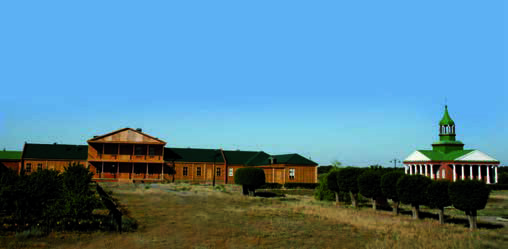
Khan's Horde includes a whole group of historical and cultural monuments of the XIX century. All of them are under the protection of the state and are included in a single ensemble as a monument of history and culture "Khan's Horde". Let's list these monuments - elements of the complex:
The building of the hospital, built in 1852. The building was restored, is a one-storey wooden house. Now the Urdinskaya district hospital is located there.
Gusman Azerbayev's House was built in 1905. Gusman Azerbayev is an active participant in the establishment of the Soviet power in the region, civil and Great Patriotic Wars. He died in 1943.
Seitkali Mendeshev' house was built in 1842. Seitkali Mendeshev, a Soviet party and statesman, lived in this house from 1916 to 1920. After graduating from the Kazan Teachers' Seminary in 1903, he worked for 13 years as a teacher in the villages of the Bokey Steppe. In 1918 at the Bukeyev Congress of Soviets he was elected a member of the provincial executive committee, and in 1919 - its chairman. S. Mendeshev participated in the formation of the first Kazakh cavalry regiment and the establishment of the first Komsomol organizations. In 1920 Mendeshev became the first chairman of the Central Executive Committee of the KASSR. In 1924-1925 he became the first chairman of the Central Executive Committee of the KASSR. - Member of the Presidium of the CEC KASSR. Delegate of the Fifth Congress of the Comintern. In 1930-1937 - People's Commissar of Education, Chairman of the Committee on Science. In 1937 Mendeshev was repressed. There are more than 20 publications, which reflect the life and work of S. Mendeshev.
The house of doctor A.A. Sergachev, built in 1832, is wooden, one-storey. Russian doctor A.A. Sergachev, personal doctor of Zhangir Khan, lived and worked in this house. This monument has now been restored.
Khan's Palace, built in 1827. Khan Zhangir chose a green oasis "Zhas Kus" for the construction of his home. Construction began in 1826. There were 23 rooms inside the khan's house. At present, the eastern wing of the house has been preserved and in 2002 (by the 200th anniversary of the Bokey Horde) it was restored and brought to its original form.
The Treasury building, built in 1867, is brick and one-storey. The building belonged to the Treasury, in the Soviet period the building housed the provincial (Bukeyev province), then the county and district branches of the State Bank of the USSR. In the 1960s the building was transferred to the Urdinsky Museum of History and Local Lore. In 1981-1983 the building was restored. Since 2001 it has been displaying the exposition of the Museum "History of Bokey Horde".
The building of the Pedagogical College, built in 1868. From the very beginning, the Targyn one-class primary school was opened in 1868. 40 children studied at the school every year. Later, in 1918, the first Komsomol cell in Kazakhstan was organized here. In 1920 in this building on the basis of Zhangir's school the Bukeyev institute of national education was opened. In 1923-1928 it was rebuilt into a pedagogical technical school and became one of the first specialized secondary educational institutions in Kazakhstan. G. Karash, G. Begaliev and others taught there.
Khan's Mosque, built in 1835, is a beautiful building of the whole Khan's Horde. The building of the European architecture, with a high dome minaret, the plan and the facade are made by Khan Zhangir himself. The roof was made of sheet iron painted with green paint. A beautiful minaret rises from the center of the roof. In 1938 the mosque burned down. In 2001, according to the preserved photographs, it was built again and restored to its original form. At present, it houses the Museum of Independence, the exposition of which tells the way of development of independent Kazakhstan.
The building of the women's school was built in 1883. The house is wooden. In this school the prominent public and political figure Alma Urazbaeva studied. Now the monument is restored and is a part of the Bokeyorda historical and museum complex. Since 2002, it houses the Museum of Public Education.
The building where the first printing house was located was built in 1818. The house is wooden, it has a memorial plaque with the text: "In the summer of 1918 the first Kazakh Soviet printing house was opened in this house". Since November 1918, the newspapers "Kyrgyzskaya Pravda" and "Cossack Durystygy" have been published in the Horde. Since February, 1919 the newspaper "Durystyk Zholy" began to be issued, the issue of pedagogical magazine "Mughalim" was organized.
The complex of the monument includes the mausoleums of Dauletkerey, Khan Zhangir and Muhammad-Salyk Babazhanov, located at the ancestral cemetery 3 km away from the village of Khan's Horde.
Dauletkerey's mausoleum - a famous kuishi, composer, founder of lyrical direction in the Kazakh musical art of the XIX century - was built in 2000, made of white stone. Its height is 7.8 m, diameter is 4.5 m.
The mausoleum of Khan Zhangir was restored in 1997 and built again of white stone, inside the mausoleum there are updated gravestones on stone slabs to Zhangir and his wife Fatima, and also installed kulpytas of Khan Zhangir.
The mausoleum of M.S. Babazhanov - an ethnographer, public figure and enlightener who studied historical monuments, legends and tales, folklore of the Kazakh people. The height - 7,8 m, diameter - 4,5 m. It was built in 2001.
The author of the whole group of mausoleums is the People's Artist and sculptor Kopbol Demesinov, a representative of the Mangistau School of Architecture.
The object is visited.