Information
- Location
- West Kazakhstan Region, Terekti District
- Period
- 600 – 401
- Type
- Сomplex
- Kind
- Archaeological sites
- Authors
- Лукпанова Яна Амангельдиевна
Sources
- Қазақстанның киелі орындарының географиясы: Табиғат, археология, этнография және діни сәулет өнері нысандарының тізілімі / Жалпы редакциясын басқарған ҚР ҰҒА академигі Байтанаев Б.Ә. – Алматы: Ә.Х. Марғұлан атындағы Археология институты, 2017. – 1-шығарылым. – 904 б.
Description
It is located 50 km east-south-east of Uralsk, not far from the Taksai station (Terekti district, West Kazakhstan region).
The unique monument of archeology, consisting of five groups of barrows of Taksai-1-5, was opened by the detachment under the leadership of Ya.A. Lukpanova in 2012. That's when the excavations of the burial ground of Taksai-1 were started. In the period 2015-2017, barrows from Taksai-1-3 groups were studied. The results of the research showed the presence of complex hipped, tiled structures, ground wooden buildings, rich burials, accompanied by the use of fire in the ritual. These are tombs belonging to the military aristocracy, priesthood and tribal leaders of nomads of the early Iron Age, who inhabited the territory of Western Kazakhstan.
Taksai-1 is one of the rare monuments that gave unique materials of funeral rites and material culture of early nomadic and late Sarmatian periods. The burial ground consisted of six earthen embankments, barrows No. 1 and No. 2 are the largest, their height reaches about 4 m and diameter - 70 m. Barrows No. 3-6 are emergency barrows, the surface is ploughed, and the monuments were in the process of disappearing. The real discovery was the excavation of barrow No. 6, the results of the research of which became world famous.
Barrow No. 4 of the Taksai-1 burial mound differs in its large size of the funeral embankment and grave pit. The height of the barrow exceeded 2 m. The depth of the grave pit is more than 3 m. For the Late Sarmatian culture, such dimensions of the graveyard are rare and unique. Under the barrow embankment, a gravestone ritual ground from the mainland was found. In the burial ground there were found items typical for a warrior-rider: a horse knot, a set of bladed weapons consisting of a long sword, a dagger, a battle knife with bronze parts of the handle and a bronze forged pot. This grave belongs to the elite burial complexes of late Sarmatian culture and is part of the circle of burials of professional warriors, and the analysis of the material allows us to date this burial of the second half of the III century AD. This social stage was formed in the late Sarmatian society in the late II - first half of the III century AD.
Barrow No. 6, 1 m high and 41 m in diameter. The burial structure found in the mound consisted of a wooden structure located in the center above the pit, around which a red-colored clay rampart was fixed, and on the periphery of the barrow there were additionally constructed two circular ramparts made of mainland clay. Underneath them, two women were buried at the level of the ancient horizon. The third burial was carried out in a complex, carefully designed pit with a double log ceiling above it, with the remains of powerful bonfires, with the imitation of the afterlife chariot and the temple of the sun. Judging by the luxurious specific items of metal, wood, bone and glass, it belonged to a woman from the privileged class.
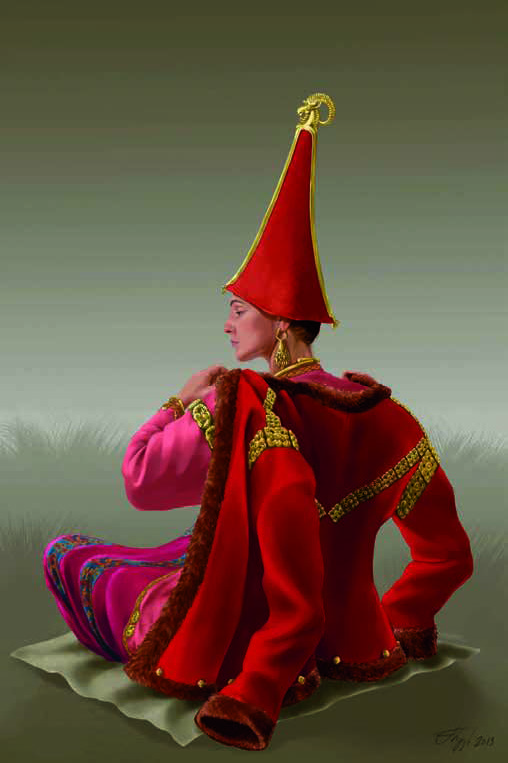
Once a woman's rich funerary decoration was decorated with gold articles made in the form of solar symbols, and a cone-shaped headdress was put on her head, which contained the meaning of a symbolic tree of life. The presence of the image of the animal (mountain goat) on the top of the headdress served as an incignation of the "royal" power, a high social rank. Iranian-speaking peoples have a cult of this animal, it is associated with the cult of mountains, the cycle of "tree" and fertility. According to the famous archaeologist Kemal A. Akishev, pointed hats were worn not only by Saks-Tigrahaud, but also by representatives of all other Saka tribes and even European Scythians.
The burial was accompanied by five sets of horse bridle, a bronze cauldron with a prototype of a gleamed camel, a fragment of a wooden bowl with golden shackles, a mirror with a zoomorphic handle in a nut case, frying stoves, glass vessels, ocular beads, knives, and a ritual box in which objects for priestly ceremonies were placed. These are the brushes of two wolves, a miniature vessel, a mortar with a pestle, the teeth and fangs of a wolf, and a wooden comb depicting the confrontation between the Persians on a chariot and a nomad. Analogies to the image on the Taksai crest are found on a painted wooden panel of the tomb in Tatarli (Anatolia, present-day Turkey). Barrow No. 6 is dated to the end of the VI - beginning of the V century BC.
The Taksai-2 burial ground is a complex dating back to the early period. The oldest burials discovered here date back to the Bronze Age, and a flint arrowhead was found on the periphery near the ditch. In the IV century BC, graves "sarmat" were left here. Under the embankment of barrow No. 2 in the center was discovered underbarrow structure in the form of earth blocks laid out in rings. A total of nine single and paired burials were discovered in the barrow. The graves are square, rectangular with shoulders, bottom graves, catacomb graves, all located around the central pit.
The burial № 3, made in the catacomb with an arch entrance, was the main one, located in the center of the barrow and belonged to a man - a representative of the upper class of early Iron Age society. The depth of the pit is 6.6 m. The grave is disturbed in antiquity, the man's bones are scattered. The accompanying elements of the complex are represented by plaques, piercing, overlays made of gold, fragments of silverware, iron rods to load the arrows, iron fragments.
The Taksai-3 monument is located 5 km northeast of the Taksai-1 complex. Complex wooden structures of the tent type, based on the ramparts, were found here, in the center of which were fixed grave pits with a dromos, rectangular shape or burials on the ancient horizon. In the funeral rite there is the use of fire in the form of bonfires, burials of nervous horses were found.
The accompanying complex in the graves is represented by a rich quiver, akinakas, horse bridle, a fragment of a bowl with gold covers, bone products made in animal style, umbilicals, military staff, bone spoon. The complex is dated beforehand to the V century BC, and the presence of elements of the Scythian triad - items of arms, bridle and animal style in the form of products made of noble yellow metal, as well as a scepter - indicates the belonging of the buried to the military elite.
The repertoire of zoomorphic images of Taksai is represented by real or fantastic animals. It is not so many faces. A total of seven complementary images are presented. The images of these animals created an invisible informative ornament that sheds light on the reconstruction of the ideological and religious views of the early nomads.
As a result of complex ethno-political processes, the culture of the near-Uralic nomads, which is a symbiosis of several large ethnic groups, was formed on the territory of Western Kazakhstan. The population of this region in the early Iron Age created an independent and unique culture, absorbing part of the culture of the Scythians, Saks, Savromats and forest-steppe population.
The materials found in the Taksai burial ground show that the early nomads have made significant progress in metal and woodworking and bone carving. Decorations, household items, weapons, bridle, made by them, were magnificent in their execution, and at the same time reflected the specifics and peculiarities of nomadic worldview. As part of the discovered items there are products of both local and foreign production. Many of them are unique and real works of art, transmitting the high level of artistic culture of the ancient population.
The monument, the materials of which are similar in such famous burial grounds as Kyryk-Oba-2, Besoba, Uigarak, Tagisken, Filippovka, Pyatimary, Pokrovka, Sara, is unique. Its peculiarity is not only in the objects found in the burials, but also in the carefully designed architecture of burials, kinds and types of funeral rites, the variety of methods and techniques of burials, the diversity of burials, covering the period from the beginning of the I millennium BC to the III century AD.
The materials of the complex make it possible to classify it as sacred. This area for hundreds of years from the Bronze Age to the ethnographic modernity in the worldview of the tribes that lived here, was firmly associated with an elite pantheon. The kulpytases of the XIX century, which are present next to each other, are a vivid proof of this.
The vicinity of Taksai is the land where the great nomads of the Ural steppes lived for thousands of years, leaving here their funeral monuments testifying to the level of economic, cultural, political ties, memory of ancestors and sacred places. They returned here and performed rituals dedicated to the cult of ancestors.