Information
- Location
- Atyrau Region, Kyzylkoga District
- Period
- 1301 – 1600
- Type
- Necropolis
- Kind
- Monuments of urban planning and architecture
- Authors
- Ажигали Серик Ескендирулы
Sources
- Қазақстанның киелі орындарының географиясы: Табиғат, археология, этнография және діни сәулет өнері нысандарының тізілімі / Жалпы редакциясын басқарған ҚР ҰҒА академигі Байтанаев Б.Ә. – Алматы: Ә.Х. Марғұлан атындағы Археология институты, 2017. – 1-шығарылым. – 904 б.
Description
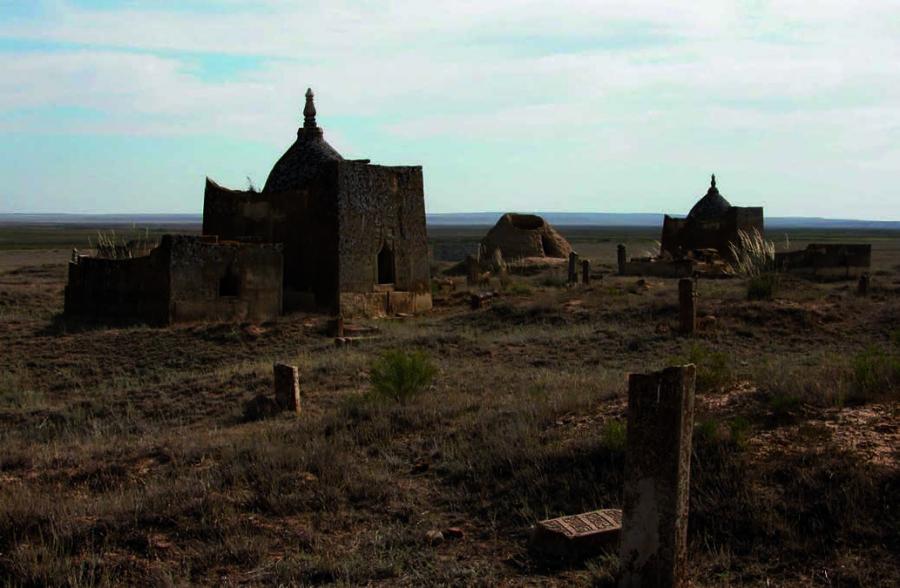
Located in the Kyzylkoga district, Atyrau region, 9 km southeast of the village (station) Sagyz, on the border with Aktobe region (the distinction goes on the territory of the necropolis, which is classified as Atyrau region). The monument is located on the left bank of the middle reaches of the Sagyz River, south of one of its channels.
The eponymous of the ancient cemetery is a girl/woman-hero (alyp), whose burial in the western part of the necropolis was marked by a shyrak lamp and a pole. Previously, there was obviously a mausoleum of baked bricks, from which only traces of a rectangular layout have survived. Variants of legends about Alyp ana have long existed among the local Kazakh population. According to one of them [Amanshin, 1948], the girl Alyp ana was a beloved of Tukty ata, "who were not destined to be together in life (at the will of their parents), so they killed themselves and were buried nearby, on different banks of Sagyz ("the closest distance to the other for the whole time of their... lives"). Now these are the cemeteries of the same name, where "from time immemorial" there were two beautiful mausoleums. According to another legend (recorded by local historians in the village of Mukyr from A. Rsmukanov, died in 1990), Alyp ana (also known as Shashty-aziz) was the wife of the regional legendary character Tukty ata (Baba-tukty - literally "hairy grandfather") and the mother of the historical emir Edyge. Next comes a retelling of the famous plot of epic legend about Edyge Batyr, his birth on the Syrdarya River, the fight against Toktamys and his subsequent actual reign in the Golden Horde.
These legends, together with the presence on the necropolis of the Alyp ana remnants of burnt square bricks of medieval format give certain grounds for the early lower dating of the complex, which, however, can be finally proved and clarified by archaeological research. [In connection with the legend of Alyp ana and Tukty ata, as parents of Er Edyge and eponymes of these cemeteries, recently researchers have been actively developing a version of the possible burial site of the latter in Sagyz. Among other things, this assumption has certain, but so far mainly indirect grounds (including the indication on the topographic maps - 20 km east of Sagyz station "cemetery Edge/Edyge?") and requires a serious complex, primarily ethno-archaeological, justification (research). It should be noted that, according to many scientists, including Ch. Valikhanov, the famous emir Edyge, the dungeon of the Golden Horde, is buried in Central Kazakhstan - in Ulytau].
At the same time, the name of the necropolis Alyp ana can also reflect the circle of legends about a girl-hero, who wanted to marry only someone, who would fight her. In the Kazakh epic this image appears under the name of Dariga. In general, such "gender" orientation of the eponymy of the complex finds a certain confirmation in the "female" attributes of the monuments.
Thus, the necropolis of Alyp ana, as well as the necropolis of Tukty ata, is connected with a cycle of historical legends, testifying to the importance of the Embo-Sagyz district and adjacent territories in the history of steppe Kazakhstan during the period of the Golden Horde (Zhosha Khanate) and the time of its disintegration. The monument is still known among the population of the nearby districts of Aktobe and Atyrau regions, is a significant historical, cultural and historical-architectural object with the prospects of its further use in terms of security and restoration work, archaeological research and inclusion in the tourist routes of the regional level. The object has the status of an architectural monument of local importance; in December 2011 it was included in the List of Historical and Cultural Monuments of Tourist Interest approved by the Committee on Culture of the Ministry of Culture and Information of the Republic of Kazakhstan.
According to the "Archaeological Map of Kazakhstan" [AMK, 1960, p. 367], the necropolis of Alyp ana was examined by A.H. Margulan in 1950. In 1979-1980 the monument was for the first time studied by the expedition of the Ministry of Culture of Kazakhstan (headed by S.E. Azhigali). In 2004, it was further investigated by the West Kazakhstan Complex Ethnoarcheological Expedition (headed by S.E. Ajigali, head of the squad - R.A. Beknazarov).
The Alyp Ana necropolis is one of the largest architectural memorial complexes in the Sagyz River valley (about 250 registered objects). It is mainly represented by monuments of the second half of the XIX - early XX centuries, the material for which was limestone sandstone. First of all, they are tiled mausoleums. Their constructions are typical for this type of structures: the walls laid out on the edges of the blocks, from the inside have a bundle of slabs. The basis of the ceiling is a false vault based on the tromps and decorated outside in the form of a helmet with a spike in the top. Of particular interest is the hexagonal facade monument of the last third of the XIX century, which is a high example of folk architecture of the Kazakhs. On the necropolis, one should also highlight the rare type of small mausoleums made of burnt bricks, which have a characteristic slope of the walls outward and belong, apparently, to the second half of the XIX century. Alyp ana saganatams are characterized by a typical structure and simplicity of decorative solutions. As a rule, they are supplemented by the installation of the stela of kulpytas on the western side. Small forms of memorial architecture are mainly represented by kulpytases of various types. It is characteristic that on a number of them "female" attributes are reliefly depicted: ornaments, boots (masi), shoes that is well connected with legends about the woman - "founder" of the cemetery. Mainly representatives of Kazakh Kete family were buried on the necropolis of Alyp ana, as well as Adai (less often).