Information
- Location
- Atyrau Region, Makhambet District
- Period
- 1801 – 1999
- Type
- Necropolis
- Kind
- Monuments of urban planning and architecture
- Authors
- Ажигали Серик Ескендирулы
Sources
- Қазақстанның киелі орындарының географиясы: Табиғат, археология, этнография және діни сәулет өнері нысандарының тізілімі / Жалпы редакциясын басқарған ҚР ҰҒА академигі Байтанаев Б.Ә. – Алматы: Ә.Х. Марғұлан атындағы Археология институты, 2017. – 1-шығарылым. – 904 б.
Description
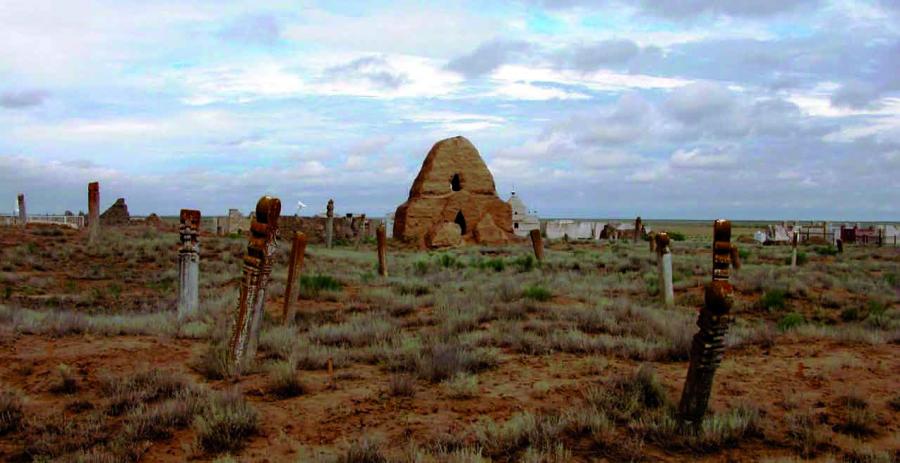
It is located 3 km to ENE from Ortakshyl village, 62 km to NNW from Atyrau city (Makhambet district, Atyrau region). The cemetery is located on a small hill to the left of the Atyrau-Inder highway.
The necropolis was formed during the XIX century as a patrimonial cemetery of a division of sebek of a large Kazakh family of berish and is still existing. Among the local population the monument is also called "Altyn mayiti", where the word "mayit" (corpse, dead man) in the modern context is a dialectal synonym of the term "beyit" - cemetery, necropolis. But initially the name meant a separate, concrete grave, as the old-timers assert that Altyn is the name of the girl who died during the migration and was buried here (it was written down in 2005 in the village Ortakshyl from Murzagaliuly A., born in 1924, and Kusanov O., born in 1930). According to other informants (recorded in 1998 by a resident of Almaly WKO Kabibullin Sh., born in 1924), in the vicinity of the former "13th aul (Ortakshyl) there are two ancient cemeteries of the genus Berish - Sebek: "Altyn Koryma" and "Katyn Korymy". Their names come from the names of the women sisters, of whom there were only nine. The eldest was Altyn, and the youngest dissatisfied father, who wanted to have a son, named him so: "Katyn" ("baba"). They were later buried here and became the epochs of these beyits. According to the same data, Begaly Bi (or Bekali Bi) is also buried here. It is well known that Aituar bi Usenuly (1780-1854), a well-known among the Kazakhs of the Northern Caspian Sea, is buried at "Altyn Korymy", in whose honor a slender kulpytas is established. Among his many wise verdicts is the resolution of the conflict between Turlan Batyr and Dauletkali-Tore, when the latter's claims to common people's lands were rejected.
The Altyn Necropolis, as a functioning cemetery, is a rather important site of pilgrimage, as well as cultural tourism with obvious prospects for development in this regard, including due to its quite convenient, close location to Atyrau, which has a significant potential for international tourism. In perspective tourist routes the monument can be well coordinated with other historical and cultural objects of the region - medieval settlement Saraishyk, group of original architectural memorial complexes of the left bank (Kopmola and others).
The object has the status of a monument of architecture of local importance, in December 2011 is included in the approved by the Committee on Culture of the CIM of RK "List of historical and cultural monuments that have become objects of tourist interest". In general, the Altyn necropolis should be considered a significant site of the "sacred geography" of the North Caspian zone. The monument was examined by architectural and ethnoarchaeological expeditions of the Institute "Kazprojectrestoration" and the Institute of History, Archaeology and Ethnography / Institute of History and Ethnology in 1988, 1990 and 2005 (by A.O. Itenov, N.D. Kulbaeva; S.E. Azhigali).
The Altyn necropolis is one of the most significant Kazakh architectural memorial complexes in the left-bank part of the Ural (Zhaiyk) and in the North-Caspian sub-region in general: the area of the necropolis is 260×220 m, there are more than 450 memorial structures. The most popular types of monuments are quadrangular raw fences such as "tortkulak" (often large, giant), burial mounds. Tortkulaks made of raw bricks and blocks have their own compositional and planning features: sharply protruding angular triangular elevations, orientation by walls on the countries of the world, arrangement of entrance openings in the southern walls; often they are supplemented by installation of stela-kulpytas on the western side. On the necropolis there are also many tortkulak fences with less pronounced angular elevations.
Four dome mausoleums made of raw bricks, which belong to the middle - second half of the XIX century, are especially notable in the complex. They are varieties of the widespread type of Kazakh "uitams". All of them in general are of the same type, except for the hexagonal monument with a severely damaged dome, but have peculiar design and other features. The composition of the structures is based on a tetrahedral stocky frame with a spheroconical or pyramidal dome. The entrance part of the mausoleums is solved in the form of a protruding portal on the southern facade, and one of them has similar, but deaf protrusions on the other facades. Among the peculiarities of the buildings it is necessary to note the inclusion of reed layers in the masonry walls and, possibly, in the base of the mausoleums (as waterproofing), as well as the use of beams, logs in the ceiling apertures and dome structures; in one case, the upper part of the dome of the monument is reinforced with a cross-shaped log structure (like a shanyrak of a yurt). On the western side of the mausoleums, kulpytases with epitaphs were also installed, reliably dating back to these original examples of folk architecture of the Kazakhs.
The stone-carved steles of the Altyn necropolis are also of great interest both for monuments of Kazakh monumental glyptics and Arabic epigraphy. Among them there are various types of flat and volumetric kulpytases, as well as their unique varieties. Some of the earliest types of steles in the middle of the 19th century are gravitating towards the Mangyshlak specimens. There is also a group of kulpytases with a harmonious volumetric and tier composition and skilled processing of details of division and decoration of planes, which belong to the "elegant" direction of stone-cutting art in Western Kazakhstan. Of particular interest are their giant varieties (up to 3 m high), among which are often outstanding examples of monumental stone-cutting. Decorative-epigraphic and epigraphic monuments with certain features of the influence of the Volga-Tatar memorial tradition are also peculiar. Unique and relict types of steles should be noted in particular: for example, kulpytas in the form of a petrified tree, similar to the Mancistau-Ustyurt "qada tasam", which are considered to be Kipchak knotties. A rare type of monument received distribution at the beginning of the XX century in the valley of Zhaiyk is represented by a rounded disk-shaped epigraphic stele with epitaph placement in three concentric circles (currently stored in the Central State Museum in Almaty). In the area of the necropolis there are several more Kazakh bays, which have a certain historical, architectural and ethnographic significance. At the same time, between the necropolis of Altyn and cemetery of Karamuryn there is a remarkable place where year-round green grass (bidaiyk) is growing, to which the local population attaches special importance (qasietti zher). This piece of land is marked by an iron pole with a white flag.