Information
- Location
- Almaty District, Zhambyl District
- Period
- 1500 BCE – 1200
- Category
- Historical and cultural monuments of international significance
- Type
- Petroglyph
- Kind
- Archaeological sites
- Authors
- Железняков Борис Анатольевич
Sources
- Қазақстанның киелі орындарының географиясы: Табиғат, археология, этнография және діни сәулет өнері нысандарының тізілімі / Жалпы редакциясын басқарған ҚР ҰҒА академигі Байтанаев Б.Ә. – Алматы: Ә.Х. Марғұлан атындағы Археология институты, 2017. – 1-шығарылым. – 904 б.
Description
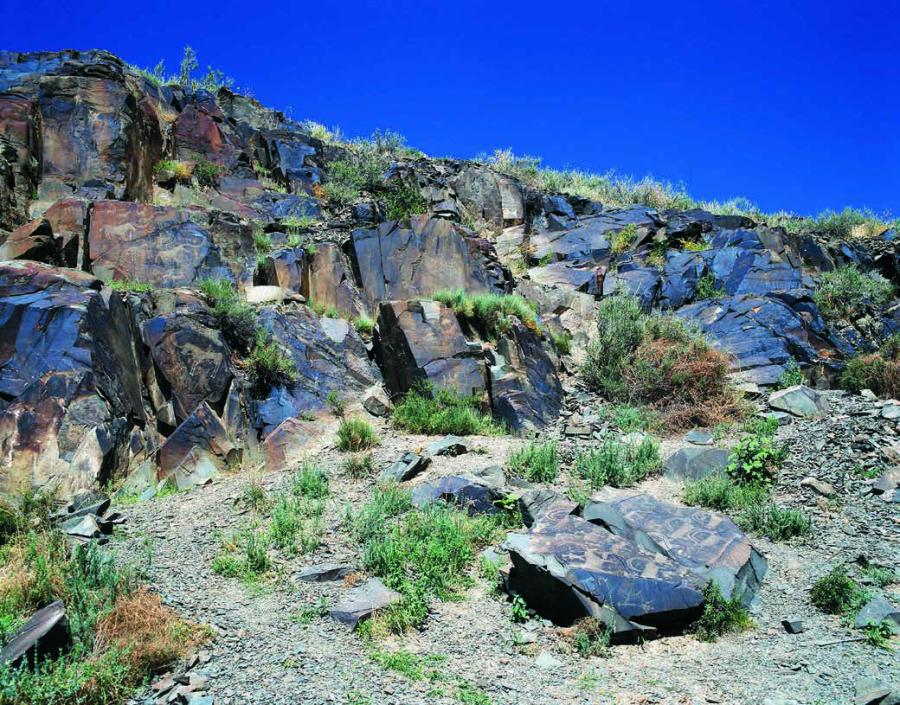
Tamgaly, petroglyphs in the archaeological landscape of Tamgaly/Tanbaly. The monument is located in the south-east of Kazakhstan, in the tract Tanbaly, located in the south-eastern part of the Chu-Ili mountains (Shu-Ile Taulary, Kaz.), 4 km north-west of the village of Karabastau and 170 km north-west of Almaty (Zhambyl district, Almaty region). The monument, according to the overwhelming majority of scientists, is one of the brightest monuments of rock art in Kazakhstan and Central Asia.
In addition to the unique petroglyphs located directly on the rocks of Tanbaly Canyon, localized on six groups of petroglyphs, there are numerous separate locations, of which there are about 50, only 5,200 images inside the World Heritage Site. The archaeological complex of Tamgaly includes settlements and burial grounds, as well as altars and quarries.
The petroglyphs of Tamgaly were discovered by an archeological detachment headed by A.G. Maximova in 1957, which carried out excavations at the Karakuduk II burial ground. Since the 1970s, A.N. Maryashev has been studying petroglyphs, later the expedition led by him, as well as A.G. Medoev and B.J. Aubekerov, who made a significant contribution to the study of petroglyphs of Kazakhstan. Since 1990th expedition, which continued archeological researches, was headed by A.E. Rogozhinsky. The great number of scientists, ethnographers, volunteers made their contribution to the common cause.
The petroglyphs of Tamgaly were carved in the picket technique with stone or metal tools. All of them were divided into 48 separate complexes during the documentation. A true masterpiece of rock art is considered to be a significant plane with six impressive images of "sun-headed" deities carved over a string of small images of dancing and praying people. The large size of the early petroglyphs, their unique visual content and iconography place them on a par with the most valuable petroglyphs of Central Asian rock art.
Most of the petroglyphs are located in the middle and lower parts of the main gorge, as well as in the sais, located to the north-west of the main gorge, adjacent to Tamgaly Mount. The total number of drawings on the six main groups is 3200. There are 2,000 more petroglyphs in the rest of the territory of the UNESCO monument.
Among them there are 30 images of "sun-headed" deities or priests, mates, warriors of palitzens, couples, women in childbirth, as well as multi-figured compositions depicting people and animals, scenes of animal hunting and scenes of sacrifice, reticulated bulls and horses. Pictures of chariots and prints of "divine feet" are rare, but there are numerous solar signs.
Most of the petroglyphs are from the Bronze Age. Drawings made in the Saxon "animal" style are mostly placed separately from older petroglyphs, but in some cases complement or even overlap them. Medieval rock carvings are carved in the hills surrounding the gorge and in the anhydrous sais adjoining it. The central complex stands out with the densest concentration of petroglyphs and, presumably, altars, which indicates the possible ceremonial purpose of this place for sacrifices. The inscriptions on the rocks were also carved out. Thus, in the central gorge there are Turkic runic and Oirat inscriptions. Two Tibetan inscriptions and several undefined inscriptions have been recently discovered in the gorge to the Shoshkaly.
Sacred terrain of Tanbala is determined by the presence of a unique "exposition in the open air" - a synchronous and dense group of petroglyphs, with a diverse (universal) repertoire of images of scenes with bright anthropomorphic and zoomorphic images, which, we believe, decorated the ancient sanctuary. They are executed in a single stylistic manner, denoted by the phrase "artistic "style of Tamgaly" of the Middle Bronze Age. It is confirmed by numerous and unique images of later periods of history: the so-called "beggars", as well as Saks, Usuns, Syanbi, Huns, Iranians, ancient Turks, Dzungars and Kazakhs. Each subsequent "generation" tried to leave its mark in the sacralization of the area, paying tribute to the holy place.
The true evidence of Tamgaly's sacredness is also the numerous petroglyphs' renewals by the local population of different historical periods. For example, on the stage of the Bronze Age with the sacrifice of a bull the animal was turned into a horse with a rider in ancient Turkic times. In turn, under the stage there are two "archaic" warriors depicted clearly in the "sauyskandyk" style, more ancient than the "tamgaly" style. Similar chronological layers differ almost every large plane of the central gorge of Tamgaly. Also single visitor's images, for example, the "altar of fire" are related to the visit of representatives of the hierarchy of Iranian priesthood in antiquity to this sacred place. Sacred inscriptions and images of ancient Turks and Dzungars testify to the sacred respect for the four thousand years of Tamgaly's history.
These petroglyphs often belong to the masterpieces of rock art of their chronological periods in terms of their artistic merits and the most unique images. For example: "Beak-like" deer, deer in the "flying galloping", the belonging of some images still remains controversial, for example, the male sitting deity belongs to the ancient Turkic or dzungarian wave of sacralization of Tamgaly. Many of the Tamgalian petroglyphs find direct analogies in rock art and other objects and objects of art in wide spaces from Transbaikalia and Mongolia to North-Eastern Iran and Scandinavia. It is in the full sense of the encyclopedia of sacred signs, images, plots, entire paintings of the World, at different stages of human development.
In 2004, the petroglyphs of the archaeological landscape of Tanbaly were inscribed on the UNESCO World Cultural Heritage List. Tamgaly was nominated on the basis of the following criterion: "A large and inter-connected group of petroglyphs with sacred images, altars and credenzas, together with their associated settlements and burials, which provides essential evidence of the material life and beliefs of the predominantly nomadic peoples of the Central Asian steppes from the Bronze Age to the present day".
The natural landscape of Tamgaly is also unique, and many of the flora and fauna are endemic.