Information
- Location
- Almaty District, Talgar District
- Period
- 701 – 1299
- Category
- Historical and cultural monuments of international significance
- Type
- city
- Kind
- Archaeological sites
Sources
- Қазақстанның киелі орындарының географиясы: Табиғат, археология, этнография және діни сәулет өнері нысандарының тізілімі / Жалпы редакциясын басқарған ҚР ҰҒА академигі Байтанаев Б.Ә. – Алматы: Ә.Х. Марғұлан атындағы Археология институты, 2017. – 1-шығарылым. – 904 б.
Description
Talgar/Talkhir is a blacksmith's town. In the geographical treatise "Hudud al-Alem" ("Borders of the world"), which was composed in 982 by an anonymous Persian geographer, among the settlements of the North-Eastern Zhetysu named the village of Talkhiza. It was located among the mountains on the border between the Turkic tribes of Chigils and Karluks. "Its inhabitants, - according to the characteristic of the medieval author, - are belligerent, brave and valiant. Analyzing the name of the village, scientists came to the conclusion that it was distorted by the copyist of the original work and sounded differently - Talhira.
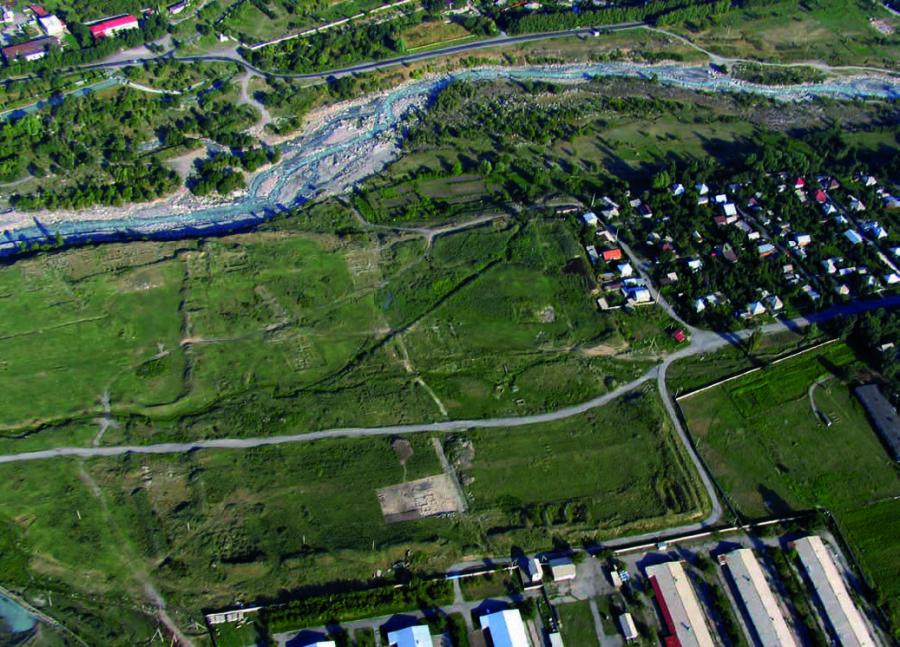
It is easy to find out the name of the modern city of Talgar, as the highest peak of the Ile Alatau and the rapid mountain river and medieval city are called. The predecessor of modern Talgar was located on the right bank of the river of the same name, at its exit from the mountain gorge to the valley. Nowadays, none of the scientists doubts that this settlement corresponds to the settlement of Talkhiza. Its remains are located in Talgar district of Almaty region. The monument is included in the UNESCO World Cultural Heritage List.
The ruins of the medieval town of Talhira are now an elevated quadrangular section surrounded on all sides by a berm. It is a citadel of 9 hectares. There were towers at the corners of the rampart and along the perimeter. Behind the rampart there was a moat. Four entrances were opposite each other in the middle of the fortress walls. They were connected by roads, which divided the entire city into four almost equal parts. The fortified part of the city was adjoined by buildings on all sides, which were a kind of trade and craft and agricultural suburbs.
Archaeological excavations have been carried out for many years in order to determine the time of the city's emergence, the periods of ups and downs in its life, the cause of death, as well as to present a clear picture of the topography. Significant material has been accumulated which covers many aspects of the life of medieval Talhira (I.I. Kopylov, S. Zholdasbayev, T.V. Savelieva, K.M. Baipakov, K. Chang).
At the end of VIII - beginning of IX century on the place of the future city there was a fortified rate. Merchants and craftsmen settled near its walls. At first they served the owner of the city and his yard, but soon began to produce goods for the surrounding settled and nomadic population. This was how the city was gradually formed as a center of administrative power, as well as a center of crafts and trade development. Such a way of formation of the city is typical for many Kazakhstani and Central Asian settlements.
The Great Silk Road played a huge role in the city's growth.
At the end of the IX - beginning of the X centuries Talkhir became a major urban center. Within the framework of the unified Karakhanid state, economic and cultural ties of separate regions were strengthened, crafts and trade, agriculture and cattle breeding were developed. Under these conditions, the number of cities is growing. Their territories are increasing significantly. The sedentary agricultural and urban culture in the Ile Valley is developing particularly rapidly. Some pre-existing cities are becoming the capital cities of large geographical and economic regions. One of these capitals is Talkhir, the largest city on the left bank of the Ile Valley. The territory of Talhira in XI-XII centuries increases and all it is built up.
However, the development of the central and suburban parts of the city differed. Archaeological excavations showed that the central part of the city was densely populated, with houses facing each other. The residential areas were dissected by the main streets, as well as intra-quarter streets and deadlocks. The main stone paved bridge connecting the western and eastern entrances to the city was opened and cleared. The length of the bridge was 300 m, width - 3 m. A pedestrian sidewalk stretched along the bridge on one side. The level of the sidewalk was 15-20 cm above the bridge level and separated from the bridge by a curb made of densely stacked stones. Perpendicular to the central pavement, a narrower street led inside the block, the surface of which was also paved with stone. Its width was 1.8-2 m. In addition to the cobbled streets in medieval Talhira, there was an extensive plumbing the net. For example, during the cleaning of the pottery workshop, a water supply system was found to supply water directly to the production complex. The 12.5 m long water pipeline consisted of 32 ceramic pipes 42-43 cm long and 15-16 cm in diameter. In the suburban area of the house there were farmyards and cattle yards.
Who inhabited Talkhir? The legality of this question is quite justified. Written sources give quite a definite answer - dwarfs and chigilas. These are Turkic tribes, to which the Ile valley belonged since VIII century AD. Up to the beginning of the XIII century they were united into a state called the Karluk Kaganate with the capital in the city of Kayalyk, which was located in the foothills of the Dzungarian ridge. Even after the establishment of the Karakhanids' domination, the Karluks did not lose the known autonomy. Along with the Karluks, the city was inhabited by descendants of the Usuns, as well as descendants from Sogda (Bukhara and Samarkand districts), and there were diasporas of merchants from Iran and China.
Like every big city, Talkhir was a multi-faceted city. The central part of the city was built up in separate quarters. However, it is precisely established that the artisans mainly settled in the rabad suburbs. Potter's workshops, dish stoves, various devices and tools of masters were found here: stone bases of pottery machines, anvils, sipai, mortars, a set of mineral dyes. It is known that potters supplied the town and the surrounding rural population with their products.
During this period, the production of metal products is developing, a high level is reached by forging, locksmith's craft, production of jewelry made of precious metals. The blacksmith's craft has reached a special success. Hundreds of iron products: agricultural tools, weapons (sabres, daggers, knives), original iron lamps, various tools of blacksmiths (anvils, hammers, forceps) and builders (hammers, saws, nails, chisels, bits, scissors). Investigating finds from iron by means of macro- and microstructural analysis, scientists have revealed presence of various grades of iron, cast iron and steel, including crucible (leader-burite steel), more known as bulat or damask steel. Medicines produced massive candlesticks and decorated lamps. Glasslodeliers blown out elegant decanters and jugs. The development of crafts and the rise of the city's economy helped to strengthen the trade role of Talhira. The city served the whole district, both agricultural and nomadic.
As a result of international trade along the Great Silk Road, the city received luxury goods, as well as highly artistic products from distant countries. Among the imported items found in Talhira are elegant bronze jugs, bowls and dishes. Such products originate from the southern regions of Central Asia and Iran. From the same place a bronze hemispherical bowl, richly decorated with floral ornaments, was found during excavations. Of great interest is a copper dish, in the center of which the medallion depicts two sphinxes in heraldic pose. Porcelain bowls and bronze mirrors, toothbrushes and bone sticks for meals were brought from China to Talhir. Chess made of ivory and Buddha's bone figurine was brought here from India, and glazed pottery was delivered from Afrasiab.
The trade required a lot of money. And it is not surprising that many copper and silver coins were found during the excavations of Talhira. Most of them were minted in XI-XII centuries in different cities of Central Asia. However, there is some data to suggest that in the Talhira itself there was a mint.
The remains of the ancient settlement of Talkhir were known and described by C.C. Valikhanov in his diary of a trip to Issyk-Kul in 1856. He writes: "In the upper reaches of Talgar we saw the remains of a barrow called Rustemovskiy by the Kirgizes. This barrow was very strong in its time, even now there are only two entrances to it. It has three steep and 6 fathoms deep. The square on which the barrow stood is 8 fathoms high from the ground.
There are many apple trees in the moat and on the parade, as well as barberries and other bushes. The medieval city of Talkhir is a city on the Great Silk Road, where different ethnic groups lived. They were Turks, Sogdians. There were trade factions of Iranian and Central Asian merchants, Chinese merchants. Literacy was widespread in the city, with inscriptions in Arabic, Persian and Chinese.
No cult buildings have been opened yet, and this mosque is probably a Nestorian church, a Buddhist temple. However, the presence of Buddhist cult articles, the image of crosses on ceramics shows the presence of them and, of course, a large trade and craft city, which was Talkhir, was also a spiritual and sacred center.