Information
- Location
- Zhambyl Region, Taraz city
- Period
- 1 – 1900
- Category
- Historical and cultural monuments of republican significance
- Type
- City, city
- Kind
- Archaeological sites
Sources
- Қазақстанның киелі орындарының географиясы: Табиғат, археология, этнография және діни сәулет өнері нысандарының тізілімі / Жалпы редакциясын басқарған ҚР ҰҒА академигі Байтанаев Б.Ә. – Алматы: Ә.Х. Марғұлан атындағы Археология институты, 2017. – 1-шығарылым. – 904 б.
Description
In place of the central quarters of modern Taraz are the remains of the famous medieval city of Kazakhstan. The first mention of it is contained in the Byzantine sources and refers to 568. It was at this time that Byzantium tried to conclude a treaty with the Western Turks in contrast to Iran. For this purpose Emperor Justinian II sent the embassy headed by Zemarch of Cilicia to the Turkic kagan Dizabul. During the trip Zemarch, under the description of the Byzantium historian Menander, has visited the valley of Talas where has been accepted in the rate of the Turkic Khagan near Taraz.
Later, many medieval geographers, historians and travelers wrote about Taraz (Talas). And it is not surprising, because the city occupied one of the central positions on the Great Silk Road. It is no coincidence that the authors of the description of the city noted, first of all, the trading importance of Taraz. For example, the Chinese traveler Xuan Jian wrote: "Dalos (Talas) has a circumference of 8 to 9 li. Merchants from many countries stay here and sell all kinds of goods".
More than three centuries later, Ibn Haukal reports: "Taraz is a place where Muslims and Turks trade", while Makdisi writes: "Taraz is a large fortified city with many gardens, densely populated, with a moat, four gates and a populated rabad. A large river flows at the city gates, and part of the city is located on the other side of the river. A road passes through the river, the cathedral mosque is among the bazaars".
However, none of the ancient authors name the exact location of Taraz, and therefore for a long time the city was searched in different places. Taraz was identified with the ruins of the ancient hillfort of Tuimakent on the right bank of the Talas River, and with the medieval hillfort of Sadyr-Kurgan. Famous orientalist V.V. Bartold, who explored the cities of Talas valley in 1893-1894, was most inclined to place the medieval Taraz on the site of Aulie-Ata.
The intuition of the prominent orientalist was later fully confirmed by the studies of archaeologists M.E. Masson, A.N. Bernstam and G.I. Pacevich. Their excavations at the site of the ancient hillfort located in the centre of Zhambyl city gave such vivid and expressive findings that there is no doubt about the identity of this hillfort and ancient Taraz.
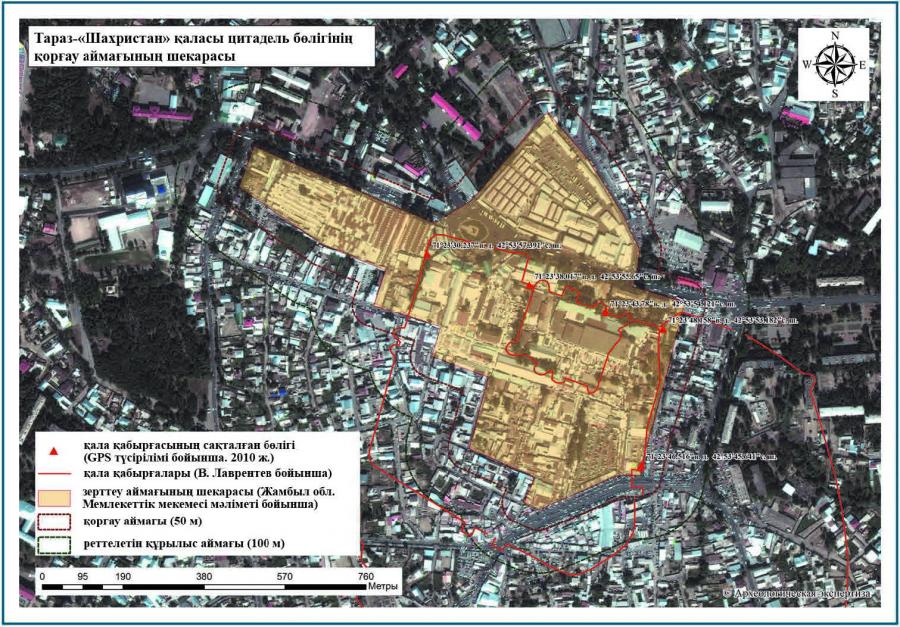
The oldest part of Taraz is the citadel, which housed the residence of the ruler. The citadel was adjoined by a walled city area called Shahrestan. There were dwellings of nobility, rich merchants, craftsmen, shops. There were trade and craft suburbs adjoining the walls of Shakhrestan from all sides - rabads with workshops and dwellings of masters, as well as houses of ordinary people.
Taraz at the same time was the center of a large cultural and economic region. In addition to Taraz, it included many towns, villages, individual estates and castles. To date, only the ruins of the hills, which have been swamped, have remained from them. In hot summer, the grass burns out on them and from the hills you can clearly see yellow inclusions of ruins in the greenery of the fields.
Archaeologists know very well that where the hillocks rise, life used to boil in the past. One of these hills was located east of Zhambyl near Talas station. These are the remains of the famous medieval town that occupied an important position on the Great Silk Road - Lower Barskhan. Deh Nujikes was the closest town to Taraz from the north. Makdisi wrote about it in the X century: "Deh Nujikes is a small town, where the market is three months in spring, meat without bones (sold) for four dirhams in May. It has many buildings, it is fortified and has a citadel. Near Deh Nujikes was the city of Adakhkes. West of Taraz stood the city of Juvikat. To the north, on the right bank of Talas, is the city of Jamukat. South of Taraz there was a large city of Atlakh. Other cities can be listed, but it is clear that Taraz was the center of an important and highly developed region in terms of culture and economy.
Its borders, according to scientists, were heavily guarded from sudden attacks by enemies, the oasis protected the walls and fortresses with permanent military garrisons. It was impossible to bypass them, and it was not easy to take such a strong fortress by storm, especially since the surprise of the attack was ruled out. At least, according to historians, when at the end of the IX century the founder of the powerful Central Asian Samanid dynasty Ismail ibn Ahmed went to war on Taraz, he faced many difficulties, and only after a long and persistent resistance of the Emir of Taraz was forced to surrender and with many dekhkans to adopt Islam.
The heyday of Taraz falls on the X-XII centuries. At this time in the city operates a water pipeline, the main streets are paved with stone slabs. As before, when under the Turgesh Taraz issued bronze coins, which had a wide circulation, the mint of Taraz in the Karakhanid era continues to mint money. Pottery, blacksmithing, coppersmithing and jewellery have reached a high level of development. A lot of construction works were carried out in Taraz, including baths. Two of them were found and investigated.
Islam held leading positions in the ideology of the citizens, but a part of the population still professed Christianity, and the steppe Turks believed in Tengri, Umai, and shamans, as before, made their kamlaniyas. However, mosques and madrassas were already functioning in the city. The remains of the madrassa, which was located in the citadel of Taraz, were investigated by archaeologists.
In the XII-beginning of XIII century Zhetysu became the arena of bloody military clashes, many cities in this troubled time were looted. According to the geographer Yakut, Khorezmshah Muhammad, being unable to defend the outskirts of the property, "destroyed with his own hands the valley of Lasi at this time passed to the city of Yangi-Talas, located in the upper reaches of the Talas River. The city of Talas ceased to exist in the XV century, but the settled population on this place continued to live until the end of the XVIII-XIX centuries, until the formation of the city of Aulie-Ata on the site of Taraz in the VI-XII centuries.
One of the most important questions in the history of the city is the time of its emergence. Archaeologists define this time as the time when the city's history was founded. It was between the middle of the I century BC and the beginning of the I century AD that the city appeared. At the same time, it should be emphasized that it was a city with inherent functions of a political, economic and cultural center, which had many other features included in the concept of "city", distinguishing it from the village, parking lots, shelters: a large area and large population, the presence of fortification.
Excavations carried out by archaeologists E.I. Ageyeva, M.S. Mershchiev and T.N. Senigova on the ancient Taraz hillfort showed that the lowest layers of the hillfort contain handmade ceramics, jewelry, and bone arrowheads, which are convincingly dated to the end of the I millennium BC. Remains of construction structures made of rectangular mud brick have been cleared. A bronze Kushan coin dating back to the I-II century AD was found in these layers.
Information and written sources about the events of the end of the I millennium BC and projected on the Talas valley region are interesting. It is known that in 55 BC the powerful Hun empire was divided into two parts - northern and southern. The ruler of the northern Huns of Zhizhi accepted the proposal of the state of Kangju to move to the banks of Talas to help Kangju in the fight against their opponent - the state of Usun. However, soon the disagreements between Zhizhi and the Kangju soon began, ending with the fact that the ruler of the Huns, after a clash with the Kangju, was forced to build a fortress in which it was besieged by the Chinese army, sent to destroy the Huns. Zhizhi's castle was stormed, and he and his closest associates were killed. This information gives an indirect idea of urban planning in the region, traditions of sedentary and urban life.
Thus, studies of recent years have shown that Kangju settlements belonging to the first centuries AD were widespread in the Talas River valley. Among them, the largest were Assa (on the bank of the river of the same name, 15 km west of Taraz) and Zhailautobe (18 km north of Taraz). Earlier, archaeologist M.S. Mershchiev conducted excavations of the Choltobe monument, located 45 km east of Taraz, near the railway station Ak-Chulak.
The excavations carried out on it revealed that the hill concealed the remains of the architectural complex, sub-square in plan, with the sides of the length of about 40 m. Along all sides there were long narrow rooms of the corridor type with vaulted ceilings erected from large mud bricks of trapezoidal shape. The inner courtyard of the complex was closed with these rooms. In the south-eastern part of the courtyard there was a huge cross-shaped structure. Three rooms were found in the thicker part of its masonry. One of them is long, narrow, like the rooms located on the sides of the main building, the other two are small, almost square in plan. The originality of the layout of the architectural complex, especially the presence of an unusual cross-shaped structure, as well as the lack of direct analogies to it, complicates the understanding of the purpose of the building.
It is dated to the Choltobe I-IV centuries and cannot yet be defined as an ordinary settlement. Most likely, it was a temple complex connected with the cult of fire. The monumental architecture of the building gives an idea of highly developed architecture and construction among the Kangju tribes of Talas valley, which in general determines the level of settled and urban life in the state of Kalgju.
Thus, the given data of written sources and archeological materials give all grounds to speak about the beginning of urban life in the region and about occurrence of the urbanized settlement on a place of modern Taraz at the end of I millennium BC - early I millennium AD. Consequently, the age of Taraz is determined by two millennia.
In the XIX century, Aulie-Ata appeared on the ruins of Taraz, and after the revolution it became one of the most beautiful cities of our republic - Zhambyl, to which its original name - Taraz - is now returned.
Taraz with its various temple complexes, mosques and madrassas, ancient cemeteries of Zoroastrians and Christians at Tekturmas cemetery, with the mausoleum of Karakhan and Davudbek - former and remaining centers of pilgrimage - is a major sacral center of Kazakhstan.