Information
- Location
- Almaty District, Panfilov District
- Period
- 1643 – 1756
- Type
- Historical landscape
- Kind
- Buildings of monumental art
Sources
- Қазақстанның киелі орындарының географиясы: Табиғат, археология, этнография және діни сәулет өнері нысандарының тізілімі / Жалпы редакциясын басқарған ҚР ҰҒА академигі Байтанаев Б.Ә. – Алматы: Ә.Х. Марғұлан атындағы Археология институты, 2017. – 1-шығарылым. – 904 б.
Description
The historical landscape is located near the village of Onzhas, in Belzhailau, where a series of mountain jailau stretches from west to east as a kind of corridor between Zhetysu Alatau and the Altyn Emel Ridge (Panfilov district, Almaty region).
The Battle of Orbulak was a battle that took place during the first stage of the Kazakh-Dzungar wars (1643-1756), in which the Kazakhs led by Zhangir Khan and the army of the viceroy of the Emir of Bukhara in Samarkand, Yalangtush Bahadur (Zhalantos Batyr), who came to their aid, won the victory over the army of Erdeni-Batur in 1643.
According to historical data, Zhangir Khan, who ruled in the Kazakh khanate from 1643 to 1652, having received the news about the approach of the superior Dzungar army headed by Erdeni-Batur, decided to meet the enemies in ambush in the narrow gorge of the river Orbulak of Zhetysu Alatau and try to defeat the dzungar or to restrain their attack on the main Kazakh lands. Zhangir Khan, who at that time had a few troops (600 people), decided to prepare an echelonized defense in the form of trenches 2.5-3 km long and deep in human growth, as well as a high rampart. Part of the warriors occupied the defense in the trenches, and part of the dispersed on the cliffs, controlling from a height of all the passages. So Khan prepared a trap for dzungars. In the course of the battle, dzungars were stopped by a hail of rocks from the surrounding cliffs, as well as by firearms, which were used by Kazakhs for the first time. Then Kazakh soldiers hit dzungars in the rear, and Zhalantos Batyr's soldiers, numbering 20,000 people, who had fallen into disarray to help the Kazakhs, were killed by randomly retreating enemies. As a result, the dzungars were defeated, losing more than 10,000 soldiers and forced to retreat.
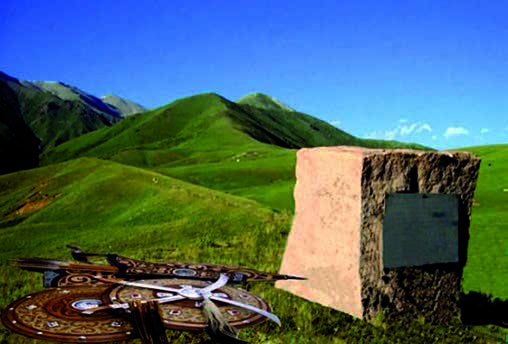
The monument on the site of the Battle of Orbulak was erected in 1993 in honor of its 350th anniversary. It is a granite stone of 2×2×2 m in size. The monument is crowned with the Orbulak Hill, which is 2,200 m above sea level. From the west and east, the hill is surrounded by the rivers Orbulak, which flows into Keskenteren, and Zharbulak. In 2017, a memorial monument was erected at the site of the historical battle as part of the implementation of the President Nursultan Nazarbayev "Look into the Future: Modernization of Public Consciousness" programme article in the direction of "Tugan zher" and "Sacred Geography".
The monument, erected in 2017, is a vertical black stone with a memorable inscription in three languages: "From descendants - the valiant Kazakh sarbazes, who defeated the dzungars in the battle for freedom and independence of the native land!". The building weighs about a half-tone and has a special QR code for tourists.
The sacredness of the object/place is justified by the fact that due to this great victory the plans of dzungars to capture Zhetysu at lightning speed and massive advance into the interior of Kazakhstan were disrupted. Zhangir Sultan demonstrated the effectiveness of the trenching method, a new tactic for Central Asia of multiple-round shooting with foot-rifles. In the course of this battle, Kazakhs successfully interacted with Maverannahr's troops. A monument of history and monumental art of republican importance and a pilgrimage site and religious tourism.