Information
- Location
- Almaty District, Panfilov District
- Period
- 1500 BCE – 1800
- Type
- Archaeological landscape
- Kind
- Archaeological sites
- Authors
- Железняков Борис Анатольевич
Sources
- Қазақстанның киелі орындарының географиясы: Табиғат, археология, этнография және діни сәулет өнері нысандарының тізілімі / Жалпы редакциясын басқарған ҚР ҰҒА академигі Байтанаев Б.Ә. – Алматы: Ә.Х. Марғұлан атындағы Археология институты, 2017. – 1-шығарылым. – 904 б.
Description
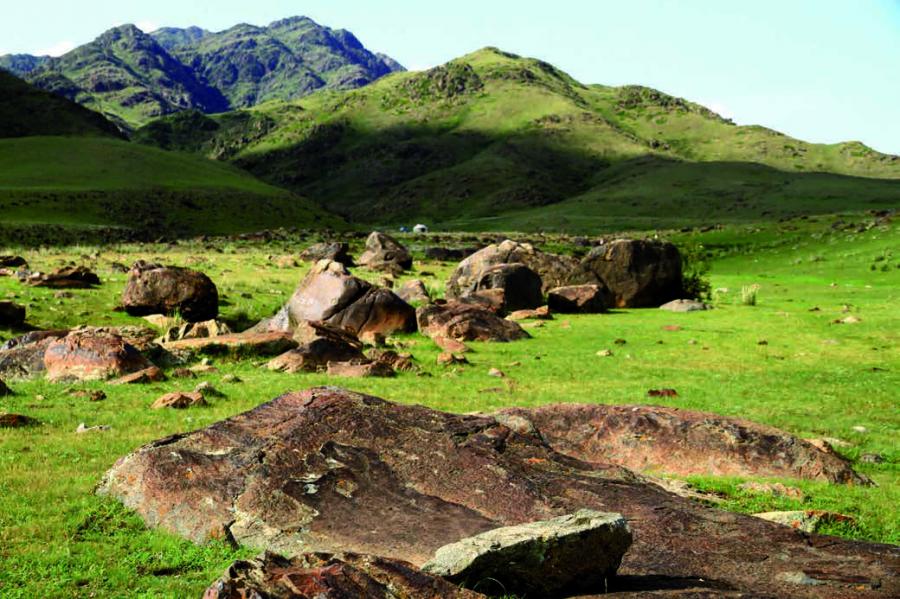
The object is located in the place of the greatest narrowing (between the ridge and foothill part of Koyandytau - the south-western spur of Zhetysu Alatau) and the raising of the middle mountain plateau. The area is abundantly watered by small rivers flowing from the gorges of its southern slopes, cutting through the ancient moraine. A closer look at the area reveals the irrigation system of the Kaishy outflow cone, which distributes water along the slope. The landscape is located 25 km to the east of Konyrolen village (Panfilov district, Almaty region).
In the lower part of the removal cone from the southern slopes of Koyandytau there are more than a dozen barrows of Saka time of different sizes, up to the "royal" ones. Above, there are numerous stone calculations that can be preliminarily attributed to the construction of the sanctuary, dwellings, fences, including menhirs, dug into the ground, the structure of which requires documentation and research.
The boulders left over from the motion of the moraine patinated from the sun were carved with numerous petroglyphs in the transition period from Bronze to Early Iron. The number of them only in the central part exceeds 600. The size of the whole complex, which stretches at the very foot of the mountains, exceeds the area of 2×2 km. The number of known petroglyphs is more than 1,200. There is an image of a "sun-headed", renewed mythological scene with deer and small animals: with a "sunny face", numerous solar signs, chariots, various sacral animals, also with solar symbolism. According to the analysis of the repertoire of petroglyphs and, most importantly, their chronology, the complex is connected with the largest in Kazakhstan location of rock paintings by Yeshkiolmes, located to the north, and Usek - to the east of Kaishy. At the same time, there is a difference in the rock material on which the images were made: mirror-patinated surfaces of the rocks of Yeshkiolmes; rather convenient, even, but not numerous fragments of the rocks of Usek. Kayshy boulders are the most unsuitable material for knockouts, but their relative abundance testifies to the vital or sacral need for these images among the ancient population.
During the first visit of archaeologists B.A. Zheleznyakov, S.A. Potapov, L.A. Hermann it was noted that the images of the central part of the sanctuary belonged to the transition period from the Late Bronze Age to the first stage of the early Iron Age. Further research has shown that there are both earlier images and later, but not so massive, images; separate corners of the Kaishy were sacralized. Based on the results of preliminary studies in 2011, the Kaishy region is significantly distinguished in terms of its artistic value and uniqueness of images, as well as its landscape component, in comparison with two other monuments of the micro-region (Sarytau, Sarybastau). Compared to the Usek, Kaishy is distinguished by its scale (number of petroglyphs) and a significant number of Bronze Age petroglyphs, defined by the sequence of the transition to the early Iron Age images. The petroglyphs of Kaishy are characterized by a wider chronological dating, where in the Bronze Age unique masterpieces were carved, "presenting" the views of that era through the naturalistic art and the tendency to the symbolism of art traced right here. In 2015, an altar plane was documented on a separate rock with carved images - a single composition of two large deer, one horn updated into a " guise " accompanied by initially carved small animals.
Besides, in the same area at the exit from one of the small gorges with traces of a stream, now dry, more than 20 inscriptions in Tibetan and Oirat languages were found: "ohm-manipadme-khum". Also, the ruins of four separate structures in one place and several united in one, obviously economic structure, in the neighboring gorge. It can be assumed that this is one of the three temples-monasteries built in the 1670s in Dzungaria (I.V. Erofeeva). It was a little later than 1648, when the Oirat written language was created ("clear writing").
The territory of the plateau adjoins (separated by the Koyandytau Ridge) the place of the Battle of Orbulak in 1643 and, apparently, is connected with the beginning of the dzungarian movement to the Eastern Zhetysu, preceding the Orbulak. The landscape is an outstanding example of natural (retreating moraine, naturally humidified middle plateau on the southern slopes of Koyandytau) and archaeological landscape (XV-III centuries BC, XVII-XVIII centuries).
The monument has been studied since 2011. This is the largest collection of petroglyphs known in the entire South Zhetysu Alatau at the moment. Such places were chosen by priests and shamans as pagan centers of power, where there was an invisible world axis. If Indian and Iranian sources speak about it indirectly, as they are the sources of other regions, then to "make speak" sacred landscapes of mountain and steppe regions of Kazakhstan is an immediate task of domestic archeologists and cultural scientists, art critics. The stone engravings in Kaishy indicate the genesis of the local religious system, which obviously differed significantly from the southern regions, where the more developed systems of the Iranian Plateau and Hindustan are reflected. The very written codification of the religious system was alien to the carriers of culture, who sacralized the space of Kaishy.
Sources
Железняков Б.А. Алтарные наскальные композиции с оленями Жетысу (Кайши, Актерек) // ИАС. – 2017. – № 5. – С. 111–126.
Потапов С.А., Железняков Б.А., Херманн Л. Петроглифы Кайши // Известия НАН РК. Сер. обществ. наук. – 2012. – № 3 (283). – С. 25–30.
Hermann L. Die Petroglyphen vom Usektal in Kasachstan. – Paris, 2011. – 72 р.
Zheleznyaкov B., Devlet E. Rock art studies, management and presentation in Central Asia (2010–2014) // News of Rock Art studies V. – Oxford, 2016. – P. 115–126.