Information
- Location
- Almaty District, Panfilov District
- Period
- 800 BCE – 1 BCE
- Type
- Petroglyph
- Kind
- Archaeological sites
- Authors
- Марьяшев Алексей Николаевич
Sources
- Қазақстанның киелі орындарының географиясы: Табиғат, археология, этнография және діни сәулет өнері нысандарының тізілімі / Жалпы редакциясын басқарған ҚР ҰҒА академигі Байтанаев Б.Ә. – Алматы: Ә.Х. Марғұлан атындағы Археология институты, 2017. – 1-шығарылым. – 904 б.
Description
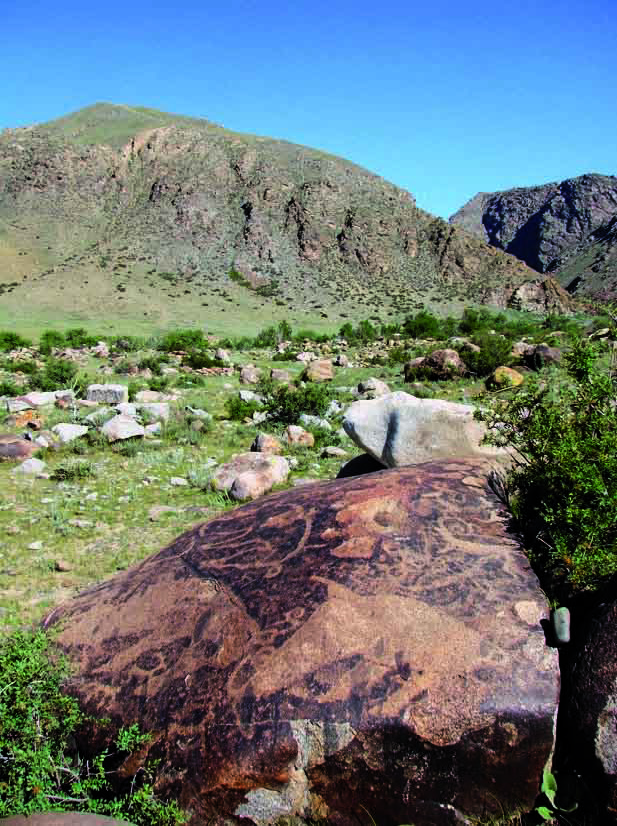
Petroglyphs of the early Iron Age. The accumulation of petroglyphs is located 42-45 km north of Zharkent, on the southern slopes of the Toksanbai Ridge near the confluence of the Middle and Small Usek Rivers. It occupies an area of several hundred meters on the terrace under the hill and on its western slope (Panfilov district, Almaty region).
The petroglyph complex was opened in 1982 by the KazPI expedition (headed by A.N. Maryashev). In 1943, on the opposite bank of the Middle Usek River, a large burial ground of the early Iron Age was found on a flat section of the Nifontova regional specialist.
The sacral significance of petroglyphs of the small Koitas gorge lies in the fact that the rock drawings show the full range of religious and mythological views of the ancient peoples of the region of the early Iron Age. Some plots represent an ancient altar for religious rites. Petroglyphs from the early Iron Age predominate in the collection, with a small number of earlier drawings, possibly from the late Bronze Age. They reflect the change in a number of mythological notions of the previous epoch, which can be seen in the plots and style of drawings. At the very beginning of the gorge there is a stone with large figures of wild boars in animal style. The presence of the sanctuary and altar on a large stone confirms the connection of the object with religion. The object is of historical value, as it contains information on the history of culture, mythology and art of the Saka tribes.
The drawings are carved on large granite boulders with black or brown patina, as well as on separate rocky outcrops. The repertoire of petroglyphs is typical of Saxon times. Goats, argali, deer, wild boars, horses, dogs, and archers are depicted. The most expressive petroglyphs are found at the mouth of the Small Usek River. As in other cases, accumulations of Saxon petroglyphs have their main part - the altar. This is a large stone on which large figures of wild boars in animal style, ranging in size from 0.7-0.8 to 1 m, are carved. Behind it there are many other petroglyphs, some of which are contoured, some of which are ornamented with stripes, volutes or spirals. The drawings are also applied to the stones located on the western slope of the hill, a remnant of the Ice Age. There are also drawings on the hills next door and near the settlements.
In total, there are about 1,000 petroglyphs in the cluster. Some scenes are not only of historical interest, but also of artistic interest in terms of their artistic expression and mastery.
Object of tourism.
Sources
Бейсенов А.З., Марьяшев А.Н. Петроглифы раннего железного века Жетысу. – Алматы: Институт археологии им. А.Х. Маргулана, 2014. – 156 с. + 46 с. цв. ил.
Марьяшев А.Н., Горячев А.А. Наскальные изображения Семиречья. – Алматы: Институт археологии им. А.Х. Маргулана; Фонд «XXI век», 2002. – 264 с.
Нифонтова Л.К. Отчет об экспедициях в долину р. Усек Панфиловского района // Архив отдела археологии ИИАЭ АН Каз.ССР, 1949.
Maryashev A.N., Goryachev A.A., Potapov S.A. Felsbilder im Siebenstromland // Repertoire des petroglyphes d´Asie Centrale. – Paris, 1998. – 146 с.