Information
- Location
- Almaty District, Enbekshikazakh District
- Period
- 600 BCE – 401 BCE
- Category
- Historical and cultural monuments of republican significance
- Type
- Necropolis
- Kind
- Archaeological sites
Sources
- Қазақстанның киелі орындарының географиясы: Табиғат, археология, этнография және діни сәулет өнері нысандарының тізілімі / Жалпы редакциясын басқарған ҚР ҰҒА академигі Байтанаев Б.Ә. – Алматы: Ә.Х. Марғұлан атындағы Археология институты, 2017. – 1-шығарылым. – 904 б.
Description
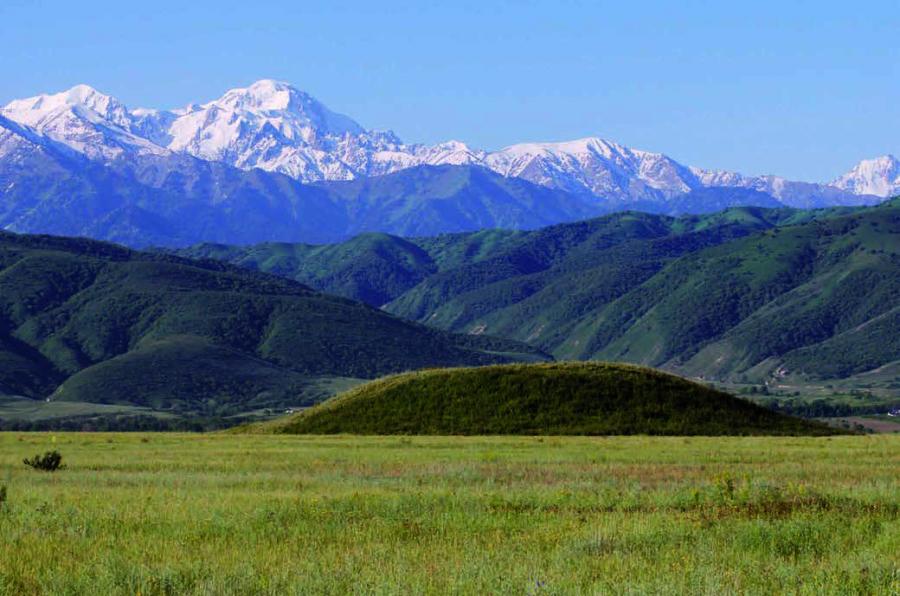
It is a part of the burial ground located on the left bank of the Issyk River 50 km east of Almaty. The barrows differ in parameters: diameter from 30 to 90 m, height - from 4 to 15 m. K.A. Akishev pointed to 45 burial mounds. The territory of the protected zone of the reserve-museum now covers both banks of the Issyk River and includes more than 300 multi-temporal barrows.
Archaeological research of the barrow was carried out in 1969-1970 under the direction of K.A. Akishev. B.N. Nurmukhanbetov, A.S. Zagorodniy, A.K. Akishev, T.V. Vorobieva (artist), O.V. Medvedev (photographer) took part in the works. Reconstruction of the appearance of the Issyk Golden Man was made by K.A. Akishev and V.I. Sadomskov.
The Issyk barrow has a diameter of 60 m and a height of 6 m. Its embankment is multi-layered. The barrow contained two burials: central and lateral (southern). The central grave was disturbed by the robbers of antiquity, the side grave remained undisturbed. The funerary structure is a rectangular pit in which a structure made of processed Tien Shan spruce logs with a length of 1.5 to 3 m was placed. The internal dimension of the pit was 2.9 x 1.5 m, the external dimension was 3.3 x 1.9 m, and the depth of the pit was 1.5 m. The remains of the buried person with the accompanying object complex, placed in a strictly defined order - over 4,000 gold objects, iron sword and dagger, hryvnia, two rings, a bronze mirror, 31 clay, metal (silver and bronze) and wooden vessels, a silver spoon, a wooden scoop and beads of carnelian and paste - were found there. The remains of man were found on the northern wall, originally laid on his back, with his head facing the sunset. He was about 15-18 years old. The length of the skeleton from the skull to the heel bones is 165 cm.
The buried man lay in ritual clothes decorated with certain symbols. He was wearing a thin, apparently, silk shirt, and over it - a short jacket, covered with gold plaques in the form of a trefoil and the head of a cat's predator. On the head of the Issyk warrior was a headdress - kulakh with complex symbolism: two arrows, images of golden mountains with three tops and growing trees (on top of which the bird sits), on the sides are two goats. This frieze is separated by images of winged cat raptors, the kulakh is crowned with a miniature golden statuette of argali. The central emblem is formed by two protomes of horses with mountain goat horns and wings. There were two rings on the fingers of the buried man's right hand. One of them - with a mirror shield, the other - with a relief image of a solar deity.
The shape and decor of the headdress, as well as the entire costume, suggests that it was probably military, ritual, as well as the costume itself, cult, caste. Issyk headdress is a "sacred model of the cosmos", it reflects the concept of the ancient nomadic world of Zhetysu. Images of a goat-deer and a goat-horse horse, widely used in the decoration of clothes, cult attributes of the Scythian-Saka epoch - sacred images that accompanied the dead to another world, to the "heavenly pastures". The creature, which combines the features of a quick-legged horse and a tauteke that lived on mountain tops, was able to quickly overcome the difficult and dangerous path to heavenly pastures. It was such an animal, buried with a warrior, hunter, nomad, helped him in the difficult journey. The horse in mythology was a solar deity, a companion of a solar deity or acted in one of the hypostases of a solar deity. He could also appear as a winged being. The winged horse from the kulakh of an Issyk warrior shows that the popular image of tulpar among Turkic-speaking peoples was formed in the epoch of ancient nomads. Images of a bird, deer, horse, goat, and goatee horses were universal symbols of the Sun and the Upper World; the upper part of the mythological picture of the world. They symbolized the sacredness, the sanctity of the chief priest.
The Issyk barrow, like other early nomadic monuments, shows that the horse is an integral part of men's cultural and military life. The main tandem of nomadic culture characters - "Batyr and his horse" - appeared in the I millennium BC. In total, the belt was decorated with 13 onlays in the form of a deer's head and three massive ones in the form of a lying deer (moose), whose horns and wings end with heads of eagle griffins. It is believed that in these images the plot of the main idea is conveyed: life is an eternal cycle of births and deaths. The belt was perceived as a sign of power, military valor. Iron sword and dagger in scabbard, covered with gold plates, decorated with zoomorphic symbols, including images of eagles' griffins.
Earring in the left ear and hryvnia - completed the image, being the necessary attributes of the warrior, having a symbolic meaning. Thus, hryvnia made of gold, decorated with certain animal images, were an attribute of a man related to the military class, the nomadic elite. In the costume and decoration of armament items gold was used, which symbolized the "embodiment of ideas of immortality, eternity, omnipotence". Gold was associated with the royal power. The symbolic function, semiotic properties of weapons items, such as the belt, made with the use of gold, was enhanced. In general, in the image of an Issyk man we see a hero-protector, a hero-progenitor, a hero-leader, a hero-guardian, an ideal image of a nomadic epic warrior. A thorough analysis of the headdress of an Issyk warrior and his semantics allowed K.A. and A.K. Akishev to come to a conclusion about the ethnicity of an Issyk man to the saka-tigrahaud, saka in arrow-shaped hats.
Materials of Issyk barrow in system of other elite complexes of early nomads of Eurasia show internal unity of a nomadic civilization of a mountain-valley and steppe zone of Eurasia in I millennium BC, presence of steady interrelations. According to K.A. Akishev, the maestro of Kazakhstan archeology, the art of Issyk demonstrates the connection, on the one hand, with the work of the tribes of Southern Siberia, with the art of Achaemenid Iran and Bactria, on the other hand. The Issyk barrow is one of the many elite barrows of Zhetysu, which is a phenomenal occurrence in Central Asia. K.A. Akishev noted that this is possible with a sufficiently high level of development of society, its power structures, strictly organized military-political system, mass fanatical adherence to religious and ideological dogmas.
Another criterion for the high level of development of the Zhetysu Sakas' society is the written signs affixed to the silver bowl. According to experts, it was created on the basis of or has a common prototype with the ancient Indian script Kharoshtchi. Written monuments discovered in Zhetysu, Afghanistan and southern Central Asia date from the III century BC to the IX century AD and have different character (they contain reports about the king's campaign, calendar information, legal documents, ritual inscriptions).
The Issyk barrow materials served as a starting point for the study of nomadic culture in the Eurasian steppes, which allowed us to raise the issue of steppe civilization. He is one of the factors that allow to assert that the Scythian-Saka world is a system of early states with its own economic, social system and ideology.
The Issyk barrow is unique as a sacral monument of materialized mental culture, mythopoetical perception and system of social micro- and macrocosmos of Saka tribes of the Iron Age. According to A.K. Akishev, "The Golden Man is the center of the world, the center of society, the living embodiment of harmony in the Universe" [Akishev A., 1984, p. 53]. Issyk barrow has become one of the cultural brands of the Republic of Kazakhstan in the international space, becoming an organic part of the state symbols of independent Kazakhstan.