Information
- Location
- Almaty city, Medeu District
- Period
- 1884 – 2002
- Category
- Historical and cultural monuments of republican significance
- Type
- Собор
- Kind
- Monuments of urban planning and architecture
Sources
- Қазақстанның киелі орындарының географиясы: Табиғат, археология, этнография және діни сәулет өнері нысандарының тізілімі / Жалпы редакциясын басқарған ҚР ҰҒА академигі Байтанаев Б.Ә. – Алматы: Ә.Х. Марғұлан атындағы Археология институты, 2017. – 1-шығарылым. – 904 б.
Description
It is located in the park named after 28 Panfilov Guardsmen in Almaty, Gogol Street, 40v.
In 1872 in connection with the transfer of the regional diocese of the Russian Orthodox Church from Tashkent to Vernyi there was built a cathedral church (1884), which was destroyed by the earthquake three years later. The solemn laying of the new cathedral took place on September 26, 1904 for the 50th anniversary of the city of Verny, and the construction was completed in 1907. The cathedral was named Voznesensky, as its main altar was dedicated to the Ascension of the Lord (the ascension of Jesus Christ to heaven), the other two altars were dedicated to the Annunciation and memory of the Holy Martyrs of Faith, Hope, Love, and the mother of their Mother Sophia - the heavenly patronesses of Zhetysu. Ascension Cathedral withstood with dignity the devastating earthquake in Vernyi in January 1911, proving a high degree of seismic stability.
In connection with the policy of propaganda of atheism in the USSR in 1929-1994, the building of the Ascension Cathedral was used for cultural needs: since 1929 it housed the Central Museum of Kazakhstan (CMK), and on the bell tower of the Cathedral were installed antennas of the All-Union Radio, in the room were records of the choir and soloists of the Kazakh Radio Committee (with the participation of artistic directors B. Baikadamov, B. Erzakovich, B. Orlov, V. Pirogova, L. Hamidi). The Society of Proletarian Tourism and Excursions and the editorial office of the women's newspaper "Tilshi" were also located here. In 1929, significant changes were made in the interior of the building - the second floor was added to accommodate the administrative premises of the Central Museum of the Kazakh SSR (CMK). In 1963-1966, 1976 the restoration works were carried out in respect of the monument of architecture. Since 1985, in connection with the move of the CMK to a new building, the Cathedral has housed the Directorate of Art Exhibitions and the Society for the Protection of Monuments, and then the Concert and Exhibition Pavilion. According to the decision of the President of the Republic of Kazakhstan N.A. Nazarbayev in 1995 the cathedral was officially transferred to the indefinite use of the Almaty-Semipalatinsk diocese. In 1995-2002 after the use of the building by public organizations of the city specialists of the Institute of "Kazprojectrestoration" was carried out the restoration of the temple, painting of the building and the structure of the iconostasis (the project of architect T. Turekulov, artist Yu. Supis, V. Lukin).
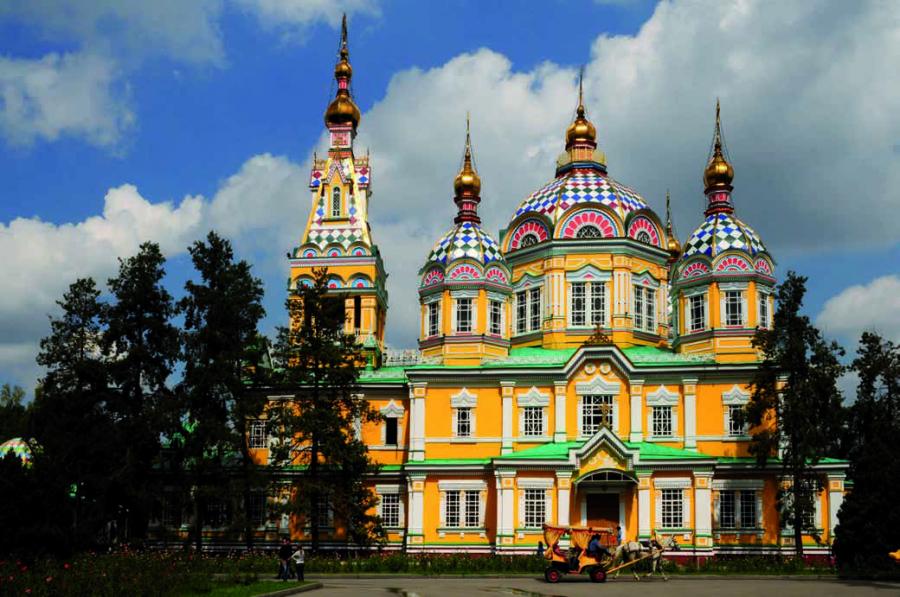
The author of the project of the Ascension Cathedral was the architect K.A. Borisoglebskiy, the famous Vernenskiy architect A.P. Zenkov supplemented and partially redesigned the project. The cathedral was built at the height of eclecticism and is a vivid example of Russian colonial architecture of the early XX century, the so-called Russian style. The three-dimensional composition of the building is built according to all canons of church construction. It is formed of two parts - the main volume with an altar and sacristy, covered by five chapters (dedicated to Jesus and the four apostles), and the bell tower with a tent ceiling. The cruciform construction in the plan of sizes 30×50 m has a longitudinal-axis symmetrical lay-out. The highest point on the upper end of the cross on the main dome is 39.63 m, on top of the bell tower - 44.2 m. Capacity of the cathedral is 1 800 people. The two-gable roof of the cathedral is decorated with five domes with onions and crosses, raised on low octahedral drums with wide rectangular window openings. The walls of the building, the roof rafters are made of the trunks of tarred, two-year-old aging Tien Shan spruce. The majestic temple, sparkling with gilded domes, with the picturesque roof and bell tower brightly painted "in a checker", became one of the symbols of the Vernyi and was visible from any point of the city in the beginning of the XX century.
The sacredness of the Holy Ascension Cathedral is justified by the fact that it is one of the two cathedrals of Astana and Almaty diocese of the Russian Orthodox Church. The cathedral holds worship services on the main Orthodox holidays and exhibits sacred religious objects for worshiping the faithful. In addition, the Voznesenskiy Church is a unique monument of wooden architecture of the early XX century. It is one of the highest wooden buildings in the world, the world's tallest orthodox wooden temple. The building of the cathedral is unique in the fact that a lot of things have been implemented here for the first time in the construction practice of Zhetysu (application of reinforced concrete structures, supply and exhaust ventilation systems, reinforced concrete base/plinth; in order to strengthen the seismic stability at the corners and in the partitions of the log cabin were fastened with clamps made of wooden beams tightened with vertical bolts; arrangement of an anti-seismic moat along the perimeter of the building, etc.).
Ascension Cathedral is a monument of history, urban planning and architecture of national importance, is part of the Almaty State Historical and Architectural Reserve. By the resolution of the Council of Ministers of the Kazakh SSR dated January 26, 1982 the Ascension Cathedral was included as a monument of town-planning and architecture in the State list of historical and cultural monuments of the Kazakh SSR of republican importance.
Sources
Вознесенский кафедральный собор. Верный – Алма-Ата – Алматы. – Алматы: Кумбез, 2001. – 269 с.
Кафедральный собор // Алма-Ата и алматинцы / Н.А. Букетова. – Алматы: Елнур, 2007. – 160 с. ‑ С. 95.
Кафедральный Туркестанский Софийский собор // Памятники истории и культуры Алматы (каталог документов). – Алматы, 2003. – С. 38–41.
Кириков Б.А. Дерево и сейсмостойкость // Древнейшие и новейшие сейсмостойкие конструкции. – М., 1990. – С. 44–48.
Памятники истории и культуры Алматы. Каталог документов / Состав. Л.А. Матвеева. – Алматы: Онер, 2003. – 208 с.
Проскурин В.Н. Собор Вознесенский // Свод памятников истории и культуры города Алматы. – Алматы: Казахская энциклопедия, 2006. – С. 87–88.
Свод памятников истории и культуры города Алматы. – Алматы: Казахская энциклопедия, 2006. – 360 с.
Свято-Вознесенский кафедральный собор Алма-Аты (к 90-летию строительства и освящения собора посвящается) / Сост. О. Ходаковская. – Алматы, 1996. – 36 с.