Information
- Location
- Almaty District, Ile District
- Period
- 800 BCE – 201 BCE
- Type
- Tumulus
- Kind
- Archaeological sites
Sources
- Қазақстанның киелі орындарының географиясы: Табиғат, археология, этнография және діни сәулет өнері нысандарының тізілімі / Жалпы редакциясын басқарған ҚР ҰҒА академигі Байтанаев Б.Ә. – Алматы: Ә.Х. Марғұлан атындағы Археология институты, 2017. – 1-шығарылым. – 904 б.
Description
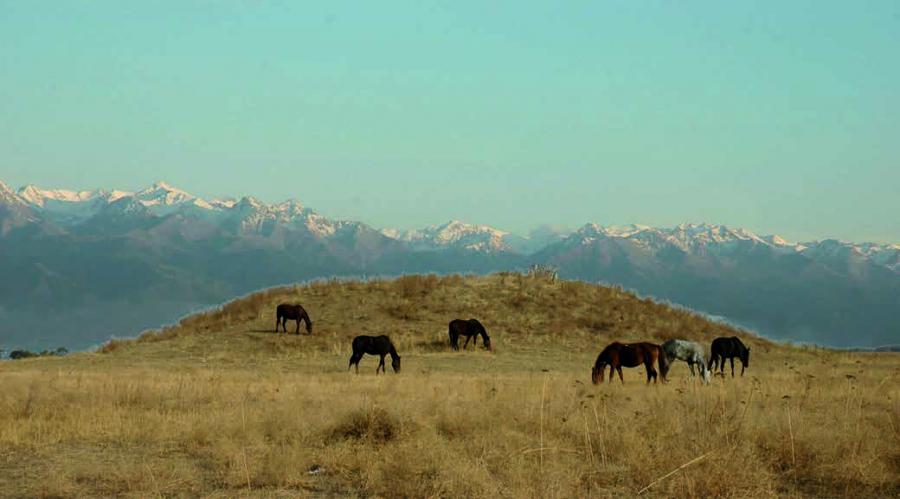
One of the largest burial grounds of the Saka time is Borolday, which occupies a part of the high plateau of the same name, located in the north-western part of Almaty. Dozens of magnificent barrows against the background of mountains with white hats of tops present a completely fantastic picture, especially in spring, when the green barrows are surrounded by a scarlet sea of poppies.
Borolday barrows - huge structures that compare with the Egyptian pyramids, reaching a height of 20 m and a diameter of 120-150 m, as well as small hills up to a height of 1-1.5 m and a diameter of 5-7 m. The length of the burial site is 3 km, width 800 m. The most part of the burial ground has been preserved - there is no modern building here. This is a rare case when the burial ground is surrounded by ravines and a canyon of the Big Almatinka river bed, so the whole area is difficult to develop.
Scientists have established that Borolday barrows, as well as Issyk, Talgar, and Kegen barrows, were erected by the Saka tribes that occupied Zhetysu in the 8th-3rd centuries B.C., and Usuns - the people who lived in the 3rd century B.C. - Both were ancestors of the Kazakhs.
Each large burial mound is an architectural structure, the necropolis is a kind of architectural ensemble. Parts of it are the barrows themselves with their complex structure of embankments and graves, rings of stone masonry around the barrows, vertical stones-mengiras around, places of tricks - cult feasts, sacrifices. The whole territory of the necropolis is an "ancient picture" of the ideas about the universe, the place of man in it, a platform for rituals and religious ceremonies related to the cult of ancestors, calendar cycles, celebrations of Nauryz, autumn, summer and winter festivals. Now it is a kind of open-air museum.
For many years, scientists and the public of Almaty periodically raised the issue of giving the Borolday barrows the status of a monument of history and culture with the organization of an archaeological reserve on its territory. In 2006, a resolution was adopted to withdraw 430 hectares of land from the city's land fund for the organization of the "Borolday Sakas barrows" museum. It can be said with good reason that the barrows of Borolday are not an ordinary project. Its implementation will be the embodiment of the idea of creating an infrastructure of historical tourism in Almaty. Archaeological Park is an optimal form of preservation of natural and historical-cultural heritage, a qualitatively new phenomenon in relation to other types of open-air museum. Similar archeological open-air museums-reserves, similar in visual and conceptual content to the Borolday museum, are in the Republic of Hungary under Budapest and in the Republic of Korea in Gyeongju. In Korea, the National Archaeological Museum-Reserve "Timuli Park" is a world-class site with 20 royal barrows of the ancient Korean state of Silla (IX century).
The first cycle of work on the creation of the Borolday museum has already begun. The project was developed and the entrance complex was constructed. The organization of an archaeological park and the development of tourism infrastructure will contribute to the educational, cultural and economic development of tourism through the development of the service sector, as well as the creation of research potential for the study of historical, cultural and natural heritage of the entire region of Zhetysu and Almaty.
Taking into account the richness of the region's natural resources, numerous historical monuments, well-preserved cultural folk traditions, the archaeological park and museum-tourist complex can be considered as a base for the development of scientific research in the field of archaeology, ethnography, protection and use of historical and cultural heritage, to be more precise - sacral.
Borolday necropolis was connected with the cult of ancestors and it's revered as a place of rest of the dead since ancient times and up to now.