Information
- Location
- Almaty District, Karasay District
- Period
- 1729 – 1730
Sources
- Қазақстанның киелі орындарының географиясы: Табиғат, археология, этнография және діни сәулет өнері нысандарының тізілімі / Жалпы редакциясын басқарған ҚР ҰҒА академигі Байтанаев Б.Ә. – Алматы: Ә.Х. Марғұлан атындағы Археология институты, 2017. – 1-шығарылым. – 904 б.
Description
Located near the village of Shemolgan, 120 km south of Lake Balkhash, 20 km to the NW from Almaty (Karasai district, Almaty region).
The Battle of Anyrakai (December 1729 - January 1730) - the largest and decisive battle in the Kazakh-Dzungar wars (1643-1756), in which the Dzungars aimed to seize the Kazakh lands by exterminating and enslaving the Kazakhs. The battle, where Kazakh soldiers defeated the enemy's head, thus laying the foundation for the liberation of their lands, took place in the area between Lake Balkhash and Lake Alakol at the foot of Mount Anyrakai (translated from Kazakh as "crying, moaning"). The area, called the Anyrakai triangle, surrounded on all sides by natural water and mountain obstacles, was of great strategic importance, because through it there were exits along the river Shu to Sarysu, the mountains of Ulytau and Karkaraly. The memory of the battle was preserved in the oral tradition, and historical information was recorded for the first time in 1905 by A.A. Divayev, an ethnographer and collector of Kazakh folklore.
Kazakh troops, numbering 25 - 30 thousand cavalrymen, by the time of the battle approached the foot of Mount Anyrakai. The commander-in-chief of the united army of three zhuzes was Bogenbai Batyr, a native of the Kanzhygaly tribe, Argyn. Strategic management of the Kazakh forces was carried out by talented commander Abulkhair khan. All known batyrs of the Kazakh land, bies, sultans, ancestors - representatives of all three zhuzes - Tole bi, Kazybek bi, Aiteke bi, Koigeldy, Sanryk Toktybayuly, Barak Shorekuly, Tortaul Olzhabay, Otegen Otegululy, Bogenbay Bozkosuly, Aksha Sartuly, Bopay bi, Kangeldy Srymbetuly, Alshin Taylak, Eserken Zhamankarauly and others took part in this battle. Within 40 days a number of collisions of the Kazakh militia of three zhuzes and the boundary dzungarian detachment on the river Bulanty-Beleuti and Anyrakai, in various places of Saryarka, on the bank of the river Ile took place. As a whole, one and a half months of battle on Anyrakai ended with the victory of Kazakhs. This victory was the first real step in freeing Zhetysu from the Dzungarian invasion.
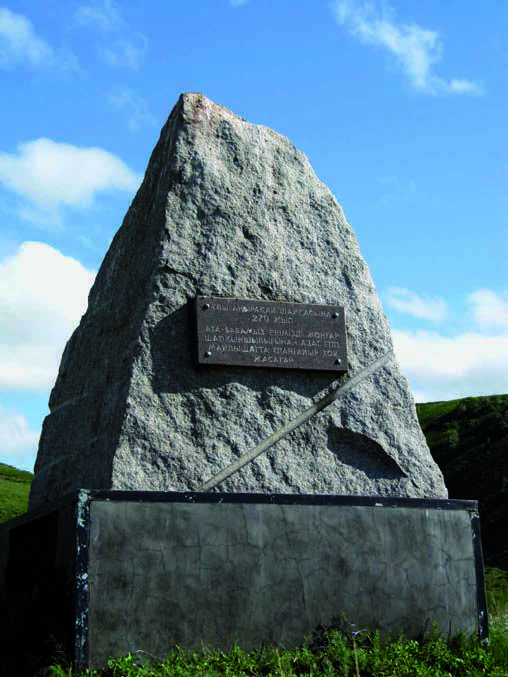
After gaining independence in connection with the 270th anniversary of that victory in 1999, a special expedition was sent to the battlefield, which set up a granite stone in the foothills of the Zhetysu Alatau of Alakol district in honor of the glorious victory of Kazakh soldiers over dzungars. In 2001 in Karasai district in honor of the Battle of Anyrakai on the 35th kilometer of the highway Almaty - Bishkek a more majestic monument was erected on a hill. "The people should know their history and realize that unity is strength," said the President of the Republic of Kazakhstan, Nursultan Nazarbayev, at the opening ceremony of the monument.
The monument to Kazakh soldiers in Karasai district is a composition of two stelae, which are in the center of the circle, symbolizing the fierce struggle of Kazakhs and Dzungars. A taller stela with the top tilted upwards is designed to depict the image of the victors, the Kazakhs, and the Dzungars symbolizes a lower stela with the top split in half. Symbolic saturation of the stelae has a coloristic solution: the "Kazakh" stela is decorated with red color, and the "Dzungarian" stela is decorated with grey color, which symbolizes the defeated enemy who has turned into dust and ashes under the hooves of Kazakh batyrs' horses. On the surface of the stelae facets there are cosmogonic and geometric ornaments typical for nomadic civilization. On the stele of the Dzungars ornaments are located chaotically, which causes an association with the chaos that the conquerors carried with them. The monument is surrounded by 12 stones with signs of animals of the eastern calendar. The authors of the building are Timur Suleimenov, President of the Union of Designers of the Republic, Honored Artist of the Republic, Almas Ordabaev, Vice-President of the Union of Designers, and Sairan Fazylov, Head of the Almaty Regional Department of Architecture and Urban Development.
The sacral nature of the object is justified by the fact that the great victory of the Kazakhs in this area contributed to the beginning of a systemic crisis in the Khanate of Dzungars, which led to its capture by China.
The object is a place of pilgrimage and religious tourism.
Monument of history and monumental art of republican importance.