Information
- Location
- Almaty District, Zhambyl District
- Period
- 800 BCE – 1400
- Category
- Historical and cultural monuments of local significance
- Type
- Petroglyph
- Kind
- Archaeological sites
- Authors
- Железняков Борис Анатольевич
Sources
- Қазақстанның киелі орындарының географиясы: Табиғат, археология, этнография және діни сәулет өнері нысандарының тізілімі / Жалпы редакциясын басқарған ҚР ҰҒА академигі Байтанаев Б.Ә. – Алматы: Ә.Х. Марғұлан атындағы Археология институты, 2017. – 1-шығарылым. – 904 б.
Description
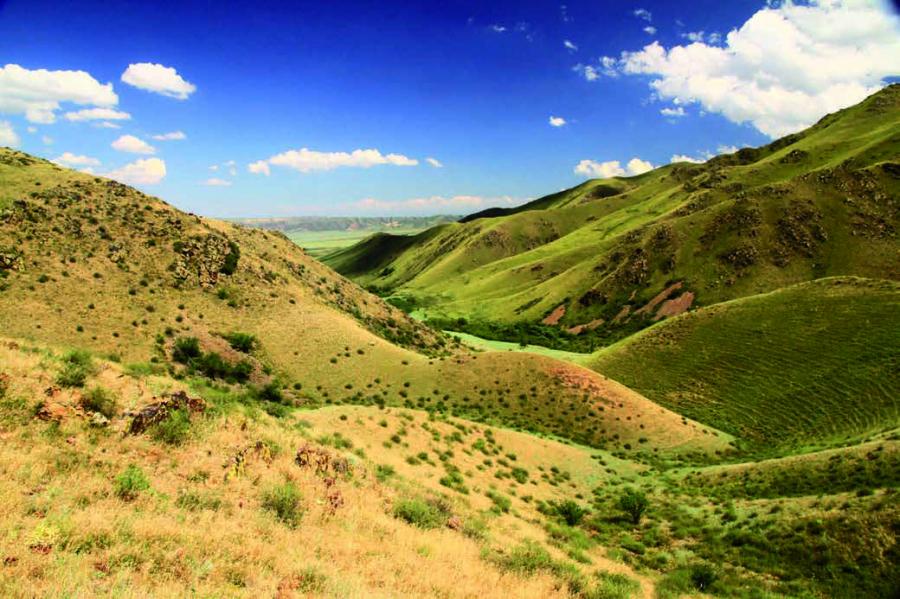
The gorge is located in 5 km to the south of the modern aul, in 130 km to the west from Almaty, in the northern part of Zhetyzhol ridge (Zhambyl district, Almaty region) [AKK, № 4032].
The Archaeological Complex Akterek has been studied for decades. Rather, the components of this unique and significant historical and cultural complex are being studied. Among them there is a burial mound of the early Iron Age and the ancient Turkic era, which is very significant in terms of area and number of burials, located in the wide expanses of the foothill removal cone. Research in the valley of the river Akterek in the late 1980s was conducted by the Zhetysu expedition led by K.A. and A.K. Akishevs. In the foothill part of Yu.I. Trifonov at the same time partially excavated the burials of medieval nomads. An article by A.S. Mirzabaev was devoted to the location of the rock art located near the exit from the gorge in its mountainous part. The complex of monuments of history, archeology, different epochs from bronze to manor - a very peculiar oasis of urban culture, fields with the system of ancient irrigation - is not a complete list of monuments of the complex Akterek. At the beginning of the XX century, V.D. Gorodetsky recorded the fortified settlement of Kerimbaytobe in Akterek. The settlement was examined by G.I. Pacevich in 1956 and is dated on the basis of collected ceramics of XI-XII centuries.
The mountainous part of the complex is occupied by compact settlements located on the sections of floodplain terraces of the narrow and winding valley. The most spectacular, sacred and visited by tourists part of the complex is petroglyphs. The main part of the rock images is located above the large settlement, where there are up to five local groups. Images date back to the Bronze Age, mainly to its late stage, to the Middle Ages.
To date, the main location of the petroglyphs of Akterek has recorded 1,462 drawings, which were punched on 219 planes. There is also information about petroglyphs in other parts of the gorge. Among the Bronze Age known today are 354 images on 84 planes; 1,019 early Iron Age; 80 petroglyphs on 27 planes are attributed to the Middle Ages; eight are dated to the period between the 18th century and the beginning of the XX century; 53 planes contain images of two and three historical epochs at once, especially the petroglyphs of the Bronze Age and early Iron Age.
Unique rock paintings belong to the Bronze Age, including the "sun" and "lunar-headed", altar plane with images of deer and hunting scenes, surrounded by dozens of smaller planes with different petroglyphs. Anthropomorphic images go back to solar and other astral cults. Solar mythology filled all spiritual culture of the population of the Bronze Age, in fact, the whole Eurasia. Solar chariots, horses, boats and ships were knocked out on the best rocky surfaces of Europe. Numerous petroglyphs of the early Iron Age, including those of large size, are concentrated in the area of rocks remote from the main clusters of petroglyphs. An ancient Turkic runic inscription was also found here.
Among the 80 anthropomorphic drawings there is a plane depicting two people shooting at each other, five fighting people armed with bows and axes. Six "sunheads" were discovered.
The Akterek complex is located in the gorge that connects the southwestern part of the Ile valley with the mountainous part of the Shu valley and the Central Tien Shan. It has a full-flowing and inexhaustible water source, relict trees and mild climate. Apparently, it served as a refuge, a place of rest for trade caravans and small missions since the Bronze Age. The first petroglyphs were carved here at the middle bronze stage. A number of plots and reconstructed rituals are being restored using literary sources such as "Rigveda" and "Avesta".