Information
- Location
- Ақтөбе облысы, Ayteke Bi District
- Period
- 1750 – 1950
- Type
- Necropolis
- Kind
- Archaeological sites
- Authors
- Ажигали Серик Ескендирулы
Sources
- Қазақстанның киелі орындарының географиясы: Табиғат, археология, этнография және діни сәулет өнері нысандарының тізілімі / Жалпы редакциясын басқарған ҚР ҰҒА академигі Байтанаев Б.Ә. – Алматы: Ә.Х. Марғұлан атындағы Археология институты, 2017. – 1-шығарылым. – 904 б.
Description
It is situated in 78 km on SSE from Tolybay settlement (Aitekebi district, Aktobe region). The cemetery is located on a relatively flat, lowered steppe area in the right bank / valley of the Olkeyek River, 4.5 km to WSW from its confluence with the Kabyrga River.
The formation of the necropolis is connected with the tragic events of the middle of the XVIII century, which took place in this area: the murder of the khan Junior Juz Abulkhair and his burial here. For several decades a large steppe cemetery was formed in this place, where burials were carried out up to the middle of the 20th century. The necropolis has long been a place of pilgrimage, especially in connection with the cult of the "holy grave" of the Khan. The burial of Abulkhair on the Khan molasy is confirmed by a whole complex of sources and evidence: historical, toponymic, polling and ethnographic, cartographic, ethno-archeological, archeological, anthropological and genetic, etc.
Eponymous of the necropolis is Abulkhair khan (1693-1748) - the largest politician and statesman of Kazakhstan in the first half of the XVIII century, the commander, the khan of the Younger Zhuz from 1710. In 1718 he received the status of the senior Kazakh khan, in some years he was elected the khan of Bashkiria and Karakalpaks, in 1740 he ruled in Khiva. The son of sultan Kazhy, from the hereditary line of sultan Usek/Osek - the son of one of the first Kazakh khans Zhanibek. As a young man he lived in Turkestan under the influence of Tauke Khan. Nomads of Kazakhs subordinate to Abulkhair were located in the Eastern and North-Eastern Aral region. Abulkhair khan was one of the main leaders of the anti-Dzungar struggle of the Kazakh people in the 20-ies of the XVIII century. In 1726 at the famous council in Ordabasy he was elected commander of the all-Kazakh army. Under his leadership, he won a number of important victories over Dzungars: in 1727 in the interfluve of Bulanty and Bileuta to the south-west of Ulytau, in 1730 under Anyrakai in the Southern Balkhash region. In a difficult military-political situation in 1730 he was forced to apply to Russia with a request to become a subject. In 1731 Abulkhair, as a khan of the Junior Juz, together with some sultans of the Middle Juz accepted the citizenship of the Russian Empire. As a result of a difficult struggle for power in the steppe Abulkhair was killed by Sultan Barak in August 1748 in the area of his summer nomads (jailau) on Olkeyek, where he was buried. A small mausoleum was erected over the Khan's grave and a tree was planted, which has begun. However, the monument was quickly destroyed and 100 years later the main landmark of the tomb was a lonely branch tree (aq tal), the remains of which were also lost in the middle of the 20th century. As a result of this and other reasons, by the 1970s, the "problem of Abulkhair's grave" arose, i.e. the need to establish its exact location.
The Khan molasy necropolis has been studied by many researchers since the middle of the XVIII century, primarily in connection with the location of Abulkhair's grave there. Descriptions of it can be found in some sources of the second half of the XVIII - XIX centuries, but very contradictory. The most reliable information is that of N. Rychkov (1771): the place of burial of Khan was a quadrangular mausoleum of raw brick, from the east of which grew a branchy tree, to the south was a stone sacrificial fence. Brief descriptions and references to the grave are given by the authors of the XIX century - A.I. Levshin, D.Eristov, D.Berkimbayev, I.I. Kraft. In the Soviet, post-war period the complex was visited by a number of expeditions and visiting groups, in the mid-1970s - early 1980s: U. Zhanibekov, A. Satayev, writer A. Kekilbaev (1979), to whom the old-timers showed the alleged grave of the Khan.
The purposeful study of the necropolis and search works by the specialists of monument studies were started in 1983 and continued, with breaks, during a number of years: 1998, 2001, 2007-2010 (by S.E. Ajigali). As a result of complex researches which included, consistently, archival and bibliographic researches, interview of informants, eye and instrumental survey, detailed survey/examination of the huge cemetery, study of epigraphic monuments, aerial photographing, geophysical and paleo-postal researches, archeological excavations, anthropological research and genetic analysis - the most probable place of Khan's burial was determined: object No. 92 in the northern part of the cemetery. This conclusion was confirmed (twice) by a comparative genetic study of the DNA of the alleged bone remains of Khan Abulkhair and his direct descendants with an exceptionally high probability of coincidence - 99.783%. On the basis of this, Hungarian anthropologists carried out a craniofacial reconstruction of the appearance of the khan, which found specific features of similarity and coincidence with the portraits of living descendants. The carried out interdisciplinary researches and the received important objective result became a reliable basis of carrying out of the state actions on arrangement of the complex of Khan molasy and its districts.
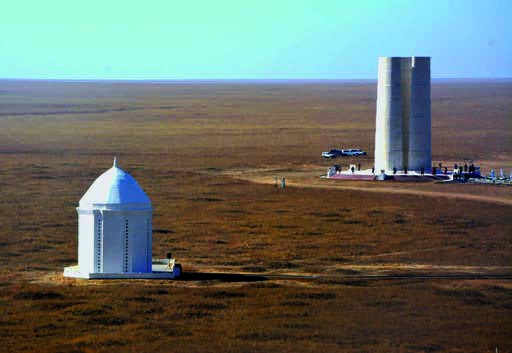
The Khan Molasy necropolis, which now has only the status of a monument of history and culture of local importance, in recent years has become a key object of "sacred geography" of the vast steppe region at the junction of Western Kazakhstan and Saryarka. In 2015, large-scale measures were taken here to organize a memorial and tourist complex (with the erection of a monumental memorial sign and a new mausoleum: architects B. Ibraev, Z. Tattybaev), and to optimize the infrastructure of the adjacent area (with the creation of the Abulkhair Khan Museum in the village of Tolybay). The object has serious prospects and special significance in terms of cultural tourism development in the North Aral Sea, Yrgyz-Torgay district.
The Khan molasy necropolis is a vast steppe cemetery located along the old dirt road running parallel to the Olkeyek riverbed. It belongs to the largest Late Kazakh memorial complexes of the northern steppe strip, the emergence of which had a pronounced causal character, namely in connection with the death / burial here - in a specific zone of summer migration - of Khan and his team. It was not tied to any settlement or pre-existing cult, monument (as, for example, Kazakh necropolis of Khan ziraty in Orda or Abat Baitak in the valley of Uly Khobda river). Quite rapid development of the necropolis on Olkeikek was connected both with the charismatic personality of the Kazakh ruler, the "great martyr", the cult of his grave and sacred tree, and with the location of the complex on the tracks of large clans of the North Aral Sea Kazakhs: Shomekei, Altyn, Zhappas. Along with them, and Kazakhs of the genus Argyn of the surrounding territories began to produce burials on the "sacred cemetery".
The memorial complex, which was quite actively functioning during the second half of the XVIII - first half of the XX century, is characterized by significant parameters: an oval-stretch plan with total dimensions of 570×295 m. The total area of the burial site is not less than 16.0 ha. In total, 942 gravestones have been identified in the necropolis. Basically, these are gravestones, hills with holes and pits above the burials and without them, just gravestones, and strongly swamped remnants of raw structures such as fences (quadrangular "tortkulak" and oval "qorgan") and mausoleums.
Besides, about 40 stone-carved monuments have been identified in the cemetery's area - stelae and tombstones, which mainly belong to the types of " koktas " (vertically installed, buried in the head of the grave monuments) and " samarqantas " (laid horizontally above the grave) and are made of imported marble stone: the area of South Kyzylkum, Nuratau, etc. There are also a number of classic planar western Kazakh kulpytases made of sandstone limestone. Most of these monuments are epigraphic in nature and date back to the second half of the XIX - early XX century. The inscriptions are in Arabic script in Kazakh with elements of Central Asian " Turkic" (Chagatai language). Epitaphs contain tribal affiliation, name, age, year of death of the buried person. The lapidary vocabulary of monuments sometimes contains interesting moments - for example: "Bu kuk tash samarkandi..." - "This koktas is Samarkand (from Samarkand)," etc. It should be noted that many of these monuments are outstanding examples of stone-cutting art, in particular, separate tombstones - " Samarqantasy " with corner columns, epigraphic and ornamental friezes.
As noted, a certain number of structures of the necropolis (probably not less than 20) originally were mausoleums or large fences of raw or "ground" (turf) brick, which in 1771 wrote Rychkov and in the late XIX century mentioned Berkimbayev. Nowadays, these are the largest, prominent hills, barrows, or objects with remnants, traces of specific layouts. It is in one of the large barrows in the northern, earliest part of the cemetery (object number 92) that the supposed bone remains of Khan Abulkhair were discovered. Excavations of this and a number of other objects revealed the peculiarities of the funeral rite - according to the Muslim rite: the position of the dead on the back, in most cases with his head to the north-west, facing the south-west; mainly in the tombs of the "fever" type (funeral slit with attacks), overlapping with logs and reed mats, or brick vaults / tombstones (such as "Sagana"); in some cases, traces of "organic blanket" - grave-clothes - are preserved.