Information
- Location
- Ақтөбе облысы, Bayganin District
- Period
- 1601 – 1700
- Category
- Historical and cultural monuments of republican significance
- Type
- Necropolis
- Kind
- Ensembles and complexes
Sources
- Қазақстанның киелі орындарының географиясы: Табиғат, археология, этнография және діни сәулет өнері нысандарының тізілімі / Жалпы редакциясын басқарған ҚР ҰҒА академигі Байтанаев Б.Ә. – Алматы: Ә.Х. Марғұлан атындағы Археология институты, 2017. – 1-шығарылым. – 904 б.
Description
It is situated in 61 km to the south-west from Zharkamys settlement (Baiganin district, Aktobe region). The complex has at least 1,000 tombstones, many of which (earthenware and chalk) have survived only in the traces.
Detailed information about the eponymous among the population is contradictory. According to the modern "restoration" epitaph, it is Baktybai Tolesuly, a Kazakh Batyr of the tribe Alim of the genus Shekti (Kabak) nicknamed Karasakal, who, according to some sources, lived in the 1720s-1780s. The burial of Karasakal, marked by a wooden pole with an inscription, is located in the north-western tip of the beyit (tomb).
However, some informants believe that Karasakal was of Bashkir origin. This is evidenced by Kerdery Abubakir's aitys with one "Nogai" at the fair in Temir, when Abubakir reproaches him for not looking for the grave of his ancestor, who lies in Kazakh soil. In this regard, it is interesting to note the information about the Bashkir Batyr Karasakal, who in 1740 revolted against the Tsarism in Bashkiria and later fled to the Kazakh steppes for Yaik. Having been called the brother of Galdan-Tseren, he and the Kazakhs who supported him were, however, persecuted by the latter. According to the Cossack Matvey Arapov, Karasakal died in the spring of 1749.But he didn't specify the exact place of burial. This attribution of the monument also raises doubts in connection with the legend given by M. Levanevsky, from which it follows that the cemetery "Karasakal Aulie" on the eastern bank of the Emba already existed in the second quarter of the XVIII century. [At the same time, it should be noted that there are other versions of the problem of the necropolis eponymous (T. Tleukabyluly)]. Characteristically, in the epos about Koblandy the Kalmykian Batyr Kara is also mentioned; Karasakal is also fixed in the Altai epos "Al-Toichi".
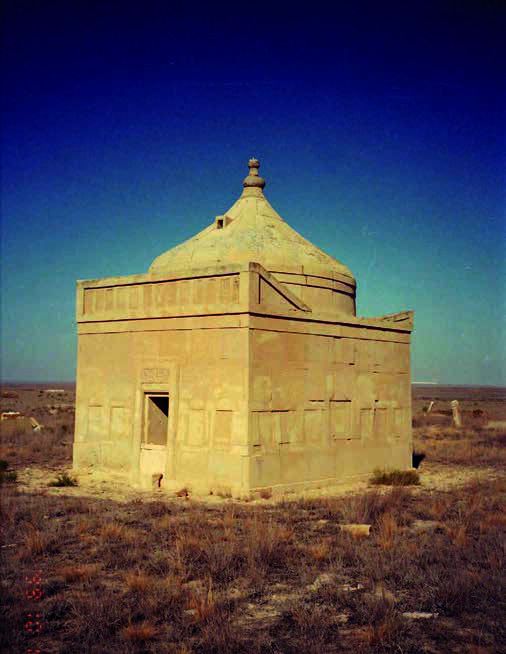
Returning to the characteristics of the necropolis, we note that it is divided into two parts: the southern (earlier) and northern, relating to the middle of the XIX - early XX century. The central part of the complex is poorly saturated with tombstones. The southern half of the complex is mainly represented by fences and fences with kulpytases made of limestone. The northern part of the necropolis is more saturated with various (architectural and artistic) types of monuments.The necropolis is characterized by a variety of types of mausoleums and saganatams, among which there are magnificent examples of architecture and stone-cutting art. The most significant monument of the complex is the mausoleum of Indibai, built in 1886-1887 (1304 A.D.). The composition of the mausoleum, built of sawn blocks of limestone, is formed by a rectangular skeleton and helmet-shaped dome. The surfaces of the monument were originally richly decorated with flat relief (outside) and contour (inside) decor with painting ornament. Saganatams from sawdust blocks constitute a significant group of buildings. Characteristically, there are possible prototypes for them here - archaic fences made of raw brick and limestone. Many of them, like saganatams, have an entrance in the southern wall framed by slabs. Very diverse and numerous in the Karasakalaulie are small forms of funeral and cult of architecture. Judging by the epigraphy and tamga signs on the kulpytases, representatives of various genera of the Junior Zhuz were buried on the necropolis: adai, tabyn, ozhyrai, kete, shekty, etc. The diversity of the various monuments of the Beit Karasakal allows us to identify the main ways of the genesis of the funeral and cult architecture in the valley of Emba in the late Middle Ages and modern times.
The Karasakal necropolis is visited in summer by pilgrims, mainly residents of Baiganin district of Aktobe region.
Coblandy Batyr, memorial and tourist complex. XV-XX centuries. Memorial and tourist complex built on the burial site of Koblandy Batyr in the village of Zhirenkopa (Kobda district, Aktobe region).
According to legend, Koblandy Batyr (15th century) is an outstanding personality immortalized in the epic poetry of Kazakhs. According to historical sources, he lived approximately in the 15th century. In the folk memory of the Kazakh, Bashkir, Karakalpak and other Turkic peoples 29 variants of the poem "Koblandy Batyr" have survived. According to these data it is established that Koblandy Batyr participated in political events of the Nogai Horde period, in the campaign to Kazan. Kobylandy Batyr fought with Alshagyr, the descendant of Yedige Bi in the fourth knee. Batyr was lost from a hand of son Alshagyr Orak Batyr.
For the first time we record data on the burial place of Koblandy Batyr with V.V. Carlson (1906). I.Kastagner (1910) notes about the location of the monument to the Batyr in 40 km from the Iletskaya defense (modern town of Sol-Iletsk, Russia). During the Soviet period Zhirenkopa settlement was formed on this place. The local population was aware of the location of the monument and noted the preservation of the remains of the mausoleum up to 1 m high up to the middle of the XX century.In 1969, the bone remains were removed from the mausoleum site by N. Shayakhmetov and S.Balmukhanov, but the anthropological research was not completed logically. The works were continued only in 2005 by Kazakh anthropologists O.Ismagulov and A.Ismagulova. As a result of additional archaeological research (Zh. Smayilov and O. Oshanov) the remains of the medieval mausoleum with the buried one were cleared. The reconstruction of the skull of a Batyr was carried out in the laboratory of anthropological reconstruction of the N.N.Miklukho-Maklai Institute of Anthropology and Ethnology (Moscow) according to the method developed by M.M.Gerasimov (T.Balueva, V.Veselovskaya).
In 2007, at the initiative of the regional akim E.N. The Sagindykov Memorial Complex was erected at the burial place of the Koblandy Batyr, the author of which is the architect B. Ibraev.
The basis of the complex is a mausoleum in the form of a helmet height of 17 m, width of 12 m, built of red burnt brick, the dome is covered with iron sheet and painted in gold. Around the mausoleum there are 29 glass steles in the form of arrow-shaped menhirs. Nearby there is a museum. The building is planned in such a way that the view from above resembles the bowstring and arrow of a legendary batyr. On the territory of the complex, on the east side of the mausoleum, there is a stone block called "sharpening stone" of the batyr ("Kairaktas"), on which, according to the legend, Koblandy sharpened his sword before the campaign.
Today the complex is one of the main tourist facilities on the "Western Europe - Western China" highway.