Information
- Location
- Kostanay Region, Kostanay city
- Period
- 1879 – 1893
- Type
- Mosque
- Kind
- Buildings of monumental art
Sources
- Қазақстанның киелі орындарының географиясы: Табиғат, археология, этнография және діни сәулет өнері нысандарының тізілімі / Жалпы редакциясын басқарған ҚР ҰҒА академигі Байтанаев Б.Ә. – Алматы: Ә.Х. Марғұлан атындағы Археология институты, 2017. – 1-шығарылым. – 904 б.
Description
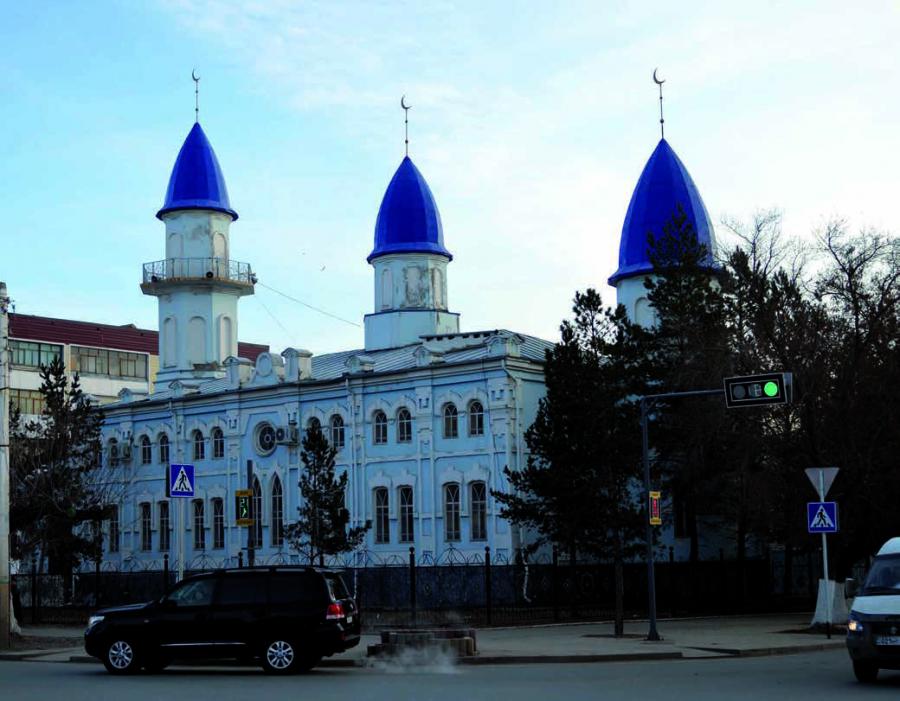
Located in Kostanay, 44, Al-Farabi Street.
The mosque is one of the oldest in the region. It was built at the end of the XIX century and is directly connected with the construction of the city itself. Since 1879, the city of Kostanay (formerly Novo-Nikolaevsk), which emerged on the banks of the Tobol River, was the center of manufacturing industry in the region and within five to six years became a connecting point of the region.
The construction of the mosque began to be considered by Muslim communities from the moment the city itself was founded. This initiative was taken by local Kazakhs, Tatars and Bashkirs engaged in trade. Prior to the construction of the mosque, there were no Muslim places of worship in the Torgay region where Muslims could pray. The rural ruler of Minaydar in Arakaragai volunteered to build a mosque in Kostanay, where wealthy Kazakhs, rich Tatar and Bashkir merchants were concentrated at that time. A huge number of questions arose before the organizers of the construction of the first mosque. How to build a mosque, according to what traditions, how much money is needed, where to buy construction materials and where to get masters? After the discussion of these questions at the general meeting of the Muslims of the Kostanay district decide to collect money and material donations for the construction of the mosque from each house where the Muslims live. Prosperous Kazakhs - poets Nurzhan, Karim, Esentai Hajji, Leker Hajji also contributed to the construction of the mosque.
Tatarian Abduali Yaushev, who was engaged in a large trade mission in Kostanay, offered the Kazakhs-Muslims: "Take the cattle collected from the people to Troitsk. And I will take responsibility for the construction of the mosque. The collected property and cattle were delivered to Troitsk. After Yaushev sold the cattle, the necessary materials for the construction of the mosque were purchased. Specialists, artists and masters from St. Petersburg were invited to create the ornamentation and decorations. Up to 1000 people participated in the construction of the mosque. Accommodation and meals for workers and invited artists were provided to the entire population of the village of Arakaragai.
In 1893, the construction of the mosque was completed. The mosque covers an area of 844.3 m2 and a building area of 5,550 m3. Until 1930, all Muslims of the city prayed in the mosque. Later, as a result of the anti-religious policy of the Soviet authorities, the mosque was turned into a club for workers in the city. During the Great Patriotic War in the building of the mosque there was an evacuation station. In the post-war years there was a cinema, in 1980-1991 there was a municipal philharmonic society.
On November 1, 1991 the mosque was returned to the population of the city. In the same year, during the celebration of Eid al-Ait, after 70 years of break, a prayer was read for the first time in the mosque. In 2002, the mosque was named after outstanding religious scientist Maral Ishaan Kurmanuly. Maral Ishaan was the main imam of Western Siberia and the organizer of the movement against the seizure of land from the Kazakh population for resettlement needs. In 1807, due to the intensification of the armed struggle against the tsarist colonial regime, Maral Ishaan supported his brother on the maternal side of Kenesary Kasymov, the leader of the national liberation movement. After the defeat in the liberation struggle, Maral Ishaan lived in Karmakshy district of Kyzylorda region. Maral ishan died in 1841 in the village of Akbalyk in Karmakshy district of Kyzylorda region. The mosque is also known as Akmeshit.