Information
- Location
- Karaganda Region, Karkaraly District
- Period
- 184 – 1853
- Type
- Mosque
- Kind
- Sacred objects, Buildings of monumental art
Sources
- Қазақстанның киелі орындарының географиясы: Табиғат, археология, этнография және діни сәулет өнері нысандарының тізілімі / Жалпы редакциясын басқарған ҚР ҰҒА академигі Байтанаев Б.Ә. – Алматы: Ә.Х. Марғұлан атындағы Археология институты, 2017. – 1-шығарылым. – 904 б.
Description
XIX century. It is located in Karkaralinsk, Kunanbai Kazhy street, 23 (Karagandy region).
Kunanbai Uskenbayev is the father of the great Abai. In the Soviet era, by virtue of the class approach in the field of social sciences, the image of Kunanbai combined all the negative features of the feudal lord, the exploiter, the unjust ruler. If Abai is a poet, enlightener, and a man who cares about his people, then Kunanbai is the exact opposite of him - so it was presented by the Soviet Abay scholars. Kunanbai now appeared quite differently. Having received the post of aga-sultan in 1849, he and his family moved to a small town.
There is a lot of evidence of noble deeds of Kunanbai. One of them is related to the construction of the mosque and madrassa where Kunanbai invested his own money. The maintenance of these establishments was paid by Kunanbai. In the tsarist period, small sums of money were allocated for these purposes. Education of Kazakh children, besides native schools, was carried out at the mosque, and therefore its opening was of great importance for the younger generation. One of the worthy deeds of Kunanbai related to the pilgrimage to Mecca was the construction of a hotel where Muslim pilgrims from their native country could move in freely. This was recorded on its front side next to the name of Kunanbai.
Thanks to the book "Diaries and letters from the journey through the Kazakh steppes" of the Polish exiled revolutionary Adolf Janushkevich, who was in the Kazakh steppes for a long time, the name became known far beyond Kazakhstan. In the book he gives a characteristic of Kunanbai, fundamentally different from the views on his personality of Soviet social scientists. He saw him as a true steppe prophet, a judge of incorruptible honesty and an exemplary Muslim. In addition, A. Yanushkevich points out that "Kunanbai has earned himself the glory of the prophet, to whom young and old, poor and rich people from the farthest villages rush for advice". The fact that Kunanbai Uskenbayev does not really resemble the described "bloodsucker of the common people" is confirmed by the memories of Turagul Kunanbayev, Arham Iskakov, and Akhat Kudaiberdiyev.
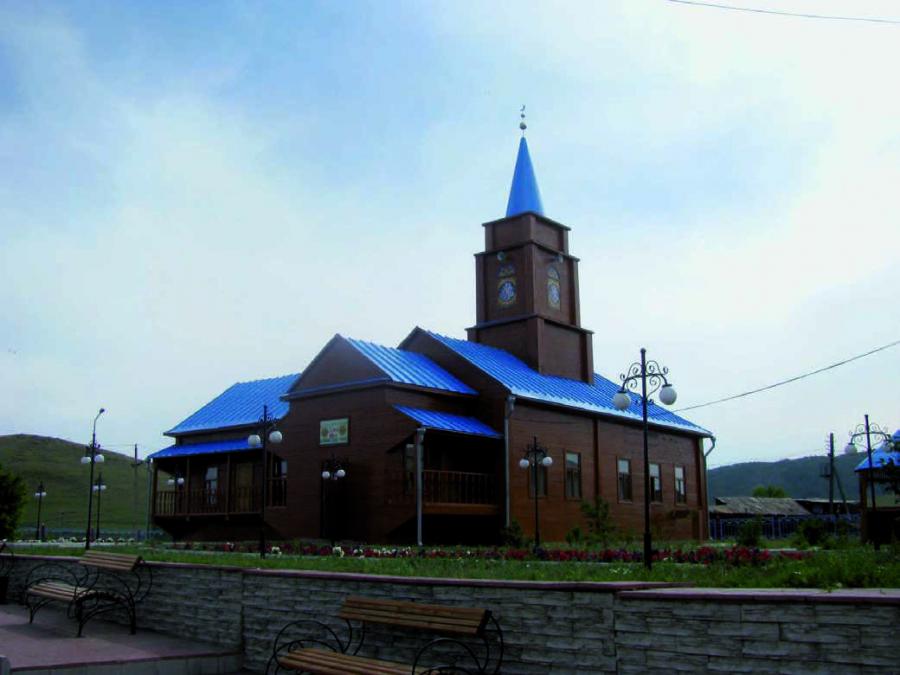
Kunanbay kazhy Mosque was built in 1849-1853. After completion of the construction for many years it became a place of gathering of Saryarka Muslims. It is a skilfully constructed wooden, two-storey building, although at that time only one-storey buildings were built. Dimensions according to the architectural plan: width 15 m, length 11 m, height 6 m. Kunanbay Uskenbayev Mosque is probably the most important attraction of the small town of Karkaralinsk, located in Karagandy region. It is one of the oldest Kazakh mosques in Kazakhstan. In addition to architectural importance, this monument has a high spiritual value for all connoisseurs of Kazakh culture.
Unfortunately, the mosque of Kunanbay Uskenbayev has not survived to this day in its original form. The minaret was barbarously destroyed during the Soviet era. The rest of the minaret was given to school, later to warehouses, and later abandoned. Such a policy was carried out in relation to other liturgical institutions in accordance with the plan of construction of a secular state. In the 1980s, the Kunanbai Mosque was rebuilt and given to believers.
The building is a local building. People come here for blessing.