Information
- Location
- Ақтөбе облысы, Ayteke Bi District
- Period
- 101 BCE – 400 BCE
- Type
- Сomplex
- Kind
- Archaeological sites
Sources
- Қазақстанның киелі орындарының географиясы: Табиғат, археология, этнография және діни сәулет өнері нысандарының тізілімі / Жалпы редакциясын басқарған ҚР ҰҒА академигі Байтанаев Б.Ә. – Алматы: Ә.Х. Марғұлан атындағы Археология институты, 2017. – 1-шығарылым. – 904 б.
Description
Located 10 km south-west of the village Taldyk (Aitekebi district, Aktobe region). The monument is located on an elevated plateau between the two right-bank tributaries of the Irgiz river - the Ulytaldyk and Ashchisai.
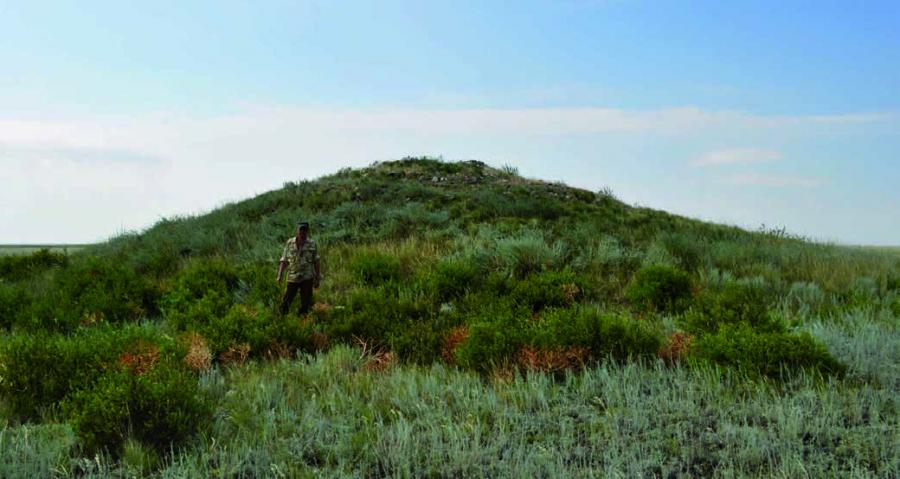
Zholkut is a complex of funerary and sacral structures, the largest in the eastern Mugalzhar region. There are various “sanctuaries” of the Gunno-Sarmatian time, which are various in layout. The complex consists of a large, with a pointed top “temple”, built of stones, and several groups of dumbbell-shaped, rectangular, and other in form funeral-and-cultural structures. Similar sanctuaries were explored in Aktobe and West Kazakhstan regions (Basshiyili, Lebedevka, Sarytau). The presence of a large cone-shaped structure, built of large boulders, as the main sacral object of the complex, is encountered for the first time. For such monuments of the Gunno-Sarmatian time, the location of the burial in one of the corners at the entrance to the rectangular "sanctuary" is typical. Accompanying inventory is often represented by bronze and iron bells, incense burners and other ritual objects. The area inside the buildings is covered with fragments of ceramics. All structures are ruined remains of complex religious buildings erected from large soil blocks.
For the first time, near the complex, studies were conducted on a group of Atpa monuments in 1986 under the guidance of S.Yu. Gutsalov, and in 2016, work was continued by A.A.Bisembayev. Excavations of a small kurgan in the southern part of the burial ground showed that it was built in the early Iron Age (the “Savromat” period). It is inherent in the western orientation of the dead, massive bronze arrowheads, bone spoon with slotted image. An interesting rite of burial. On the mainland surface, two small oval pits were traced, which at the bottom merged into one common. The dead was lowered into one of them and further placed along the entire length. Monuments of this appearance were left by the mixed Late Sarmatian population led by the Huns, during the period of consolidation, before the final migratory movement in the western direction to the Northern Black Sea coast. Late Sarmatian culture has so different features that it “drops out” of the general chrono-cultural scheme. First, the northern orientation of the buried begins to dominate. Secondly, the anthropological analysis of bone remains shows a sharp surge of Mongoloid. Thirdly, the volume of things of South Kazakhstan (Central Asian) origin is increasing. All the above aspects illustrate significant political events that took place in the eastern part of the steppes of Eurasia. The formation of the Hun state, then its collapse under the influence of Chinese diplomacy, generated under the influence of this state of migration, were reflected in the archaeological monuments of a territory remote from Mongolia - Western Kazakhstan.
The presence of imported things: "heraldic" buckles, chalcedony and nephrite disk tops of swords, jewelry, etc. in the burials of the region - an indicator of the established relations that migrated to the territory of Kazakhstan Hunnu (Hunnu) with China and the state of Kangju. An interesting archeological moment in the late Sarmatian burials, it has an anthropological expression. The burial monuments of this period are characterized by the presence of skulls with pronounced occipitometric deformation. The elite of society (Hunnish) brought a new fashion to the Western Kazakhstan region, a new "custom", a change in the shape of the skull associated with a tight bandage of baby heads near the forehead and the back of the head, and leading to the "stretching out" of the head, which is disproportionate from our point of view. This custom was then widely accepted by the local Sarmatian-Alanian population. At the same time, the movement of active groups from Central Asia at the turn of the centuries grouped the "cauldron" of new migrations, giving rise to a new hotbed of expansion to the west.
The funeral and cult constructions located in the complex, peculiarities of the funeral and memorial rite and ritual objects reflect the complex religious and worldviews of the ancient population of the region.
The Zholkut complex, located at the edge of the steppe zone, which has a similar landscape to the original territory of the Hunnish tribes of Ordos and the outskirts of Gobi, is one of the major funeral, cult and sacred centers left by the ancient nomads on the territory of Western Kazakhstan.
The Zholkut funeral and ritual complex is an archeological monument and is included in the lists of historical and cultural monuments of local importance.