Information
- Location
- Karaganda Region, Bukhar-Zhyrau District
- Period
- 1781 – 1993
- Type
- Mausoleum
- Kind
- Buildings of monumental art
Sources
- Қазақстанның киелі орындарының географиясы: Табиғат, археология, этнография және діни сәулет өнері нысандарының тізілімі / Жалпы редакциясын басқарған ҚР ҰҒА академигі Байтанаев Б.Ә. – Алматы: Ә.Х. Марғұлан атындағы Археология институты, 2017. – 1-шығарылым. – 904 б.
Description
Bukhar Zhyrau mausoleum is located at the foot of Dalba mountain, 25 km north of Shalkar village (Bukhar Zhyrau district, Karagandy region).
Bukhar Kalkamanuly (1693-1787, according to other data 1668-1781) is a well-known zhyrau. He was born and grew at the foot of Dalba city (now Bayanaul district, Pavlodar region). Bukhar originated from the Argyn tribe of the Middle Zhuz, and his ancestors belonged to the noble foremen and progenitors. Father Kalkaman was also known as a brave batyr. The name was given to him in the area where he was born (present-day Uzbekistan). People called Bukhar Zhyrau "Komekey aulie" ("Holy larynx"). Bukhar Zhyrau became an influential bi, an abyz, advisor to the khans Tauke and Abylai. Bukhar Zhyrau took part in drawing up the code of laws of Tauke khan "Zhety Zhargy" ("Seven cords"), as well as in the decision of state affairs. Zhyrau were not only zhyrshy, they were defenders of ordinary nomads. Bukhar Zhyrau stood out for his truthfulness and sincerity. After all, for a long time zhyrau listened attentively to the word of the people, consulted them on the most important issues of the people's life. Sometimes they were revered more than the Khans themselves, because the zhyrau, who possessed the gift of clairvoyance and prophecy, was considered to be the wisest, most propagating among their fellow tribesmen, possessing knowledge that was inaccessible to other mortals.
The prominent place in the history of Kazakh literature belongs to Bukhar Zhyrau. He created many songs-thoughts expressing the idea of preservation and strengthening of independence. One of the core themes of Bukhar Zhyrau's works is love for the Motherland and patriotism. In his poems he praised Khan Abylai as a progressive statesman. Both dreamed of uniting numerous Kazakh tribes into one strong state. We see in many tolgaus of the poet, the main ideologist of the Kazakh khanate, devoted to Abylai khan, sincere civil feelings, deep love to the Motherland and grief for its destiny in years of hard trials. Being the person of proud and independent manners, he, as the adviser of khan, aspired actively to influence Abylai's policy, courageously expressing the thoughts. The content of the lines reveals the activity of Abylai Khan, who, according to Zhyrau, became the ruler on the golden throne, uniting three zhuzes. He helped orphans and widows without harming anybody, ruled fairly and wisely.
...Khan Abylai atandyng,
Dunieden shykpai esh mining,
Altyn taktyng ustinde
Ush zhuzding basyn kuradyng,
Zhetim menen zhesirge
Eshbir zhaman kylmadyng.
Adildikpen zhurding sen,
Adepti iske kirding sen...
In the poem "Sabalak" Bukhar Zhyrau described the celebration of the proclamation of Abylai as a khan. Bukhar saw the purpose, mission of Abylai Khan. The social and political prestige of Bukhar Zhyrau was high. He accompanied Abylai everywhere, visited all neighboring regions bordering on Kazakh zhuzes. Good knowledge of languages of different groups of Turkic peoples, as well as Arabic, Persian, Oirat (Dzungarian) and Chinese contributed to the blossoming of his work. Abylai valued not only oratory eloquence and good knowledge of "customary law", but also diplomatic abilities and reverential respect of the people to him.
One of the core themes of Bukhar Zhyrau's compositions is love for the Motherland, patriotism. Bukhar Zhyrau was recognized as the best singer not only of the "blue blood" but also of the commoners. He glorified Bogenbay, Kabanbay, Zhanibek, Olzhabai and other batyrs in bright historical epics. They reflected the heroic struggle of Kazakhs against the Dzungarian conquerors. Bogenbay Batyr, the leader in the fight against dzungars, honored his friendship with Bukhar Zhyrau. Bukhar was not a simple, albeit highly talented, event recorder. He interpreted, analyzed and generalized them. The main idea of the great zhyrau was always the idea of uniting people. It was thanks to him that the great singer inspired the Kazakhs to win in the past, now and in the future they will win their victories. He dreamed of an independent and strong Kazakh state.
His poems contain philosophical reasoning about the essence of life. Philosophical understanding of life, aspiration for knowledge of Bukhar Zhyrau are reflected in his work. Thousand years of nomadic culture, history and philosophy have left a mark on the themes of tolgau, which raised topical issues of moral and ethical nature.
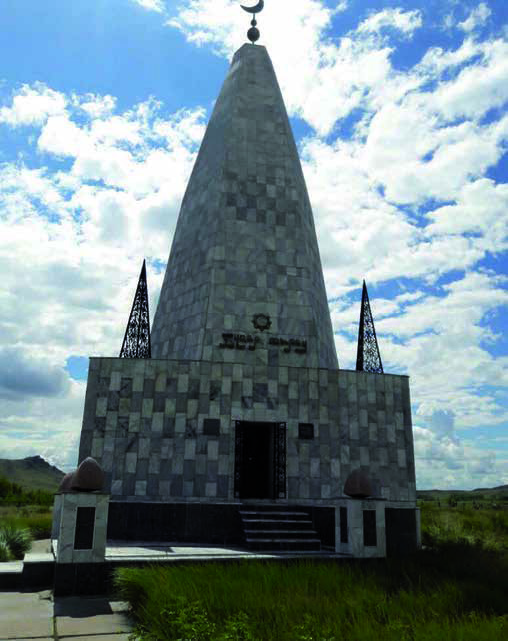
Famous Kazakh thinker, historian, ethnographer, collector of oral folk art Mashkhur-Zhusup Kopeyuly recorded the collected works of Bukhar Zhyrau, united them and handed them over to the manuscript fund. He found the grave of zhyrau and was the first to place a sign over the tombstone. In 1993, the 325th anniversary of the birth of Bukhar Zhyrau was solemnly celebrated, and a mausoleum was erected on the site of the burial, the author of which is the architect A. Saumenov. The height of the mausoleum reaches 12 m. The base is in the form of an equilateral triangle on which three pyramids rise. They symbolize three Kazakh zhuzes (Elder, Middle and Junior). The main pyramid is crowned by the golden crescent, a symbol of Islamic religion that adorns many mausoleums of Kazakhstan. The mausoleum itself resembles a men's headdress. Inside and outside it is lined with white marble.
The works of the folk sage have only now become the subject of fundamental research. Legacy of great zhyrau cannot be comprehensively estimated, as much is dispersed on archival funds. The material available to a wide range of readers is just particles of the poet's works. At present, the arsenal of specialists includes not only scattered data, but also texts of 36 tolgaus found by historian Mukhtarkhan Orazbayuly in Beijing in the Huangshish Palace, in the repository of the Manchurian kingdom. They were first published by literary critic A. Seidimbekov in the newspaper "Ana Tili" in 1990. This material presents a unique opportunity to touch a part of the literary heritage of a wonderful man, a phenomenal zhyrau, to whom such authorities as Sh.Sh. Ualikhanov, G.N. Potanin and our contemporary M.-Zh. Kopeyuly paid tribute and respect. Mukhtar Auezov and Saken Seifullin contributed to the preservation of poetic tolgaus, legends and aphorisms of the storyteller in time.
At present, the mausoleum of Bukhar Zhyrau is a sacred place associated with a historical personality.
The object is an architectural monument of local importance.