Information
- Location
- Ақтөбе облысы, Shalkar District
- Period
- 1850 – 2022
- Type
- Сomplex
- Kind
- Ensembles and complexes
- Authors
- Ажигали Серик Ескендирулы
Sources
- Қазақстанның киелі орындарының географиясы: Табиғат, археология, этнография және діни сәулет өнері нысандарының тізілімі / Жалпы редакциясын басқарған ҚР ҰҒА академигі Байтанаев Б.Ә. – Алматы: Ә.Х. Марғұлан атындағы Археология институты, 2017. – 1-шығарылым. – 904 б.
Description
1993. It is located 72 km south-south-west from Shalkar, 8.5 km west-south-west from the village of Baykadam (Shalkar district, Aktobe region). Beyit is located in the middle part of the sands of Uly Borsykkum, in the area of Sholakzhide.
The monument is a family beyit of a famous Kazakh batyr from the Shektyfamily Yeset Kotebaruly, which appeared to have been formed in the second half of the XIX century. At the end of this century, he and his younger brother Daribay were buried here, and original mausoleums were erected over their graves. As a result, beyit was called Eset - Daribay. The monument over the burial of Batyr Yeset was built by the folk architect Koshik Espenbetuly. In the early 1990s, a new memorial complex was created on the site of the old mausoleums.
Eset Kotebaruly (Kөtіbaruly) is one of the most famous Kazakh batyrs of the XIX century (1803–1889; according to other data, 1807–1888), the eldest son of Batyr Kotebar Basendeuly from the family of Shekty, Kabak subdivision. Already in the 30s of the XIX century, he emerged as one of the leaders of the national liberation movement of the Kazakhs: in 1838, together with the batyr Zholaman, he led an armed uprising against the punitive expeditions of the tsarist forces; since 1847 he was one of the struggle leaders of the Kazakhs of the Aral Sea region and the valleys of the Syrdarya against Kokand rule and Khiva. For many years, Eset Batyr led the armed struggle against tsarist colonization — the uprising under his leadership gained special strength in 1855-1858, when he led a detachment of 1,500 soldiers from the Kazakh clans Shekty, as well as Tabyn and Adai. Several punitive expeditions were sent against Eset and the civilian population. Due to the obvious inequality of forces and senseless victims, Eset batyr was forced to stop the armed struggle. In 1859 he took part in the Kazakh deputation to Tsar Alexander II. He was a prominent bi of his family, the father of the Shekty division - Kabak; in 1869, he was formally appointed assistant chief of the Irgiz district. The figure of the remarkable batyr, his rebellious spirit, the heroic physique repeatedly attracted the attention of Russian contemporaries, his military opponents, travelers. In particular, researcher K.K. von Schulz wrote: "Batyr Iset-Kutebarov is a kind of Shamil of the steppe, - because only after a 20-year struggle, from 1838 to 1858, he submitted to our power. ” The image of Batyr Eset was reflected in the Kazakh national epic (“Ayman - Sholpan”).
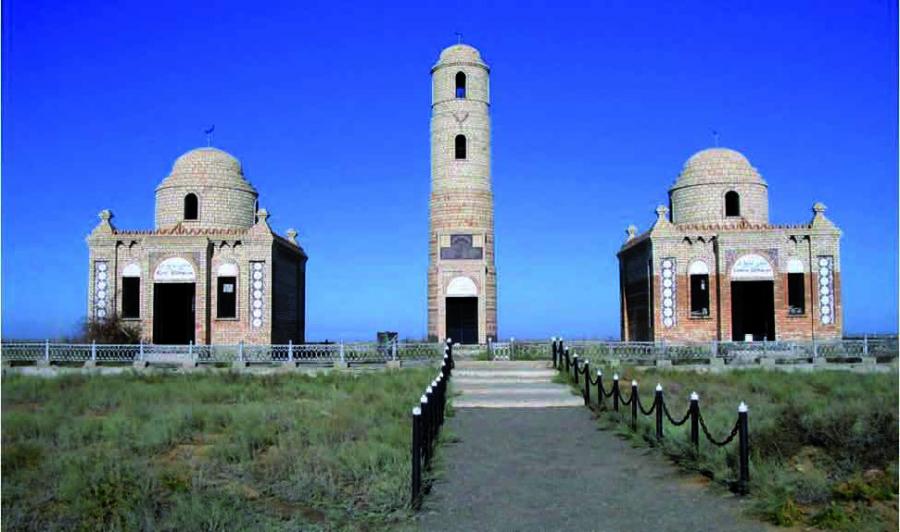
In 1944, the mausoleums of Eset and Daribay Kotebaruly were first surveyed by the Aktyubinsk department of the Office of Architectural Affairs of the Kazakh SSR (under the supervision of T.K. Basenov) and a restoration project was prepared (authors: T. Basenov, G. Kan, S. Ugryumov), which however, it was not implemented. In 1979, the monuments were explored by the expedition of the RSNRPM "Kazrestoration" (led by S. Azhigali). Already at that time they were in emergency condition, especially the Eset mausoleum, but the necessary conservation and restoration work on the monuments was not carried out. In 1993, Beyit Eset-Daribay, on the initiative of local authorities and the population, was landscaped, and new monuments made of silicate brick were erected on the site of the old mausoleums.
The memorial complex has an important scientific, historical, cultural and social significance. The original (and now lost) mausoleums of Eset and Daribay Kotebaruly and their fixation, carried out by early studies, in historical and architectural terms have not lost their value as original samples of the national architecture of the Kazakhs. At the same time, the modern memorial complex retains a special significance as a monument of history and culture associated with the activities of prominent personalities and the history of the national liberation movement of the Kazakh people. Beyit Eset - Daribay has long been popular with the population of Shalkar and the surrounding areas, is an important object of cultural tourism, pilgrimage and "sacred geography" of the North Aral subregion.
Initially, the monuments of Eset and Daribay Kotebaruly were four-domed sub-square in terms of multi-chamber mausoleums of two close architectural subtypes: “with walls partitions” and “cross-shaped pylons”. Constructions oriented by the entrances to the south, in the plan, measured 6.80 × 6.80 and 8.50 × 9.00 m; they were erected mainly from raw and partially burnt bricks. Since the post-war time, mausoleums have undergone quite serious destructions and losses, but nevertheless retained their basic compositional planning features. Relatively better preservation at the time of the survey of the late 1970s was the mausoleum of Daribay, the highest remaining height of about 5.0 m.
The modern memorial complex consists of two new identical dome mausoleums (7 × 7 m in plan, 8 m height) erected from silicate and burnt bricks, between which there is a high observation tower of the minaret type (height 16 m). On the east side of the monuments arranged rectangular openings. In the interiors, the walls and floor of the mausoleums are lined with marble slabs. The tombstones of Eset and Daribai are decorated in the form of low rectangular "Sagana", covered with cloth. The entire complex along the perimeter is surrounded by a cast-iron fence with an approach-path on the east side. The caretaker’s house is located nearby.