Information
- Location
- Ақтөбе облысы, Bayganin District
- Period
- 1750 – 1950
- Category
- Historical and cultural monuments of republican significance
- Type
- Necropolis
- Kind
- Archaeological sites
- Authors
- Ажигали Серик Ескендирулы
Sources
- Қазақстанның киелі орындарының географиясы: Табиғат, археология, этнография және діни сәулет өнері нысандарының тізілімі / Жалпы редакциясын басқарған ҚР ҰҒА академигі Байтанаев Б.Ә. – Алматы: Ә.Х. Марғұлан атындағы Археология институты, 2017. – 1-шығарылым. – 904 б.
Description
The monument is located 41 km south-west of the Zharkamys village, in the left-bank mountainous part of the Emba valley (Baygani district, Aktobe region).
The eponym of the cemetery is Batyr Daumshar (1770–1810) from the Kazakh clan Adai, a unit of kyrykmyltyk (esekei) - the son of batyr Kuttykadam Tikenekuly (1705–1798), who at one time took an active part in the fight against Kalmyks. The life and activity of Daumshar is connected with Ustyurt, the valleys of the Emba and Sagyz, where seasonal movements of its kind were located. Despite the fact that there is little documentary information about him, people remembered Daumshar as a staunch, decisive person, a fighter for the territorial independence of the Kazakhs of the Younger Zhuz. An outstanding representative of the early Kazakh intellectuals, Khalel Dosmukhameduly, put him on a par with such large batyrs as Atakozy, Syuyunkara, Oten, Narynbai, Kulbarak, Zhaparberdy, Mynbai, Koktabai and others. According to popular legend,(recorded according to M. Tanbaev, born in 1929, resident of Zharkamys village) Batyr Daumshar, who did not recognize any claims to the Kazakh lands, died during the battle with the expedition detachment (according to one version - English, according to another - Russian) , conducting research on the left bank of the Emba in the early XIX century (1810). Many participants in the battle from both sides were killed, including Daumshar’s son-in-law, Batyr Kudabai, who did not wish to take part in a clearly unequal battle and was shot by him. All the dead were buried here (Kudabai - somewhat in the distance, the British - in the valley); the area and the main cemetery were named Daumshar. A modest mazar and kulpytas were installed above the grave of a batyr, which depicts a weapon and a horse — symbols of a free steppe man. Daumshar's father, Kuttykadam Batyr, is buried on Ustyurt, 25 km south-east of the famous Beleuli caravan-sarai.
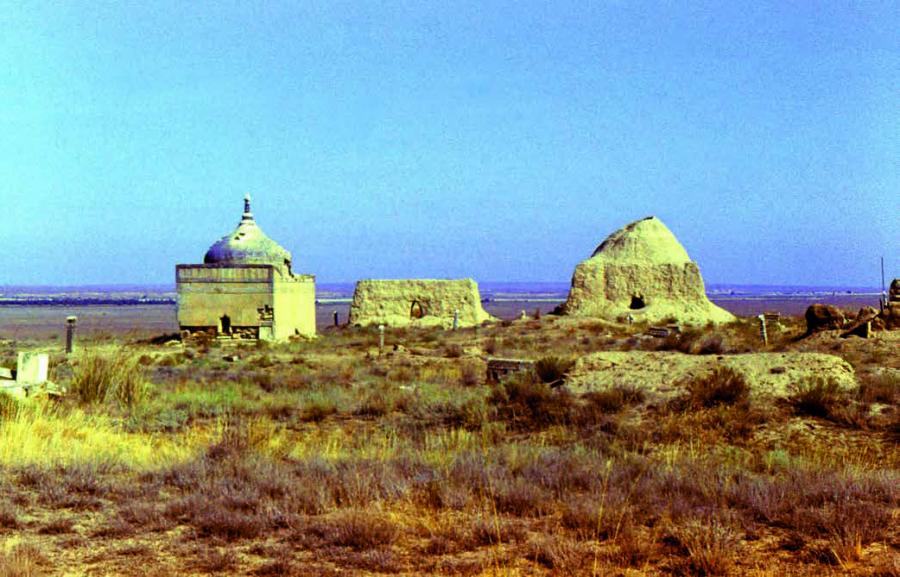
The memorial complex, located at the edge of the cliff of the Emba coast, is a rather compact old cemetery (beyit) with an area of 125 × 150 m and has more than 200 monuments. To the south-west of it are two more little beyits (one of them is Kudabaimola). The initial Mazar of Daumshar in the form of a semi-mausoleum – semi-fence was composed of raw and partially burnt bricks. At the western wall there are two kulpytases: an old, archaic red solid sandstone and a new concrete one, on which the years of life are indicated: 1770–1810 (now a large mausoleum fence is installed).
The most prominent monuments of the necropolis are the three mausoleums of sawn-off blocks with helmet domes, among which is the famous Myrza Muryn mausoleum. The monument was built in 1881–1882 (1299's), apparently by the national architect Dauletniyaz. All mausoleums are rectangular in plan, have a pronounced southern facade (parapet, through the aperture). Characterized by bright painting of ornaments in the interiors. Of considerable interest are also four raw mausoleums of the necropolis of the second half of the XIX century - dome-centered buildings, which characterize different variants of Kazakh mausoleums of the “uitam” type. There are also various types of architectural fencing - the saganatams of the complex, which are composed of sawn sandstone blocks. For most of them, surface coatings are characterized by contour décor with ornamental painting, in rare cases: flat-relief décor.
Among the small forms of the gravestone architecture on Daumshar, gravestones of the type “koitas” should be especially emphasized, among which monuments with figured edging: “legs” are especially popular. Separate archaic samples of gravestones and coarse stelae are also interesting. Judging by the epigraphy and tamga on the monuments, this is predominantly ancestral cemetery of the Adai units of the kyrykmyltyk; tombs of Kazakhs of the Shomyshty – Tabyn family are also less common.
The Daumshar necropolis has long been revered by the Kazakh population of the Baiganin district and adjacent territories, known as an extraordinary ensemble of monuments of folk architecture and monumental stone-cutting art. It has the status of a monument of architecture of republican significance; it is also important as an object related to the history of the struggle of the Kazakh people for independence. In recent years, there was carried out repair and restoration work at a number of monuments.