Information
- Location
- East Kazakhstan Region, Abay District
- Period
- 501 – 800
- Type
- Сomplex
- Kind
- Archaeological sites
- Authors
- Оралбай Ерден Қуанышбекұлы
Sources
- Қазақстанның киелі орындарының географиясы: Табиғат, археология, этнография және діни сәулет өнері нысандарының тізілімі / Жалпы редакциясын басқарған ҚР ҰҒА академигі Байтанаев Б.Ә. – Алматы: Ә.Х. Марғұлан атындағы Археология институты, 2017. – 1-шығарылым. – 904 б.
Description
The monument is located 30 km south of the village of Karaul, near Lake Sarykol (Abai district, East Kazakhstan region).
The first information about the study of the area is found in the records of the local historian V. Nikitin in 1896. In 1947, an ethnographic expedition led by L.K. Nifontova carried out research on barrows of the Bronze Age in the vicinity of Lake Sarykol; in 1948, archaeologist S.S. Chernikov conducted exploration work. As a result, four burial grounds were registered, including a remarkable burial complex near the Tekebulak River, consisting of 36 burial mounds with stone slabs. These barrows date back to the spread of the Andronov culture. Later, in 1999-2002, archaeologists from Al-Farabi Kazakh National University A.T. Toleubayev and G.K. Omarov conducted research. As a result, a large barrow was excavated and a stone processing workshop was found nearby.
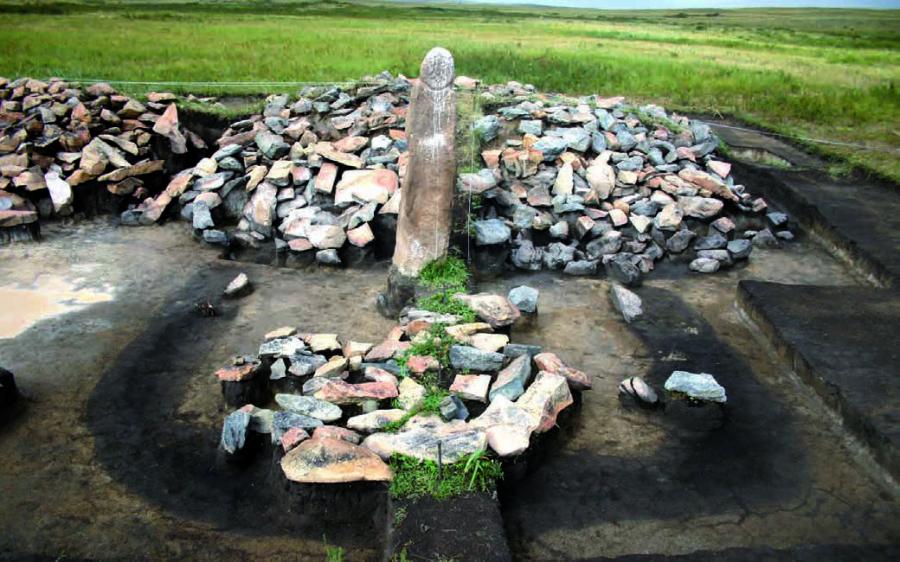
In 2006, an archeological expedition led by A. Isin discovered an archeological complex consisting of three large barrows with a huge stele in the Sarykol settlement of the Shyngystau tract. The expedition's work resulted in the discovery of household items and jewelry made of bronze, iron and gold. One of the brightest finds of the archaeological expedition was the "Golden treasure", presumably from the Turkic period.
Taking into account all characteristic features, the Sarykol complex in Shyngystau is attributed to the ancient Turkic period, i.e. to the VI-VIII centuries. Here barrows with burial of people accompanied by horses, rounded or rectangular traditional fences, stone sculptures were found. The walls of the fences were made of selected even slabs, often installed in several rows. Stone sculptures were usually located on the eastern side of the fence. Apparently, the fencing was constructed in the course of funeral and memorial cycle rituals. The value of stone sculptures lies in the fact that they can be used to judge the appearance of ancient Turks, including facial features, hair and weapons. Ancient Turks, performing memorial ceremonies, left meat, dairy products and horse equipment in small holes in the fencing with statues. Burial of objects separately, in caches, is largely associated with the rite of cremation of the Turks.
The interval between the sculpture and the cremation site was 4-5 m. This free space at that time probably served as a sacred place where shamans or priests performed their rites. This is evidenced, for example, by a red agate necklace and silver plaques decorated with inflorescence petals on the edges, which may be items of shaman's attire. Ancient Turks considered the fire sacred. It is known that the ritual of burning the dead is directly related to the cult of fire. With the belief that fire cleanses the departed into the afterlife from the sins committed by him during his lifetime, he was burned. The purified, sinless soul rises into the sky. These ideas about the power of fire were so developed in the ancient Turks that later, with the advent of Islam, their elements were preserved in the folk environment. It should be noted here that the beliefs associated with fire in the Kazakhs have been preserved until the New Times. The cult of fire originates in the culture of Saks and ancient Turks.
In 2007-2008 within the framework of the state program "Cultural Heritage" in the vicinity of Lake Sarykol within a radius of 20-25 km, exploration was carried out, as a result of which a large number of monuments and funerary complexes dating back to various cultural and chronological periods, including the Bronze Age, the early Iron Age, ancient Turkic and Kimak-Kipchak periods were discovered. In total, more than 20 Turkic stone sculptures have been discovered in the Abai district.
Sarykol is a monument of local importance in the East Kazakhstan region. Sacred place for many generations of nomads, ancient sanctuaries, where rituals of veneration of ancestors, worship of the Eternal Sky were performed. The original natural and cultural landscape with organically inscribed monuments has been preserved here. In the context of the revival of spirituality, customs and traditions of the people, the historical and cultural heritage of our ancestors acquires great significance. People often come here to worship the spirits of their ancestors.