Information
- Location
- East Kazakhstan Region, Katonkaragay District
- Period
- 850 BCE – 501 BCE
- Type
- Сomplex
- Kind
- Archaeological sites
Sources
- Қазақстанның киелі орындарының географиясы: Табиғат, археология, этнография және діни сәулет өнері нысандарының тізілімі / Жалпы редакциясын басқарған ҚР ҰҒА академигі Байтанаев Б.Ә. – Алматы: Ә.Х. Марғұлан атындағы Археология институты, 2017. – 1-шығарылым. – 904 б.
Description
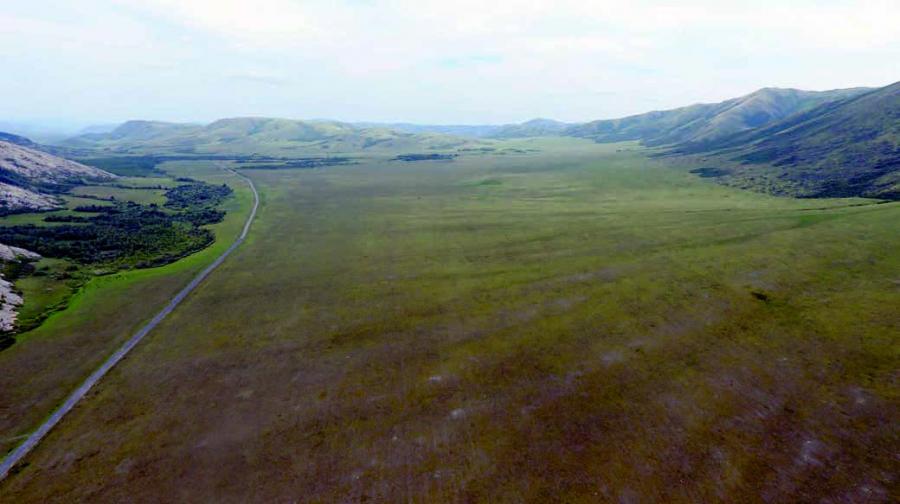
Mayemer Valley with archeological monuments is located in the upper Naryn River (Katon-Karagai district, East Kazakhstan region).
The name of the valley gave the name to the Mayemerian (Mayemirian) culture, in the territory of which the monuments of the early Saxon period were found and investigated. The early stage of the Saka era is a significant period when global changes took place in the life of the population, marked by the transition to a mobile way of life, when the main elements of nomadic culture were formed, ethical ideals were developed, etc. The study of monuments of Mayemerian culture on the territory of Kazakhstan is connected with the names of V.V. Radlova and A.V. Adrianova. A.V. Adrianov excavated two northern barrows at the mouth of the Mayemer River, a tributary of the Narym River, in a group of five barrows, as well as barrows near Solonechnyi Belok. In 1911, the barrows of the Narym River were built in a group of five burial mounds, as well as barrows near Solonechnyi Belok. A.V. Adrianov studied 14 barrows in West Altai.
Maiemer barrows, despite their common features, differ from those of the neighboring Tasmola and Biikensk cultures. In general, the Mayemerian culture is accepted for the designation of monuments of the early Scythian time in the north-western foothills of the Altai and the adjacent territory of Eastern Kazakhstan. Researchers, based on the peculiarities of the funeral design, combine into one group the monuments of Mayemer and Shilikty (S.S. Chernikov, L.S. Marsadolov).
In the burial ground located in the valley of the Bukhtarma River, there are many groups of barrows located in parallel chains. The famous "Mayemir Treasure" was discovered by A.V. Adrianov in 380 m to SW from the barrow No. 2. Under the boulder of the fence, consisting of seven stones, were folded compact objects, including a beehive with curved ends, stamped gold plates with the image of a coagulated cat's predator, a bronze, gold-coated plaque with the head of a bird of prey, etc. Pictorial objects are an organic part of the Early Saxon complex, the image of a "coagulated predator", "panthers" - a marking element, it is found throughout the Great Steppe. The analysis of materials of barrows from the Mayemerian steppe shows the variability of the funeral rite. This is explained by the invasion, the mixture of carriers of different traditions, the multi-ethnic nature of the components of culture.
In 1997, a joint archeological expedition of the Institute of Archaeology named after A.Kh. Margulan MS-AS of RK, the State Hermitage Museum and Al-Farabi KazNU with the participation of experts from KemSU and the group of the National Center for Scientific Research of France conducted research of archeological monuments in the Katon-Karagai and Bolshenarym districts of East Kazakhstan region at the junction of the territory of Kazakhstan, Russia, China and Mongolia* [*Read more about the composition of the expedition, see publications. - Note of the author]. The main purpose of the expedition was to study the monuments of the I millennium B.C. on the territory of the East Kazakhstan region. Field archaeological research was carried out in the upper reaches of the Bukhtarma River at the Mayemer-II and III burial grounds. At the top of the largest barrow was fixed "deer" stone. There are images on it: cone-shaped earrings, a belt with coinage and bow in quiver.
In one of the burial mounds (Mayemer II, No. 2) with stone rings along the perimeter and around the tomb pit, a woman's grave was found buried in undercut. The buried woman, as defined by E.V. Veselovskaya, is presumably 35-40 years old. The warrior was accompanied by a complex of objects: bone buckles of quiver, six bronze and one bone arrowheads. Bronze arrowheads - bushheaded, two-bladed, asymmetric-rhombic and rhombic - define the monument as the initial stage of the "Scythian-Saka" epoch, VIII- VII centuries BC. In another barrow (No. 3) a trapezoidal box was discovered. At the bottom of the box along the southern slab, the horse's front limbs were cleared. It is probably a memorial structure.
In 2009, at the Mayemer burial ground, the staff of the EKAE of the Institute of Archaeology named after A. Kh. Margulan continued researching burial mounds with interesting ground structures. At barrow No. 1 (40 m in diameter and 3 m high), the ground structure was based on a truncated pyramid of stone and wood on a platform of very dense clay soil. The ground stone construction on the bottom was faced with large boulders, pieces of turf, clay blocks were used. The whole structure was fortified with a layer of sandy loam and gravel on top. A stele was found in the upper part of the barrow in the centre. On the eastern side of the barrow, a dromos was recorded. The funerary structure is a box placed at the level of the ancient day surface. Around the ground structure there was a stone ring-fence. The findings included a yellow metal earring, carnelian beads, turquoise beads, kauri shells, etc.
A stele was also found in burial mound No. 2 (diameter 16.0 m, height 0.6 m) above the pit. In the grave pit, a human burial undercut was found. A deck hollowed out of a tree trunk was located under the powerful slabs laid across the grave pit. The burial was very disturbing. Human burial was separated by stones from the burial of animals - horses, small cattle and dogs. The horse was bridled.
In general, the Mayemerian culture is characterized by barrows with dromoses, burials in deep narrow pits and at the mainland level, burials in undercuts in deep pits stretched out, head in the north direction, in large stone boxes. A horse with a harness and a carcass of small cattle were laid in parallel with the dead or in the legs. Animals could be buried in a separate pit.
Currently, the Arzhan-Mayemerian time is considered within the limits of the end of the IX - 2-3rd quarter of the VI century BC.
The valley saturated with early nomadic monuments, including early Saka times, was a sacred territory for the population of the I millennium BC. Here were the graves of their ancestors. Barrows are temples that rise above a plain surrounded by majestic ridges, dazzling peaks close to God, to the eternal Sky. The pyramidal form of constructions, revealed in the monument, is undoubtedly dictated by worldviews.
Mayemerian steppe is a unique place in the Kazakh Altai, where the monuments of nomadic peoples, who lived here for several millennia, are concentrated. In addition, there are rock paintings with reference samples of the art of Scythian-Siberian animal style and nomads of the Turkic time.
Through the valley passes the road from Ust-Kamenogorsk to the depths of the Altai on the famous complex Berel and further to the Rakhmanovskie klyuchi, where lay the routes of tourists and travelers.