Information
- Location
- East Kazakhstan Region, Ayagoz District
- Period
- 901 – 1100
- Category
- Historical and cultural monuments of republican significance
- Type
- Mausoleum
- Kind
- Buildings of monumental art
- Authors
- Сатенова Марал Ратаевна
Sources
- Қазақстанның киелі орындарының географиясы: Табиғат, археология, этнография және діни сәулет өнері нысандарының тізілімі / Жалпы редакциясын басқарған ҚР ҰҒА академигі Байтанаев Б.Ә. – Алматы: Ә.Х. Марғұлан атындағы Археология институты, 2017. – 1-шығарылым. – 904 б.
Description
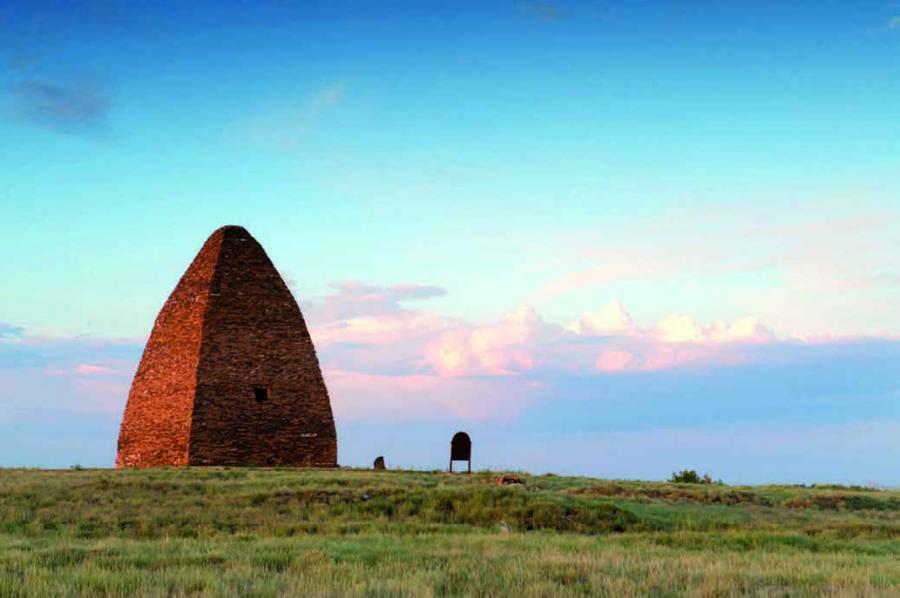
It is located 6 km south-west of the station Tansyk (Ayagoz district, East Kazakhstan region).
According to legend, the history of the mausoleum's origin is connected with the names of the heroes of the well-known folk epos "Kozy Korpesh and Bayan Sulu". The tale tells the sad story of love between the Batyr Kozy Korpesh and the beautiful Bayan, engaged in early childhood, but separated by a number of circumstances. Having grown up, the brave man Kozy Korpesh meets the beauty Bayan, but Kodar rises between the lovers, who treacherously kills a Batyr. As legend has it, Bayan Sulu avenged Kodar for the death of her beloved and then lost her life.
Originally, A. Kh. Margulan indicated that the mausoleum was built in the V-X centuries. Later, on the basis of research of the archaeological expedition's materials (1952) and the study of the text of the folk epos, the scientist dates back to the creation of the monument of the X-XI centuries. The Mausoleum of Kozy Korpesh and Bayan Sulu was visited by V.B. Bronevsky, P. Semenov-Tien Shansky, V. Radlov, N.N. Pantusov and other researchers in different years. In autumn 1856 the mausoleum was visited by Sh. Valikhanov, thanks to whom the earliest images of the monument and stone sculptures standing inside the building have reached us. According to legend, the figures depicted Kozy Korpesh, Bayan Sulu, her sister and aunt. In 1917, on behalf of G.N. Potanin, the monument was examined by A.N. Beloslyudov during his expedition near Lake Balkhash. In a letter dated January 9, 1918 A.N. Beloslyudov wrote to G.N. Potanin: "At the monument to Kozu-Kurpech was twice. There are no more stone women... two women from the monument were taken to Germany".
During the XX century the monument was subjected to a number of alterations, even before the revolution of 1917 the upper part of the building was shot down with an artillery shell. In 1970, students of the Semipalatinsk Medical Institute's construction team repositioned the top of the building on their own initiative and set up a tin crescent above it. Then they replaced the inner plaster and whitewashed it. The walls were decorated with ornaments and "decorated" with oil paints, they depict Kozy Korpesh and Bayan Sulu, two riders with torches. In addition, students installed two false sarcophagi in the burial chamber of the building, although the results of excavations carried out by anthropologist N.J. Shayakhmetov showed that there were no burials inside the building.
The Kozy Korpesh - Bayan Sulu monument is a one-chamber, square building in plan with the size of 7.6 x 7.6 m, crowned with a high conical dome. The transition from square to cone is made by a gradually tapering step-by-step masonry of limestone. The construction is typical for the construction art of ancient Kazakhstan before the Islamic period. According to researchers, the monument to Kozy Korpesh and Bayan Sulu was not a traditional tombstone. Probably, it represented a memorial construction of the type of ancient Turkic temples. According to the content of the epos, Kozy Korpesh was the son of a khan. And, as scientists assume, it could be related to the Kimak Kaganate, which existed on the territory of Kazakhstan in IX-XI centuries. This is suggested by the words "eleven people" - 11 people headed by the son of a vizier go to ask Bayan Sulu for a wife to Kozy Korpesh. In the medieval history of Kazakhstan only Kimak Kaganate consisted of 11 parts and was a strong state with developed crafts, cities and settlements, runic writing. The cult of ancestors was also of great importance in the culture of Kimaks.
Mausoleum of Kozy Korpesh - Bayan Sulu belongs to the number of unique monuments of monumental art, belonging to the medieval period of history of Kazakhstan. People's epos about immortal history of love of Kozy Korpesh and Bayan Sulu is estimated by researchers of the Central Asia as eternal and majestic product of the human spirit leaving in the infinite creative future. Many of them, including academician A. Kh. Margulan, believed that the epos "Kozy Korpesh - Bayan Sulu" is the oldest and most powerful variant of Kazakh epic creation.