Information
- Location
- East Kazakhstan Region, Katonkaragay District
- Period
- 701 – 900
- Type
- Necropolis
- Kind
- Archaeological sites
Sources
- Қазақстанның киелі орындарының географиясы: Табиғат, археология, этнография және діни сәулет өнері нысандарының тізілімі / Жалпы редакциясын басқарған ҚР ҰҒА академигі Байтанаев Б.Ә. – Алматы: Ә.Х. Марғұлан атындағы Археология институты, 2017. – 1-шығарылым. – 904 б.
Description
In a valley of the river Karakaba at height of 1 750 m above sea level some barrow groups consisting basically of funeral monuments of early Iron Age with the attached barrows of ancient Turks are fixed.
The monument was unveiled and researched by the East Kazakhstan Archaeological Expedition under the leadership of Z. Samashev.
In 2006, preliminary reconnaissance work was carried out in the valley with the participation of specialists from the University of Ghent (Belgium), as a result of which it turned out that the barrows of the early Iron Age form a chain along the north-south line with a slight deviation, and the monuments of Turkic time adjoin them from the eastern and western sides. Most of the monuments have not been visually identified yet, which is due to the strong suspension and flatness of the embankments. On average, the diameter of Turkic barrows is 10 m, the objects of the early nomadic epoch reach the size of about 17-18 m, and single ones - a little more.
In the period of 2012-2015, more than 20 funerary and memorial monuments were studied, eight of which are dated back to the early Iron Age, while the rest belong to the early Turkic period. In one of the barrows of the final stage of the early Iron Age, a ceramic boiler with bone remains of parts of a ram's carcass was found, as well as accompanying food.
Unique materials were obtained during the study of monuments of the Turkic time. Funerary structures were rectangular or oval stone fences. The bodies of the dead were at the cist, they were located in an elongated position, oriented with their heads to the east. Accompanying burials of one or two horses are fixed, which are oriented in the opposite direction to the man. The presence in men's burials of the richest accompanying equipment testifies to the high social status of the dead.
The main number of items are armaments: sabres, arrows in quivers, bows. On the surface of one of the sabers there are unique images, where there are plots with horses, made in medieval animal style. Horse harness, quivers are richly decorated with plaques of silver and gilt, bronze. All found objects were restored in the laboratory "Ostrov Krym" under the leadership of K. Altynbekov.
In the presence of such a rich military equipment is very restrained costume design. The accessories that complement their appearance include small silver or bronze earrings in the form of rings. On the face of the dead, discovered during the study of the barrow No. 9, recorded mask of a thin silver plate. Thanks to the work of restorers, it was possible to preserve large fragments of silk clothing. A unique cape made of thin felt, trimmed with silk on both sides, was rescued from the devastating impact of time. It was in a crumpled condition in the burial of a man from burial mound No. 4. It should be noted that similar capes made of thin white felt - kebenek - are part of the Kazakh traditional men's suit, which indicates the extreme stability of the most important components of the steppe material culture.
Extraordinary is the detection of three different musical instruments, their inclusion in the funeral equipment indicates the special status of the owners of these items. The instruments are made of wood and are bowed, usually they are referred to the attributes of a shaman. However in tombs there are no other signs of such activity of dead people. In this case, it is possible to assume that they were not servants of a cult, but soldiers-musicians.
The barrows date back to the VIII-IX centuries. The absence of belts - the most important symbol of a warrior in the Middle Ages in the composition of the burial equipment of rich male burial mounds, but the presence of musical instruments there, allows us to assume their special social status in society at the time.
It is necessary to note one interesting moment connected with ritual practices of the population of the past: barrows of the early Iron Age were subjected the looting or ritual desecration of graves, but in the burials of the Turkic time such traces are completely absent.
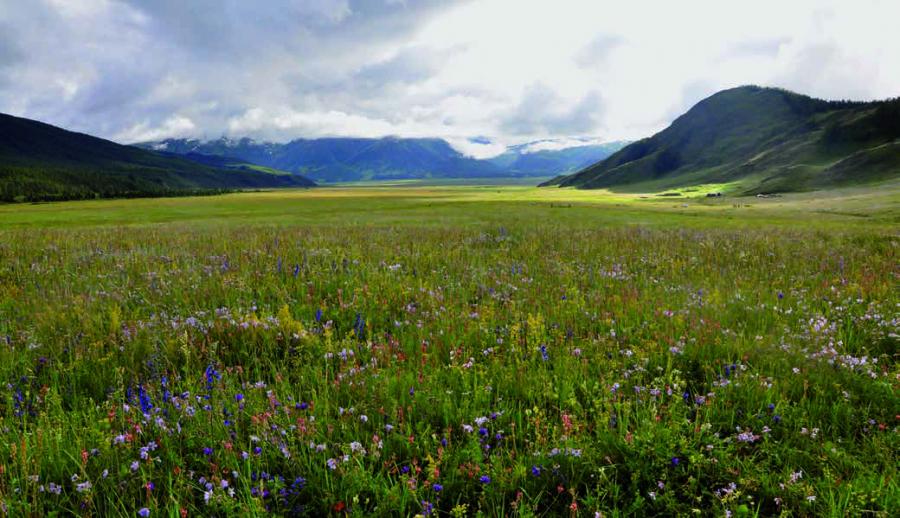
It is necessary to note the cultural landscape of the valley. It is narrow, stretched along the North-East and South-West line, surrounded by mountain spurs from all sides, but the presence of prospects on both sides creates a sense of significant space. To the east, a chain of sharp peaks can be seen going far away. Chains of barrows begin on the northern slope of a small spur and form lines crossing the valley in a cross direction. On the opposite side of the valley flows the river that gave it the name. Where the eastern group of barrows is located, the valley is cut in two by a lonely hill, or by a densely forested outlier. Obviously, it is no coincidence that the barrows are located within the space overlooking this hill. In other parts of the valley no monuments of the Turkic time were found. In the mythological representation of ancient people the hill was probably associated with the ideas about the center of the world - axis mundi - "kindik", i.e. "navel of the earth".
The Karakaba Valley is located in the unique natural zone of the Kazakh Altai. At present, it is possible to get here only by one mountain road, which was built after the First World War by order of the local volost chief Abdikerim. Austrian prisoners of war were involved into the construction of the road, so it is called Austrian. This road connects the valley of the Bukhtarma River and Markakol mountain lake. This route is included in the tourist map of Kazakhstan.