Information
- Location
- East Kazakhstan Region
- Period
- 2100 BCE – 1801 BCE
- Type
- Settlement, Petroglyph, Сomplex
- Kind
- Archaeological sites
- Authors
- Оралбай Ерден Қуанышбекұлы
Sources
- Қазақстанның киелі орындарының географиясы: Табиғат, археология, этнография және діни сәулет өнері нысандарының тізілімі / Жалпы редакциясын басқарған ҚР ҰҒА академигі Байтанаев Б.Ә. – Алматы: Ә.Х. Марғұлан атындағы Археология институты, 2017. – 1-шығарылым. – 904 б.
Description
It is located in the northern part of the Kokentau massif on a weakly wavy plain 23 km south of the village of Karasu.
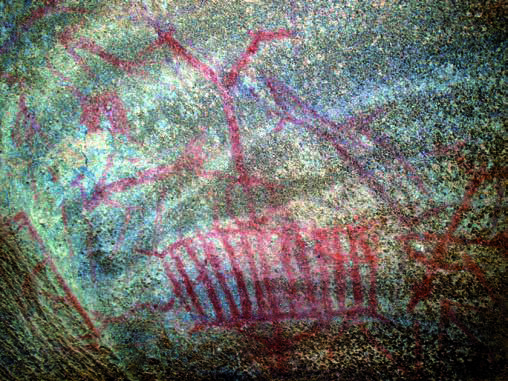
The Kokentau mountain massif is saturated with monuments of antiquity. Apparently, this area has been favorable for human activity since ancient times. In the past, most likely, it was believed that the peaks of Mount Ush-aiyr were the habitat of the mountain spirit - the owner of the surrounding area. The grottoes have images of anthropomorphic spirits, animals and some buildings. It can be said that the barely distinguishable drawings were drawn in the new Stone Age, and the nearby figures with clear lines, are made later - in the Bronze Age.
Kokentau is interesting not only for its drawings, but also for its multi-temporal archeological monuments. Nearby there are numerous settlements of the Bronze Age. Probably, the settlement in the nearest valley, if it wasn't a fence, still had an impressive size. Near one of the houses, traces of an ancient workshop where tools were made were found. A significant number of burials were also found in this area. Burials date from the Bronze Age to the early Middle Ages. This indicates that people lived here for a very long period of time. Stone has also been identified(c) The first sculptures of ancient Turkic times. Who exactly do they represent - there is no consensus yet. Most researchers assume that stone sculptures are images of dead people who put them on graves. Others see them as a generalized image of an ancestor. Others, relying on the idea of punishment widely represented in the folklore of Turkic peoples, say that stone sculptures are the embodiment of defeated noble enemies. And a part of researchers supposes that in a stone the certain mythological character is embodied.
In the course of prospecting and exploration activities in the area of Kokentau on the Sarsh area, a single barrow with a diameter of 30 m and a height of 1.5 m was discovered. In the Isakhan area there is a burial ground of five barrows with a soil embankment with a diameter of 8-25 m and a height of up to 1.3 m. The most numerous is the burial ground of Baiseke, which has 30 burial mounds, the ground structure of which is built of pierced stones. The diameter of the objects varies from 10 to 30 m, the height - up to 1.5 m. On the eastern side of the embankment of one of the barrows there is a stone stele. Judging by the peculiarities of the ground structure, the above mentioned burials can be attributed to the early Iron Age. A monument of 17 fences was found in the area of Karatobe. Most of the fences are made of large-size slabs installed vertically.
A unique monument to the Kokentau massif is the settlement of the Kokentau-1 of the Bronze Age. The unusual construction of powerful granite blocks up to 1.5 m high and weighing not less than 5-6 tons, discovered in this area, is surrounded by a triple fence of large granite blocks up to one meter high. The stones are located in such a way that people can move freely between them. Not far from these places another settlement (Kokentau-2) dated back to the Bronze Age was discovered.
A large ancient Turkic complex was found in the north-eastern foothill zone of the Kokentau massif. The monument is a rectangular structure, the walls of which are made in the form of a ground rampart with a gap on one side in the form of a gate. Inside it there are rectangular rooms, and along the main wall on the inside there are burials. As a result of archeological research, the ancient Turkic burial ground was found to the north of the Ush Aiyr peak and to the south of the Bronze Age settlement. On the eastern side of the two adjacent fences there is a sculpture on each of them. One of the statues is carved of red granite, it shows only the contours of the face and the chin line separating the head from the monolith. The second smaller statue is made of granite of lighter shade, where the shape of the head is clearly marked and the shape of the face is carved.
Thus, the archeological monuments of the Kokentau massif are unique in historical and cultural terms. Numerous archeological monuments discovered here allow to illuminate a rather long period in the history of this territory, which is several thousand years old. Further comprehensive study of Kokentau is quite promising. The proximity of the city of Semey offers a unique opportunity to develop a tourist cluster, given that Kokentau is already a frequently visited place.