Information
- Location
- East Kazakhstan Region, Tarbagatay District
- Period
- 1800 BCE – 701 BCE
- Type
- Petroglyph
- Kind
- Archaeological sites
- Authors
- Оралбай Ерден Қуанышбекұлы
Sources
- Қазақстанның киелі орындарының географиясы: Табиғат, археология, этнография және діни сәулет өнері нысандарының тізілімі / Жалпы редакциясын басқарған ҚР ҰҒА академигі Байтанаев Б.Ә. – Алматы: Ә.Х. Марғұлан атындағы Археология институты, 2017. – 1-шығарылым. – 904 б.
Description
Bronze Age. It is located in steppe area near the river Bogas (Tarbagatai district, East Kazakhstan region).
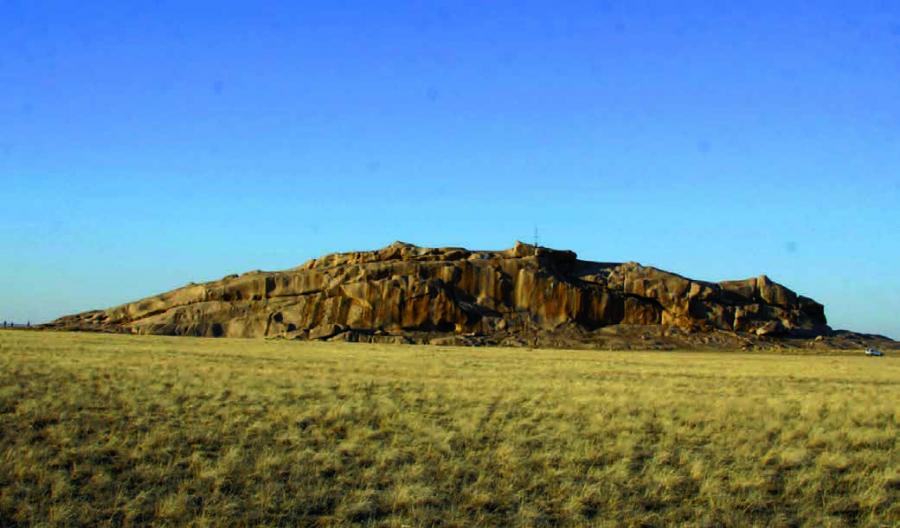
The monument is notable for the fact that it represents the only rocky hill in the whole district in the middle of the flat steppe space. The rock and the drawings on it attracted the attention of researchers who tried to find out the legends and information related to the monument.
Beisenbai Baybolov (a member of the Semipalatinsk subdivision of the West Siberian Branch of the Imperial Geographical Society) reports the following: "In ancient times there lived among the Kyrgyz (Kazakhs - Author's note) a famous old woman-hero. Once she was grazing rams with a spindle in her hands in the Tarbagatai mountains . And so, when she was sitting, the herd was attacked by wolves - boris. Defending the sheep, she threw her spindle into the wolves, which fell into the flat valley of the Bogas tract - 25-30 versts from the Tarbagatai mountains and turned into a rocky mountain 25-30 sazhs long and 8-10 sazhs high. Kyrgyz call the wolves "bori"; the word "tastagan" in Kazakh means "threw". Therefore, this mountain was called "Bori-Tastagan", i.e. "threw into wolves". It follows from the context how strong the mentioned old woman was. She held in her hands not a simple spindle, but a whole mountain. Mount "Boritastagan" is something unusual: it stands in a completely deserted flat valley and around it there are no mountains and hills, it is a completely naked rock on which a person climbes with difficulty. Near this mountain there are district extraordinary congresses of people's judges. On the stones of the mountain there are a lot of inscriptions of the names of the leaders presented at the congresses, and an ancient image of a human head of European type" [Quotedfrom: Baibolov, 1914].
In the Middle Ages, judging by some finds, in the valleys and foothills of Tarbagatai there were powerful centers of tribal associations - "koryki" or "baryki" - sanctuaries of the Western Turkic Kaganate. A special category of monuments of historical and cultural heritage are rock images - petroglyphs carved on the surface of the stone with various stone or metal tools, and set of petroglyphs - pictures made by red ochre. One of the most remarkable monuments of ancient fine arts on the territory of Kazakhstan is scribbles of Boritostagan rock. They have already become the object of research, as evidenced by the notes, reports and brief information reports recorded in various editions of the XIX - early XX centuries, especially in the Notes of the Semipalatinsk subdivision of the West Siberian Branch of the Imperial Geographical Society, which was later transformed into "Notes of the Semipalatinsk department of the Society for the Study of Kazakhstan".
Boritostagan is a cliff of light grey granite with bizarre outlines. Extended from east to west, it has a circumference of about one kilometer, and a height of about 19 m. The southern part of the cliff is almost entirely steep, while the northern part has ledges and gentle edges that can be used to climb to the top. People came here and made sacrifices, imposing scraps of material on the branches of the growing over the cliffs of the hostess or tying them on the roots of the plant, or even just tying a bundle of stems and throwing them here.
At the eastern end of the cliff, in its lower part, a niche of about 0.90 m high and 6.40-8.52 m long was formed. To penetrate this niche, it is necessary to crawl through the lateral through-hole in the rock.
The object has historical and cultural significance and oral historiographical tradition; it is associated with the history and culture of the Kazakh ethnos; it is a place of pilgrimage and religious tourism.