Information
- Location
- East Kazakhstan Region, Katonkaragay District
- Period
- 401 BCE – 201 BCE
- Category
- Historical and cultural monuments of republican significance
- Type
- Necropolis
- Kind
- Archaeological sites
Sources
- Қазақстанның киелі орындарының географиясы: Табиғат, археология, этнография және діни сәулет өнері нысандарының тізілімі / Жалпы редакциясын басқарған ҚР ҰҒА академигі Байтанаев Б.Ә. – Алматы: Ә.Х. Марғұлан атындағы Археология институты, 2017. – 1-шығарылым. – 904 б.
Description
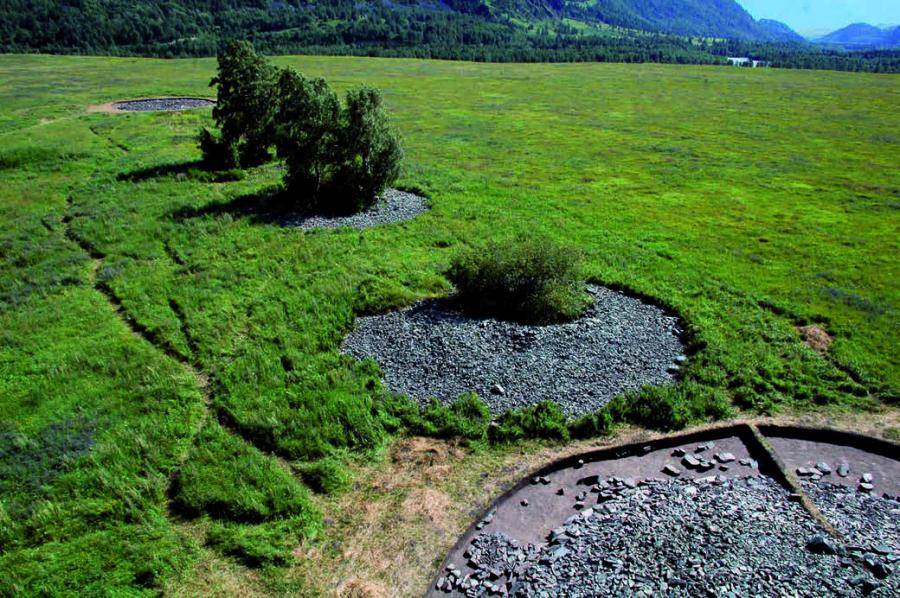
Berel, the barrows. Located 7 km from the village of the same name (Katon-Karagai district, East Kazakhstan region).
The monument is located on a flat mountain plateau surrounded by mountain spurs and limited by the rivers Bukhtarma, Kandysu (Sohatushka, Bulanty). The history of the burial ground begins in the XIX century and is connected with the name of V.V. Radlova, who studied the Great Berel Barrow in 1865 along with the Katanda Barrow. In 1959, at the initiative of S.I. Rudenko, the South Altai State Hermitage Museum expedition led by S.S. Sorokin continued research into the burial monuments of the Altai River, including a further study of the Great Berel Barrow. A new stage in the study of the monument begins in 1998, when a joint Kazakh-French expedition led by Z. Samashev began excavation of the barrow number 11 - the second largest in the entire complex. Survey works on this monument continue and nowadays by the East Kazakhstan archeological expedition (EKAE) of the Institute of Archeology named after A. Kh. Margulan under the leadership of Z. Samashev. For 20 years of archeological studying of a monument the Kazakh archeologists received a unique material. Barrows which can be carried to the category of elitist are investigated, and also those which can be carried to persons of lower social position, including to ordinary ones. Unique safety of a material from barrows with permafrost has allowed to spend interdisciplinary researches. Products from the accompanying subject complex (saddles, gold and tin plated wooden ornaments of horse equipment, clothing parts) are reconstructed in the laboratory "Crimea Island", which has developed and applied advanced restoration technologies.
In 1998, excavations of two burial mounds - No. 11 and No. 18 - were started at the Berel burial ground. In 1999, comprehensive research was already carried out here with the involvement of geocryologists, geologists, geomorphologists, soil scientists, palinologists, botanists, zoologists, architects, doctors, geneticists, paleo-anthropologists, restorers, ethnographers and other specialists. Scientists from Belgium, Italy, Russia, France and other countries took part in field research in 1998-1999.
The uniqueness of the Berel barrows, as well as other large objects of the Pazyryk culture of the Altai (VI-III centuries BC), lies in the preservation of mummified remains of buried people, horses, and organic products, which are usually inaccessible in the burials of other regions. This feature is typical for a number of barrows of Pazyryk culture in the Altai, including adjacent areas of Kazakhstan, Russia and Mongolia. In general, it is assumed that the area of the Pazyryk culture covered the Sayan-Altai highlands, Western Mongolia and Eastern Turkestan.
Within the framework of the comprehensive studies, the conditions for the formation of the frozen permafrost by the well-known geocryologists A.P. Gorbunov and E.V. Seversky were revealed. The main conditions are the required ratio of parameters of the burial chamber, including the depth, size of the barrow, its construction (large plates at the base of the ground part, a layer of medium sized plates above them and pebble covering from above) and, of course, the natural and climatic conditions. As a result, a certain temperature-humidity regime was created inside the chamber, favorable for the formation of permafrost lenses.
The area of the burial ground is 1 000×4 000 m2. According to the degree of intensity of aggregations, the barrows are conditionally divided into four groups. Z. Samashev assumed that each ridge or group of barrows marks the dynasty of the buried to different tribal (family and clan) units. The Berel burial ground is visually distinguished by the parameters and complexity of the construction of the kurgans-dominants. Together with the nature of the objects, the accompanying burial of horses, their decoration, etc. - prestige, gold covering of horses' decoration and clothes - it is possible to speak about presence of barrows of representatives of elite, reflection of social rank of "Berelians" in barrows.
Most of the barrows in the group are oval in shape. The barrow No. 11 (diameter 33.5×22.8 m; height just over 2 m) is an example of a structure construction. The barrow was based on a powerful crepidoma made up of massive vertical stone slabs and blocks along the perimeter. From the outside it was filled with small stones, pebbles, and the filling between the two rows of slabs and blocks consisted of smaller stones. At the base of the barrows, massive slabs and blocks were laid on top of each other in the direction of the centre of the barrow on the principle of "scales", the gaps between which are filled with pebbles and gravel. The purpose of the construction of such a platform was, apparently, to prevent the barrow from sprawling. The next layer consisted of medium sized slabs and stones arranged in relative order. This is the most powerful layer in terms of thickness. The whole building was densely covered with the so-called shell - small pierced stones, crushed stone, pebbles. It is obvious that the last layer served as the main insulating component. Such a construction prevented the evaporation of water, which contributed to the formation of a lens of blown permafrost. On the western and eastern sides, at the edge of the barrow, two ditches filled with small stones and a stone path were identified. The complexity of the funeral rite, its multistage nature is also confirmed by such a structural element as the accumulation of small tiles lying at the level of the ancient day surface.
The grave pit had the dimensions of 4.9×4.0 m and a depth of 5.0 m. Its internal structure is typical for the monuments of the Pazyryk culture: on the bottom of the pit there was a three-eventuated larch log cabin, covered with densely stacked semi-barbs, birch bark cloths and shrubs of Kuril tea Dasyphora fruticosa. The identified organic fragments suggest a felt blanket. The size of the log cabin was 3.65×2.15×1.40 m. Inside the log house, a deck hollowed out of a solid trunk of larch, 2.73 m long, was installed on a hill. At the corners of the deck cover were installed four bronze, gold foil-covered sculptures of birds of prey, possibly an eagle griffin. The barrow contained the remains of two men and women with their heads facing east. It is established that the man had a haircut or wig, beard and mustache.
As an accompanying object complex we can name the attributes typical for the monuments of Pazyryk culture: fragments of a ceramic jug, two wooden tables on the legs. Behind the northern wall of the log cabin was made an accompanying burial of 13 horses, laid in two tiers. Layers with horses were separated from each other by layers of birch bark and Kuril tea between them, the flooring made of birch bark cloths on the roof of the log cabin extended to the horse compartment. The horses were ritually killed by the blow of a chasing in the forehead. Animals, nervous and saddled, some of them heads are decorated with masks crowned with full-size wooden models of teke (goat) horns, and as a result they took the form, i.e. "transformed" into mythical animals. This was amplified by images of animals, birds, fantastic creatures, the images of which were decorated with horse equipment. Horse saddles represent the most ancient samples of soft saddles known on the territory of Kazakhstan. The saddle covers are decorated with images of animals, applied with the use of applications and embroidery. Remains of horses with wool, soft tissues and stomach contents allowed scientists to carry out various researches.
Among the burial mounds classified as elitist, we can also name objects Nos. 9, 10, 36. In the barrow No. 10 the saddles decorated with compositions with a procession of eight sphinxes, eight eagle griffins and a scene of tiger griffin torment of a deer are especially notable. The equipment of the two horses included shields made up of rounded sticks. The main images of horse decoration are stylized eagle griffins, argali, boar canines made of wood, fish, stylized ornament. A masterpiece of the ancient nomadic art is a button plaque with a carved image of a deer coagulated in a ring; a poster with a deer, the back part of the body of which is turned around; a three-dimensional composition of a hoofed animal, on the shoulder and thigh of which are carved images of the head of an argali and other decorations.
Barrow No. 9 is distinguished by the burial of a person, probably associated with the performance of ritual functions. In a 3.5 m deep burial chamber covered with logs, the northwestern half of the pit contained the burial of horses. In addition to the powerful overlapping of rocks and slabs, the sacral nature of the accompanying burial of horses was emphasized by the stele installed in the legs of the animals. In the northeast corner there was a staircase leaning against the pit wall. It is made of a trunk of wood with short stumps of branches. The traditional accompanying burial of five nervous and sedated horses was partially covered with separate birch bark canvases. A man and a woman were buried in the log cabin. As an accompanying burial of horses, five animals were killed. The remains of the man were found behind the log cabin wall, where he was moved as a result robberies. The disturbed remains of a young woman were accompanied by gold earrings decorated with grain, a mirror in a belt cover, a friction, a bone arrowhead, as well as a bronze miniature vessel with eight octagonal stones and seeds of coriander inside, bronze and bone arrowheads, wooden sphinx figures, clad with yellow foil (fragments of hryvnia), buttons, clothing patches. On the bones of the limbs of the woman there are holes indicating postmortem manipulation of the body. A similar woman's grave was found in burial mound No. 2 with traces of postmortem manipulation in the form of holes in the extremities, with a gold foil garment decor, with a bronze mirror with a zoomorphic handle in the form of a profile figure of a predatory animal in a leather cover on a belt, a wood stones, grains (coriander?), ceramic vessels, a wooden table with the tail of a horse and an iron knife. Behind the northwest wall of the log cabin there were burials of seven horses. The fact of drilling the lower jaw of the buried woman is also fixed in the Berel barrow No. 16.
Among the Berel barrows, object No. 36 is distinguished. Among the main structural elements there is a vertically installed slab with the length of 1.20 m, a tombstone slab of powerful blocks weighing 200-500 kg. The man was buried in a stone box accompanied by a horse. The decoration of the horse harness consisted of 66 elements made of deer horn with the use of red paint. The main animalistic image is the moose-griffin.
In recent years, objects around burial mound No. 1, burial mound No. 5 and others have been studied. Date obtained for burial mound No. 1 - 267 B.C., barrow No. 11 - 363 B.C.
An indispensable element of the Pazyryk culture monuments is burial of horses. P.A. Kosintsev, a well-known archaeologist, based on the analysis of bone remains from the Berel barrows, came to the conclusion that the selection of horses for burial was probably carried out in accordance with the status of the buried horse. Horses were selected for burial by sex (males), age (unnaturally low proportion of young individuals) and, in some cases, size (thoroughbred individuals were selected).
With regard to the ethnicity of the Pazyryk culture, including the ancient "Berelians", it is assumed that they were southerners. The scientific value of the monument lies in the unique opportunity to conduct interdisciplinary and comprehensive research of materials. This opportunity was not missed by Kazakh archaeologists. Thanks to what it was possible to reconstruct many aspects of life of ancient nomads of the Kazakh Altai, including a number of aspects of the religious and mythological party. In studying the life of the population of Berel in the early Iron Age participated paleobotanists, paleo-anthropologists, geneticists, etc. Traces on the bone remains of people testifying to the posthumous mummification of bodies; anthropological type of the buried, their age and sex; contents of the stomachs of horses, which allowed to establish vegetation and the time of year of burial; technique of carving on a horn and a tree, etc.
In addition to the monuments of the early nomadic epoch, ancient Turkic burial and storage structures were found in the valley. Sacred value for the modern inhabitants of Kazakhstan lies in the sanctity of the valley - the place of burial of ancestors. Some barrows were erected over the elite of the ancient nomadic society. Here multistage funeral and memorial rites were performed. Horses killed for burial were disguised as wild ungulates, in this case - teke. Masked horses with horns or tops were usually the first horses to lead ceremonial processions. The images of horned horses and goat-horse reflect mythological notions common for nomads in Eurasia and their neighbors. Perhaps the mythical creatures - the "bird-dumb horse" - helped the elite to reach the celestial pastures.
This valley has retained its significance as a sacred place to this day. The monuments date back to the time when the main elements of nomadic culture - both material and spiritual, ethical norms, aesthetic ideals and ideology - were formed.
At present, a museum has been opened in the valley.
The object is visited.