Information
- Location
- East Kazakhstan Region, Ulan District
- Period
- 3000 BCE – 1001 BCE
- Type
- Petroglyph
- Kind
- Archaeological sites
- Authors
- Оралбай Ерден Қуанышбекұлы
Sources
- Қазақстанның киелі орындарының географиясы: Табиғат, археология, этнография және діни сәулет өнері нысандарының тізілімі / Жалпы редакциясын басқарған ҚР ҰҒА академигі Байтанаев Б.Ә. – Алматы: Ә.Х. Марғұлан атындағы Археология институты, 2017. – 1-шығарылым. – 904 б.
Description
Beginning of the III-II thousand B.C. The monument is located 38 km south of Ust-Kamenogorsk, 3 km north of Besterek village, 2 km east of the Ust-Kamenogorsk-Samara highway, between Besterek and Sagyr settlements (Ulan district, East-Kazakhstan region).
Few references and information about it refer to the end of the XIX - beginning of the XX century, and from the 1980s began its regular systematic study and understanding. Z. Samashev was one of the first to carry out extensive research in the vicinity of the village of Sagyr and in the grotto of Akbauyr. He discovered a large number of rock paintings of different historical periods, described them and gave scientific interpretation. Since 1997, the State Hermitage Museum's Sayan-Altai archeological expedition in the Akbauyr grotto has focused on copying the drawings, searching for new images and measuring the distances between them in detail. After the systematization of drawings, analysis of connections with the surrounding landscape, it was suggested that there was a stationary point for astronomical observations. Researchers and local lore specialists from the city of Ust-Kamenogorsk - E.V. Kurdakov, V.A. Ikonnikov, N.I. Levchenko, S.S. Tsaregorodtseva and others - came to the conclusion that the astroarchaeological complex of Akbauyr occupied a rather large territory, where rituals and rituals of ancient tribes living here at different times were held.
Many of the secrets of Akbauyr to modern man are probably impossible to solve anymore. There are different approaches to explaining the name of the tract. There is no word "baur" in the modern Kazakh language. The closest words to it in terms of sounding are " baurai " and " bauyr ". The word " baurai " is translated as a slope, sole (of mountain, of hill). The name Akbauyr is sometimes literally translated as "white liver". In the Kazakh-Russian dictionary for the word "bauyr" the following meanings are given: 1) liver; 2) blood relative; 3) slope, foot of the mountain. In the modern Kazakh language, the word "bauyr" has a figurative meaning - the younger brother, which can be perceived as "younger", "smaller" in relation to the higher mountains of Kyzyltas ("red stone"), located nearby. The Akbauyr grotto seems to "look" to the west, and if one observes the sunset from it, then Mount Kyzyltas and its spurs (Sorokin Mountain) really seem red [Samashev, 1990; 2006].
On the maps, the toponym "Akbauyr" is marked with a tract at the foot of Korzhymbai Mountain. Probably the most appropriate translation of "bauyr" as "slope, foot of the mountains", which does not exclude the complex multidimensional semantics of the word "Akbauyr" in general. Now the name "Akbauyr" is assigned to the whole complex of objects.
It is not a coincidence that the toponymic names of the tract contain the epithet "Ak" - white. In ancient cultures, white was sacred. Honouring of heights, hills, mountains in many early cultures was widespread and is due to the fact that the "top - mountain" was understood as a place of residence of local deities. They symbolized the center of the world, the place of contact between Heaven and Earth, Eternity and aspiration to the top world. Most likely, the rituals that were performed near Akbauyr are associated with one of the early cults of the mountains, along with the cult of the sky, sun, thunderstorm, animals and plants. On the basis of these cults many early forms of religions were formed.
Stones of megalithic complexes were seldom processed, more often they were installed in a natural state, and sometimes by means of heating or wedges they were split into natural cracks so that coarse blocks were formed. Similar slabs oriented in certain directions can be seen on Akbauyr, and on the rocky outcrops of the complex one can often see images of deer, mountain goats and horses. It is possible to assume that these drawings were a part of the difficult rituals which took place in this sanctuary.
European scientists, studying ancient sanctuaries, came to the conclusion that in the past people were extremely attentive to the location of their buildings, which often also served as calendars and were a kind of astrolaboratory. The Akbauyr tract in the Western Altai is unique in that the complex of monuments includes a grotto, in which the ministers of the cult left the original drawings, symbols, made in red paint. They often come here from Ust-Kamenogorsk, districts of East Kazakhstan region, from neighboring countries, the monument is widely known and popular, makes a significant contribution to the development of the tourist cluster of the region and the Republic as a whole.
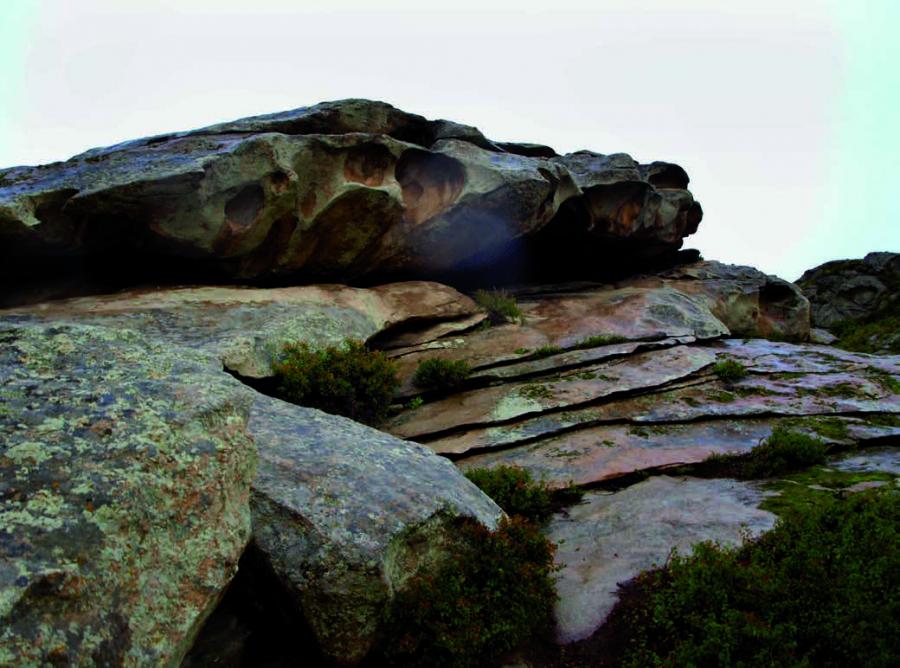
The monument is located on the south-western slope of Korzhymbai mountain - 5-6 m from the foot. The named mountain is clearly visible from afar - it is an array of gray granite, which resembles a large pyramid in shape. The grotto merges with the background of the mountain and is practically indistinguishable for an ignorant person. On the vaulted ceiling of the grotto there is a round hole, the floor is sloping, without the remnants of the cultural layer, sometimes traces of soot are visible. The length of the grotto is about 9 m, the maximum width in the middle part - 4 m, and the maximum height is closer to the entrance - 2 m.
The Akbauyr Grotto is the core of the monument of local importance; a group of petroglyphs dates back to the III-II millennium BC. In ancient times, apparently, it was one of the main objects of the vast sanctuary. According to the scientists who studied the monument, the grotto's paintings can be a mythological and epic reflection of the ancient population's ideas, a partial "map of the starry sky" or a "way of saving humanity". Judging by the conclusions of the researchers, Akbauyr is among the brightest and most valuable monuments of ancient culture in the Republic of Kazakhstan and Eurasia as a whole.
The monument fully preserves its historical and cultural value, and the condition of the object should be regarded as good, taking into account the existing modern damage to the original appearance of the monument. The area is currently protected and monitored.
A monument of local importance. A unique object of historical, cultural and socio-political importance; it is associated with the history of world and traditional religions, as well as with the history and culture of the state-forming ethnic group; it has an oral historiographical tradition; it is an object of pilgrimage and religious tourism.