Information
- Location
- North Kazakhstan Region, Aiyrtau District
- Period
- 1824
- Category
- Historical and cultural monuments of republican significance
- Type
- House
- Kind
- Buildings of monumental art
- Authors
- Маликова Сауле Зейнуллиновна
Sources
- Қазақстанның киелі орындарының географиясы: Табиғат, археология, этнография және діни сәулет өнері нысандарының тізілімі / Жалпы редакциясын басқарған ҚР ҰҒА академигі Байтанаев Б.Ә. – Алматы: Ә.Х. Марғұлан атындағы Археология институты, 2017. – 1-шығарылым. – 904 б.
Description
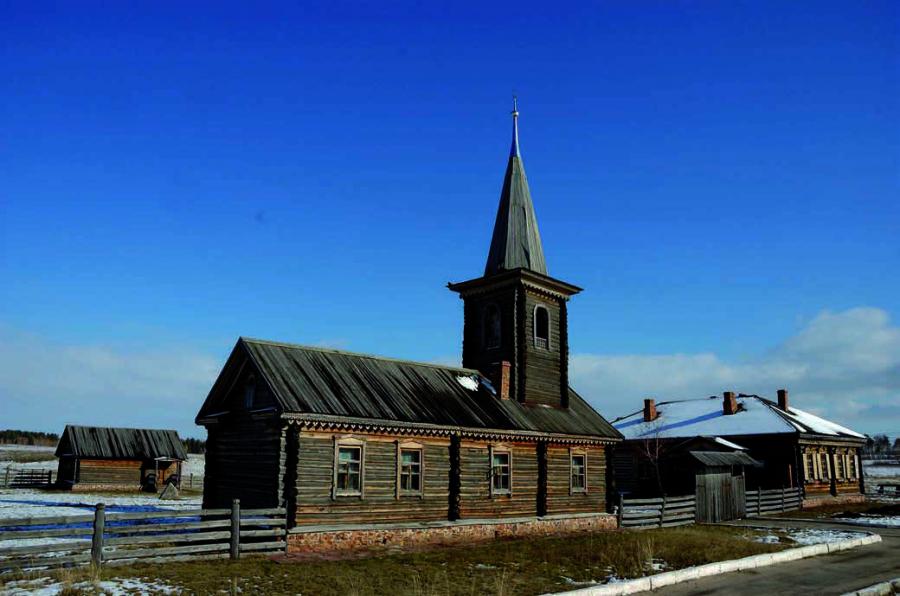
It is located in the gorge of the same name, 4 km south-east of Syrymbet village (Aiyrtau district, North Kazakhstan region).
Ualihanovs' estate was built for the widow of Khan Uali - Aiganym (grandmother of Sh. Ualihanov) on April 30, 1824 by order of Emperor Alexander I and by order of the Governor-General of Western Siberia P. Kaptsevich. Aiganym (1783-1853) was the younger wife of Uali Khan, was a very intelligent and enlightened woman, knew Arabic, Persian, Chagatai, Russian and French. "The godlike princess of the Kyrgyz-Kaisak horde, to whom wisdom is incomparable ...", - talked about her. Having become the wife of Uali Khan, she had an influence on the management of the khanate, foreign and domestic policy. After Uali Khan's death the real power in the Middle Zhuz, then the Kokchetav district within 30 years belonged to Aiganym. She made her position known to St. Petersburg by means of people loyal to her, which soon was not overlooked. As a result, she decided to build a house and a mosque for the Khan's widow. Aiganym chose the place for the house. The construction cost was 5000 rubles, which was a large sum for those times.
Ualikhanovs' estate is a monument of wooden architecture of the XIX century, a historical and cultural heritage site. According to its composition, planning and placement it resembles a Russian noble estate of the XIX century. The pencil drawing of Sh. Ualikhanov, which shows the manor: a dwelling house with three wings and a mosque, built in 1824, as well as madrassas, a mill and other household buildings, erected before 1835, is preserved.
In 1977, the topographic survey of the land plot was carried out, the foundations of the buildings were revealed, and the data on the Syrymbet estate were collected. Ualikhanovs' estate was restored to the 150th anniversary of Shokan Ualikhanov in 1985. It consists of a manor house with a living room, a school, a mosque, a mill, a dwelling house for servants, a bathhouse and household buildings. Its area is more than 4030 m2. In 1993, the complex was included in the Syrymbet Historical and Ethnographic Museum named after Sh. Ualikhanov. In 2008-2010, restoration works were again carried out at the estate. The building currently serves as a museum. Here you can see many unique exhibits related to the life of several generations of the Ualihanov family. The museum's exposition includes household items and applied arts of the time, exhibits related to the history of Sh. Ualihanov's family: a family tree, a portrait of the great khan Abylai, and an authentic ivory chest. Scientific works of Kazakh ethnographer Sh. Ualikhanov occupy a separate stand, his manuscripts, books and numerous documents are presented. Attention of visitors is drawn to the diorama "Map of travel to Kashgar 1858-1859". To date, the museum collection has more than 6900 exhibits, of which 1300 are located in the exhibition halls.
Shokan Ualikhanov's childhood and youth passed in the estate. The Ualihanovs' estate played a significant role in the spread of educational ideas in the Kazakh steppe and the promotion of cultural heritage. Aityses of akyns, contests of famous poets, singers, musicians, composers took place here, Birzhan Kozhagululy, Akanseri Koramsauly, singer Koke Alzhanuly, kobyzist Kurymbai Kankozhauly, akyn Azhar performed here. The estate was visited by many Russian scientists, travelers and officials (among them the poet-petrashevets S.F. Durov and G.N. Potanin), A.K. Geins. There were also Shokhan's colleagues, scientists of various directions of science who were interested in a life, folklore of the Kazakh people. These are all celebrities of that period: P.P. Semenov-Tyan-Shansky, F.I. Usov, N. Yadrintsev, A. Sotnikov and others. Of course, this is the merit of Aiganym.
Such a case testifies to the progressive views of Aiganym. Nicholay - the heir and brother of Tsar Alexander I conceived to make a trip to Siberia. Trying to please a member of the royal family, M. Speransky reported on the need to make yurts to attract the attention of the heir. Having received such news, Aiganym gathers the best masters of the districts and begins to work. She also had a goal - she wanted to take advantage of it and help her sons. Aiganym tried to ensure their future as best as possible, to send them to study in Russia, among them was her grandson Shokan. His knowledge, outlook and excellent upbringing will be highly appreciated by the Russian enlightened society.
All children and grandchildren of Aiganym received a brilliant education - Genghis (Shyngys), son of Genghis Zhankozha - a famous musician, kobyzist, Sakipkerey (Kozyke) - a talented composer, was a friend of Akan-seri. His son Makezhan studied in St. Petersburg at the Imperial Art School. Then he entered the academy, where he studied together with T.G. Shevchenko. The works that came out from under his brush, received prizes at the III International Congress of Orientalists. Mahmud graduated from the Cadet Corps in Omsk, then studied in St. Petersburg. He retired as a lieutenant. After the 1905 revolution he fell into disgrace. From Makezhan's son - Idris - the well-known architect in Kazakhstan Shota Ualihanov, the author of the Emblem of the Republic of Kazakhstan would be born.
In the area of the estate there is a family cemetery, where Aiganym and Shokan's father were buried. The witness of the fact that the last descendants of the ancient dynasty branch are buried here, are modest stone slabs.
Ualihanovs' estate is actively visited and is a tourist attraction.