Information
- Location
- Павлодар облысы, Ertis District
- Period
- 1750 – 2003
- Type
- Stele
- Kind
- Sacred objects
- Authors
- Батталов Қайрат Қанатұлы
Sources
- Қазақстанның киелі орындарының географиясы: Табиғат, археология, этнография және діни сәулет өнері нысандарының тізілімі / Жалпы редакциясын басқарған ҚР ҰҒА академигі Байтанаев Б.Ә. – Алматы: Ә.Х. Марғұлан атындағы Археология институты, 2017. – 1-шығарылым. – 904 б.
Description
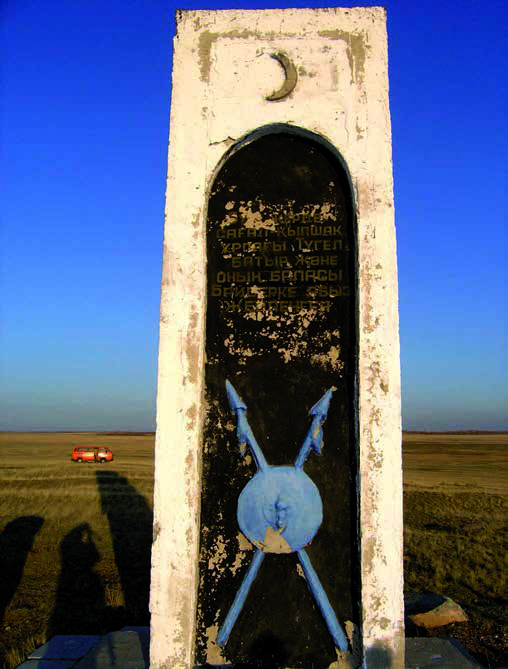
The object is located near the administrative border of Pavlodar and North Kazakhstan regions, 2-3 km north of the village Kyzylagash, North Kazakhstan region (Irtysh district, Pavlodar region). It is a monument erected on the hill of Zhuantobe, on the place where the tomb of Tugel Batyr was supposedly located.
The main aspects of life and struggle against the Kalmyks of Tugel Batyr were covered in the pages of the periodical press and in the meetings of local amateur local ethnographers. These materials were based on the legends that have survived among the Kazakhs of the Pavlodar Kypchak tribe. Oral legends about Batyr were published in the work "Tugel Batyr and his descendants" of local ethnographers M. Zhamanbalinov and A. Badelkhanov. The same information was also reflected in the work of "Ertis - Bayanaul region" by Tleke Zhenis and in the work of "Essays of the history of Pavlodar Irtysh region" by Tleuken Insebayev.
According to the legends of the Kazakhs of the Irtysh region, the time of exploits of Tugel Batyr and his comrades-in-arms belongs to the period of Kazakh-Dzungarian wars in the 20-50s of the XVIII century. The memory of the events of that era in the Irtysh region was preserved in the form of toponyms Korgankol, Nayza, Bogenbay, Zhazytobe, Kalmak molasy, Moynak auyly, Moynak lake, Zhalauly.
Tugel Batyr became one of the leaders of the Kazakh militia in the battles with the Kalmyks for the steppes of the left bank of the Irtysh River, for pastures along the river Sleti. Other names of Kypchak Batyrs are also mentioned together with Tugel Batyr - Zhoisandyk, Moynak, Koshkarbay, Zhazy, Karabatyr, Lepes, Shan, Otel, Kozhabergen, Baisary; Kanzhygaly batyrs - Aitkozha, Bozsha, Boranbay; Kerei batyrs - Amanbay, Esenbay; Uak batyrs - Kurymsy and Omir. However, a special role is given to the Kypchak batyrs Tugel Batyr, Zhazy and Koshkarbay as the most authoritative leaders of the army.
According to the stories of the aksakals, Kazakhs used to spend the winter in the Irtysh Valley, which is rich in forests, fresh water and grass. And as the summer camps served the left-bank steppes of the Irtysh region. Once, when Kazakhs gathered on spring pastures and caught the Kalmyks in their summer camps, Kazakh batyrs Tugel, Zhazy and Koshkarbay decided to fight back the enemy. According to legends, which came to us thanks to the local historian M. Zhamanbalinov, the eastern coast of the salt lake Zhalauly becomes a conventional place of militia gathering for the Batyrs. It was near the lake that the military banners (zhalau) of the clan militias were raised, hence the name of the lake - Zhalauly.
Fearing the militia of the three Kypchak batyrs, the Kalmyks from the Sleti River are shifting towards Bestobe. Here the militia of three Kypchak batyrs fought with Dzungars. According to legend, other Kazakh batyrs - Moynak, Lepes, Otel, Baysary and Kozhabergen - also took part in this battle. Tugel Batyr fought with the famous Dzungarian Batyr and won this fight, battling the enemy. Clashes continued for several days, in one of which Zhazy Batyr died of a cannonball. Tugel Batyr delivered the body of Zhazy Batyr in his village and buried on one of the hills. Tuffet, where the grave of Zhazy Batyr is located, is called Zhazytobe. As a result of the battle, the Kazakhs managed to win, the battle banners on Lake Zhalauly for a long time served as a symbol of this important event.
Tugel Batyr not much survived Zhazy Batyr. According to legend, the Batyr went to sleep overnight in the village, located on the hill Zhuantobe, where he was poisoned by a widow, bribed by the Kalmyks. According to the Batyr's covenant, he was buried on the Zhuantobe hill, where a memorial stele was installed in 2003. The monument above the grave of Tugel Batyr is made of iron and concrete.
The memorable stele above the grave of Tugel Batyr is included in the list of the most significant monuments of the history of the Kazakh-Dzungarian conflict in the Pavlodar Irtysh region and is an important element of the historical memory of the local Kazakh population. The significance of the memorable stele over the grave of Tugel Batyr as a sacred object is determined by the role played by Tugel Batyr in the liberation war of the Kazakhs against Dzungars, in the organizational activities and personal military example of the Batyr in the fight against the enemy, in respect for the memory of the glorious ancestor by modern Kazakhs. To this day, Kazakhs of Pavlodar's Irtysh region honor the memory of the glorious Batyr, set an example for the younger generation, organize memorial dinners and read prayers at the grave of the Batyr.