Information
- Location
- Павлодар облысы, Ekibastuz District
- Period
- 3000 BCE – 800 BCE
- Type
- Petroglyph
- Kind
- Archaeological sites
- Authors
- Мерц Виктор Карлович
Sources
- Қазақстанның киелі орындарының географиясы: Табиғат, археология, этнография және діни сәулет өнері нысандарының тізілімі / Жалпы редакциясын басқарған ҚР ҰҒА академигі Байтанаев Б.Ә. – Алматы: Ә.Х. Марғұлан атындағы Археология институты, 2017. – 1-шығарылым. – 904 б.
Description
The monument is located on the right bank of the Olenti River, 5 km southwest of the village of Tai (former "Olentinsky" farm), Ekibastuz District, Pavlodar Region.
Rock paintings are included in the complex of archeological monuments, including Eneolithic site, burial ground of the Bronze Age and barrows of the early Iron Age, timed to the surface of the terraces of the left and right banks of the Olenti River. Rock paintings are located on the rocky outcrops of the right bank of the Olenti River. They were discovered by geologist O. Mol in 1972. They were repeatedly inspected by expeditions of the Pavlodar Regional Museum of History and Local Lore under the direction of V.K. Merts in 1988-2007. In 2005, the detachment of the group for the study of early Iron Age monuments and ancient art of the Institute of Archaeology named after A. Kh. Margulan (headed by Z. Samashev).
In 2005, he was a member of the group for the study of early Iron Age monuments and ancient art at the Margulan Institute of Archaeology (headed by Z. Samashev).
The sacral nature of the object lies in the fact that it includes, in addition to the multi-temporal archaeological monuments, a cult object of the Eneolithic Era and bronze with rock paintings, which is a sanctuary of the most ancient pastoralists of North-Eastern Kazakhstan. As cult object it was used for a long time and was connected with ritual actions of ancient inhabitants of the Olenti valley.
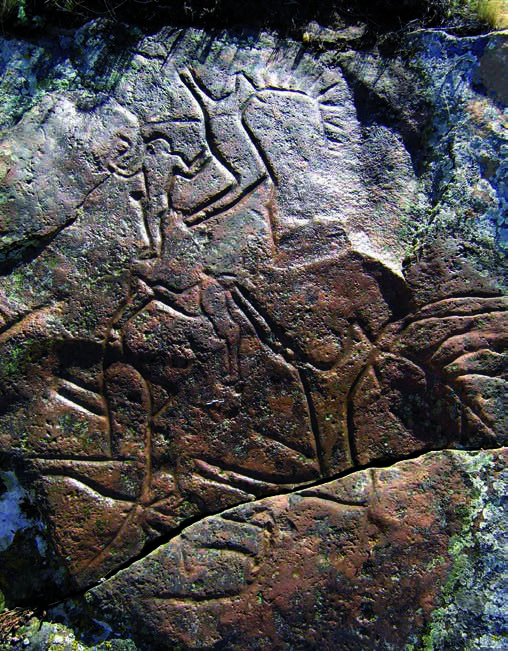
The monument is timed to the steep slope of the root terrace of the right bank of the Olenti River, near the cemetery of Yakshibay. It consists of large stone blocks of paleogene sandstones with anthropomorphic and zoomorphic images on their surface: archers, animals, bulls, horses, deer, camels, cat raptors; scenes of hunting, erotic and cult actions. The panel with the image of a man with a rod in his right hand is especially notable, and with his left hand he points to a deer with big horns. In total, 17 blocks with more than 50 images made by the technique of deep engraving, which is not typical for the majority of monuments of rock art in Kazakhstan, were revealed. The surface of some planes is specially ground over the images, which, apparently, was connected with special actions of ritual character.
The monument is a cult place of ancient pastoralists of the Olenti River valley, for whom it was undoubtedly of sacral importance in the Eneolithic and Bronze Age. It is a testimony to the high spiritual culture of the ancient population of Northeast Saryarka. This gives it special scientific and cultural-historical significance for modern culture as one of the unique samples of primitive art and a source of spiritual culture of the ancient tribes of Northern Kazakhstan, which has no analogues in the region and beyond.