Information
- Location
- Павлодар облысы, Bayanaul District
- Period
- 1764 – 1800
- Type
- Sore tas
- Kind
- Sacred objects
- Authors
- Батталов Қайрат Қанатұлы
Sources
- Қазақстанның киелі орындарының географиясы: Табиғат, археология, этнография және діни сәулет өнері нысандарының тізілімі / Жалпы редакциясын басқарған ҚР ҰҒА академигі Байтанаев Б.Ә. – Алматы: Ә.Х. Марғұлан атындағы Археология институты, 2017. – 1-шығарылым. – 904 б.
Description
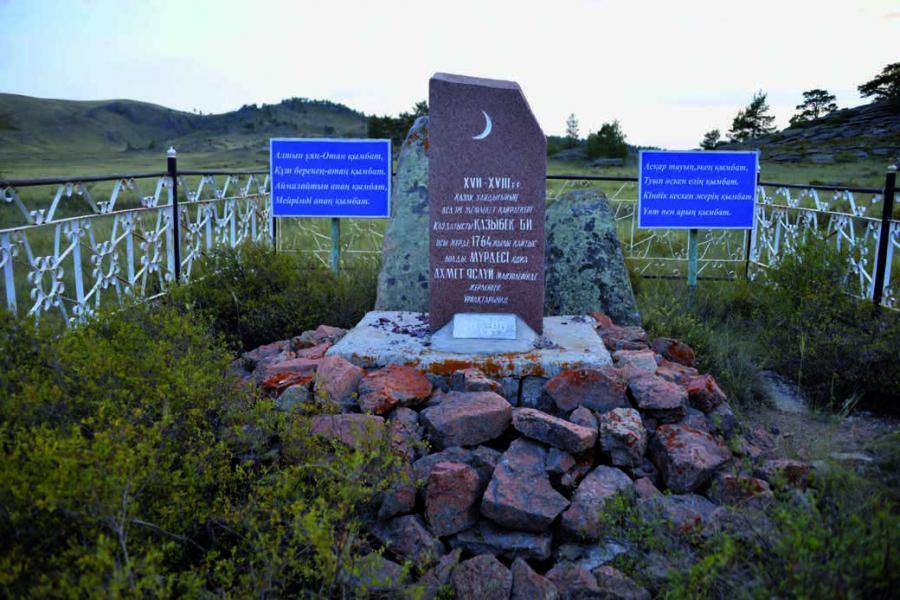
It is situated in the Dalbinskye mountains, 2-3 km south-west of the village of Muryntal (Bayanaul district, Pavlodar region). Sore Tas of Kazybek Bi is located in a picturesque area where the Terektibulak mountain stream flows. Sore Tas of Kazybek Bi is a stone embankment with a fence and stone steles, on which the body of the dead Kazybek Bi was supposedly stored.
Kazybek bi (about 1667-1764) was a famous bi of the Middle Zhuz, one of the historical statesmen of the Kazakh khanate, one of the three tobe bies of Tauke khan. Kazybek bi originated from the family of Karakesek of the Argyn tribe of the Middle Zhuz. Even in his youth he became known for his bright, flamboyant speeches, which made him famous in the whole Kazakh khanate. Kazybek Bi stood out as an expert speaker and connoisseur of Kazakh traditions and customs. Tauke khan, impressed by the talent of young bi, takes 14-year-old Kazybek as a member of the delegation to the court of the Dzungarian ruler. Thanks to the fiery speeches of the young bi, it was managed to return the stolen cattle and captives. Kazybek Bi became known as Kаz Dauysty (with anserine voice) for his loud and clear voice.
The time when Kazybek Bi lived and worked in power is one of the most difficult stages in the history of Kazakhs. The Kazakh khanate experienced a deep political crisis caused by the centrifugal trend. Central power loses control on the ground, and local sultans, who declared themselves khans of the zhuzes, increasingly use their power. It was in this epoch that Tauke Khan took bold steps for the sake of preserving the unity of the khanate: he appointed his representatives - the Bies from the common people - "Karasuyek" to each zhuz. At the same time, the bet was made on the most authoritative bies. In the Elder and Junior Zhuzes, the famous Tole and Aiteke became the bies, and in the Middle Zhuz, Kazybek Bi, who had unquestioned authority and respect, was chosen. Three bies became a good support of the central power and tried to keep the unity of the khanate. With the direct participation of three bies in order to systematize the norms of customary law and strengthen the order in the khanate under Tauke Khan was developed a set of laws - "Zheti Zhargy".
Kazybek Bi took an active part in the awakening of the national consciousness of the Kazakh people, urging people to unite against the external enemy - Dzungars. Kazybek Bi also stood out with appeals for strengthening ties with the Russian state. After Tauke Khan's death he continued his active social and political activity, was an advisor to Sameke and Abilmambet khans. In the beginning of 40th years of the XVIII century, in the period of strengthening of military pressure of Dzungars on the Kazakh khanate, conducted negotiations and participated in release of the Kazakh sultan Abylai from Dzungarian captivity.
In the 40s of the XVIII century, the bi moved from the Syr Darya nomads to the Saryarka steppe. In his old age, he withdrew from political affairs, giving all the power to his son Bekbolat. He lived in the Karkaraly Mountains, then in the Dalbinskie Mountains. Kazybek Bi met his death at an advanced age at a wintering in the Dalbinskie Mountains. It was decided to deliver the body of the dead Kazybek bi to Turkestan, where the prominent figures of the Kazakh khanate were buried. However, communication was complicated by the harsh winter, and the descendants of Bi decided to keep the body until spring. For this purpose, near the wintering of bi old stone steles were collected, and the body of bi was laid on them. The technique of preserving the body of the dead without decaying was familiar to Kazakhs and was often used in the absence of an opportunity to deliver the body to the ancestral or other place of burial. By spring, the body of Kazybek bi was brought to Turkestan by his sons, headed by Bekbolat, and he was buried in the mausoleum of Khoja Ahmed Yasawi.
Kazybek Bi left the descendants with a rich spiritual and legal heritage, playing an outstanding role in preserving the unity of the Kazakhs and uniting them in the fight against Dzungars. The words and expressions attributed to Kazybek were transmitted among the Kazakhs for centuries and always stood out for their profound knowledge of Kazakh life and practice.
Information about the stone steles, on which the body of the bi was supposedly stored, about their location was transmitted among the Bi tribesmen. Later, the place, where the sore tas was located, was improved. The descendants keep a sacred memory of this, the sore tas has a sacred meaning in the minds of the Kazakhs and is one of the most visited places in the Dalbinskye mountains.