Information
- Location
- Павлодар облысы, Ekibastuz District
- Period
- 1871 – 1900
- Type
- Mausoleum
- Kind
- Buildings of monumental art
- Authors
- Батталов Қайрат Қанатұлы
Sources
- Қазақстанның киелі орындарының географиясы: Табиғат, археология, этнография және діни сәулет өнері нысандарының тізілімі / Жалпы редакциясын басқарған ҚР ҰҒА академигі Байтанаев Б.Ә. – Алматы: Ә.Х. Марғұлан атындағы Археология институты, 2017. – 1-шығарылым. – 904 б.
Description
It is located 70 km from Ekibastuz, 15 km south-west of Akkol village. The sacral site is a complex of buildings consisting of a mausoleum, a mosque and a pilgrimage house.
Isabek ishaan khazret (1792-1871) - a religious figure of the XIX century, a descendant of the first missionaries of Islam, philosopher, educator, mentor of the famous Mashkhur-Zhusup Kopeyev. He belongs to a special social group of the Kazakh society, kozha, the representatives of which are traditionally considered descendants of the Arab missionaries of Islam. The genealogy of Isabek Ishaan mentions the names of the grandfather of Khazret Akku ishaan and father Murat ishaan. Isabek Ishaan originated from the steppe famous Sayid-kozha genus, which inhabited the southern regions of the country. Isabek's father, Murat Ishaan, was the first to settle in Saryarka at the end of the XVII century at the age of 20-21 years. The spread of Islam in the steppe was associated with representatives of kozha. Representatives of this genus received an addition to the name "ishaan".
According to the definition in the Islamic explanatory dictionary, ishaan is an honorary title of Sufi mentor in Central Asia. Usually, Ishaan lived in a monastery, receiving donations, revered as a saint. The title of Ishaan was often hereditary. Ishaans sometimes became the leaders of armed actions against the tsarist authorities in Turkestan in the XIX century, enjoyed high authority in the Kazakh steppe. As the famous traveler Armeni Vambery noted in his diaries: "Orthodox Muslim clergy - ulems boast the title of interpreters of the scriptures, but in rivalry with the ishaans, clothed with mystical secrets, they always lose. It is harder to attract a superstitious Central Asian citizen with a book, without which he always does, than with a magic spell and external ritual. Without a scholar and little scholar mullahs in Central Asia are easy to do, but the Fatiha (blessing) or the breath of even a completely illiterate ishaan is a talisman for him in the kibbitka, and in the desert, and the robberiest raid, and pastures".
Isabek Ishaan was born in the village of Akkol (now Ekibastuz district, Pavlodar region). From a young age he showed a desire to study and interest in religious education. As a child he learned to read and write in madrassa. He received his education in Bukhara. At the beginning of the XIX century he opened a madrassa in Akkol-Zhaiylma, built a mosque, where he carried out preaching and religious activities among the Kazakhs of the Middle Zhuz. Isabek Ishaan was a respected theologian in the Kazakh steppe. With his help, many believers of the Bayanaul region made a hajj to Mecca. Folk rumors attributed him numerous abilities. For example, there is a legend among Kazakhs that once Isabek Ishaan landed a flock of swans flying by while praying. There were legends about his special abilities. The famous religious figure Saduakas Gylmani, with whom Ishaan was in close contact and corresponded, wrote about the special gift of Ishaan's healing, curing him instantly from illness with one touch of his hand to the forehead of a rabid man. Also, folk traditions attribute the gift of foresight to Isabek Ishaan, the ability to predict the future. People from all over the Kazakh steppe tried to meet with him and pay tribute. Later on people classified him as "aulie" - saint. Mashkhur-Zhusup Kopeyuly singles out Isabek Ishaan in his works among all the ishaans of that time. Zhoktau is known - words of grief of Mashkhur-Zhusup Kopeyuly, devoted to Isabek Ishaan, where the loss in connection with the death of the outstanding khazret, the mentor is sung:
Medresse tam kasyna, meshit salgan,
Buiyryp topyragy sonda kalgan.
Gylym hal, Gylym kaldy bilgen tamam,
Aiyrgan hak pen butil, halal, haram
Gylymdardy koiylgan koniline
Zhigitter, bar ma endi ondai adam?
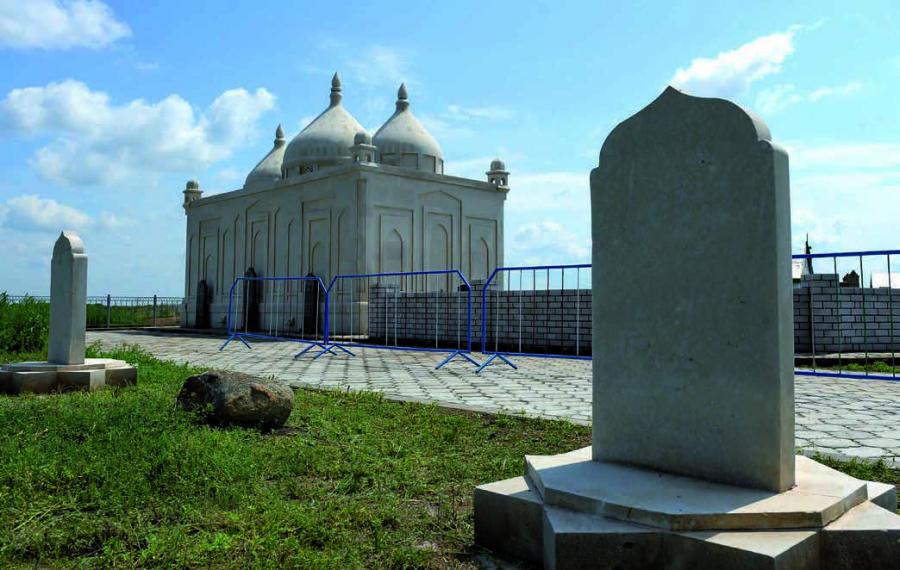
Isabek Ishaan khazret Mausoleum is a complex structure that includes two white stone mausoleums, a mosque and a house for pilgrims. Isabek Khazret himself, his only son Nurmuhamed and younger brother Mohammed Niaz were buried in a three-dome mazar. The single-dome mazar was erected on the burial site of Isabek's descendant, St. Zhandarbek kozha. Both the mausoleum is nine and seven meters high, made of white stone. At the place where the white mosque built by Isabek Ishaan was located, a new mosque was built. The gate in the form of an arch is made in Bukhara style as a reminder of the ancient city, where Isabek Ishaan studied in the middle of the XVIII century.
Nowadays Isabek Ishaan khazret Mausoleum is a sacral object of great historical and cultural importance. In the syncretic consciousness of the Kazakhs, the tomb of Isabek is a holy place, a place where the aruakh of Khazret can help to cope with misfortunes and illnesses, and to this day the tomb of the famous aulie attracts a huge number of people from all regions of the country.