Information
- Location
- Павлодар облысы, Bayanaul District
- Period
- 3000 BCE – 800 BCE
- Type
- Petroglyph
- Kind
- Archaeological sites
- Authors
- Мерц Виктор Карлович
Sources
- Қазақстанның киелі орындарының географиясы: Табиғат, археология, этнография және діни сәулет өнері нысандарының тізілімі / Жалпы редакциясын басқарған ҚР ҰҒА академигі Байтанаев Б.Ә. – Алматы: Ә.Х. Марғұлан атындағы Археология институты, 2017. – 1-шығарылым. – 904 б.
Description
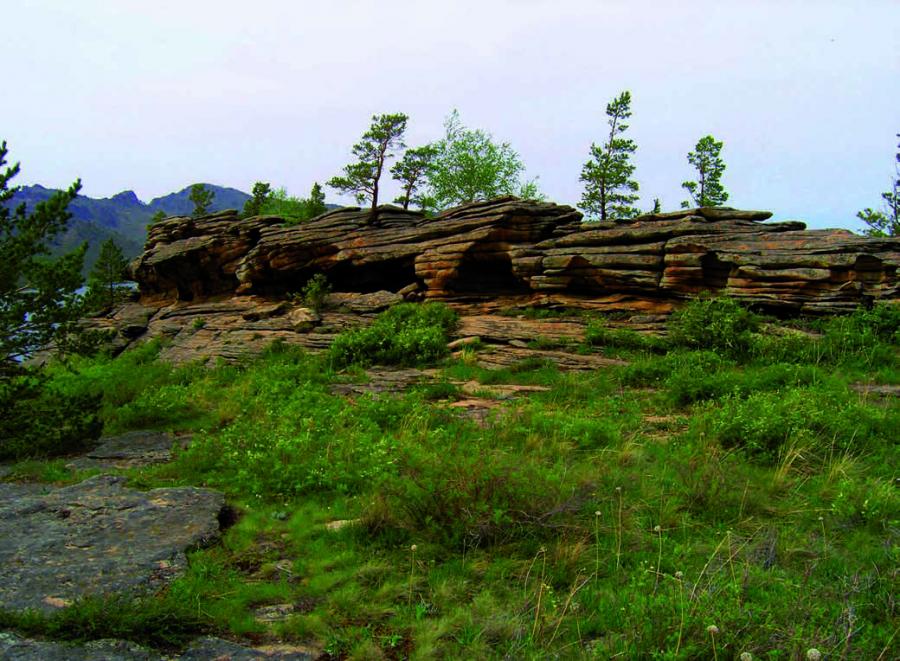
It is located 5.5 km northwest of Bayanaul village, on the south-eastern shore of Zhasybay lake (Bayanaul district, Pavlodar region). The monument was discovered in 1926 by the geographer, a member of the Omsk branch of the Russian Geographical Society P.L. Dravert and was first published by him in 1930. Then he was repeatedly examined by Pavlodar local lore specialists and scientists. On the initiative of the oldest local historian of the Pavlodar region I.V. Lagutin, who was developing the first tourist routes in the 1960s, the grotto with rock paintings on the lake Zhasybay was named after its discoverer P.L. Dravert.
The sacral nature of the monument lies in its use by the ancient inhabitants of the Bayanaul mountains as a cult object, as evidenced by the rock images made by ochre in the grotto. Besides, there were small barrows next to the grotto, built of large blocks of granite.
The rock paintings in Dravert's grotto are actually a small grotto-shaped niche 2.8 m wide, 2.10 m deep, 1.8 m high at the entrance with a flat vault formed in a rocky ledge. The drawings are made in red ochre on its ceiling part. The images occupy about 1 m2, about 15 figures can be seen, 10 of them can be defined as anthropomorphic. The composition forms a complex plot, probably connected with cult actions. Some of the drawings are not easily discernible, as they have been exposed to moisture.
It is a cult place of ancient people, reflecting their ideological ideas associated with mythological images. It is of great scientific and cultural-historical importance as a source of primitive art, archaeology and history of spiritual culture of the Eneolithic and Bronze Age tribes of Northeast Saryarka.