Information
- Location
- Түркістан облысы, Kazygurt District
- Period
- 1401 – 1900
- Type
- Сomplex, Mausoleum
- Kind
- Ensembles and complexes
- Authors
- Ёлгин Юрий Андреевич
Sources
- Қазақстанның киелі орындарының географиясы: Табиғат, археология, этнография және діни сәулет өнері нысандарының тізілімі / Жалпы редакциясын басқарған ҚР ҰҒА академигі Байтанаев Б.Ә. – Алматы: Ә.Х. Марғұлан атындағы Археология институты, 2017. – 1-шығарылым. – 904 б.
Description
According to the local legend, soon after the completion of the Ismail ata mausoleum in Turbat, Timur ordered to erect the Iskhak ata mausoleum, which laid the foundation for the cult complex of the same name. The life description of Iskhak ata has become a basis of a sacral history of a mausoleum and all complex. Iskhak ata was the son of Ismail ata. The nisba of Kazgirdi (by the toponym Kazykurt) was fixed behind him. His full name is Iskhak Khoja ibn Ismail ata Kazgirdi at-Turkistani. It seems as if he was the author of one of the earliest lists of Nasab-nama (the work of Hadith al-arifin), the so-called "Kabul list". His activity in the field of Sufi flowing south of Sairam (A.K. Muminov). A.A. Divayev names a more specific place - Sanjab (i.e. Turbat - author).
The complex is located on the southern outskirts of the village, on the left bank of the river, in a picturesquely hilly area in a vast cemetery. Includes a group of mausoleums of the XV-XIX centuries, which were destroyed and periodically restored. Currently, the entrance to the necropolis is decorated in the form of a gate with a lancet arch, built of modern rectangular brick. Inside the courtyard, to the left of the gate, there is a mosque of later origin, which is not of architectural interest. The basis of the complex is the mausoleum of Iskhak ata with a small mausoleum adjoining it, destroyed below the middle of the walls, and the mausoleum of Bezimyanny, located on the slope of the hill. Later on, several mazars were also discovered, not belonging to the category of monumental architecture, but endowed with sacral properties, built by the local population in the traditions of residential folk architecture of the XIX - early XX centuries (frame walls with plough filling, girder floors, flat roof).
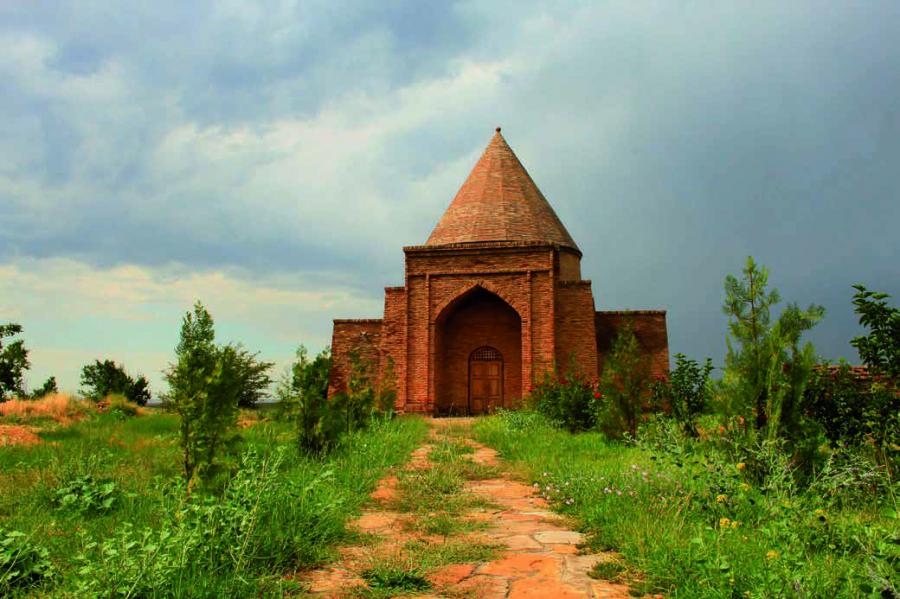
Mausoleum of Iskhak ata. XV-XIX centuries. Located on top of the hill. It is a portal-dome building. The central hall is adjoined by side pockets with tombstones connected to it by wide openings from three sides. As a result, the plan received a clearly expressed cruciform composition.
The arrow arch of the portal is enclosed in a U-shaped frame of deepened in the masonry strips. In the course of the restoration, which was completed by the beginning of the 2010s, a tent dome was built. The transition to it is carried out with the help of a tier of arched and intermediate thyroid sails. In two side vaults in the interior of the ceiling are beam vaults, in the third - the simplest beveled corners to move to a small dome. The decor is completely missing. A low portal, construction of a portal arch, dome constructions refer the monument to the Tashkent school of architecture of the XV-XIX centuries. Side pockets, crypts, present in many buildings, regardless of their function, can be considered a regional local feature (although in some cases they are also found in other regions).
The remains of a small portal-dome mausoleum (Small mazaar. XI-XII centuries?) adjoined the southwest corner of the mausoleum of Iskhak ata. The figured brickwork of its walls (paired bricks, "bows") gives it an archaic look.