Information
- Location
- Түркістан облысы, Turkistan city
- Period
- 450 – 1900
- Category
- Historical and cultural monuments of republican significance
- Type
- city
- Kind
- Archaeological sites
Sources
- Қазақстанның киелі орындарының географиясы: Табиғат, археология, этнография және діни сәулет өнері нысандарының тізілімі / Жалпы редакциясын басқарған ҚР ҰҒА академигі Байтанаев Б.Ә. – Алматы: Ә.Х. Марғұлан атындағы Археология институты, 2017. – 1-шығарылым. – 904 б.
Description
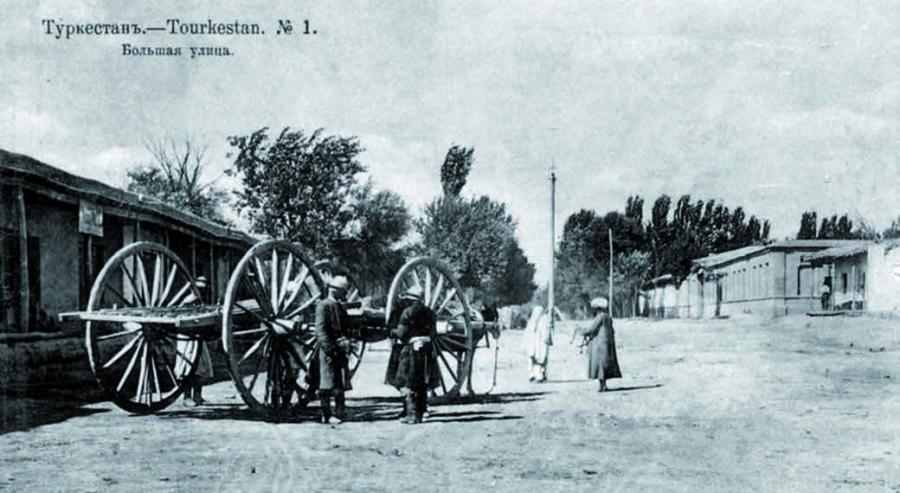
Turkestan is a sacred city (SKR). The word "Turkestan" is used in literature as a historical and geographical concept that defines the settlement of Turkic-speaking peoples of Central Asia. In Armenian and Persian sources of the VI-VIII century this word denoted the territory from the Caspian Sea and the Ural Mountains to the Altai and China. Later the borders of Turkestan region changed in connection with historical events in the direction of increase and decrease. For some time this toponym was also used for a separate historical and cultural region. In fact, Turkestan was understood as the territory from the Urals to the Altai, from the Caspian Sea to China, including Xinjiang, from modern Tomsk and Tobol to Iran and Afghanistan, covering an area of more than 3 million km2.
At the end of the I millennium B.C. - At the beginning of the I millennium B.C., the Talas River basin area, its western districts - the interfluve of Talas and Syr Darya, and the slopes of the Karatau Mountains were inhabited by the Kangyui tribes. Chinese sources say that the contemporaries of the Kangyu tribes - the Saks, Uysuns - were engaged in cattle breeding, hunting and agriculture. In the Turkestan oasis in the ancient times (V-IV centuries B.C. - IV-V centuries) there were more than 30 cities and settlements: Shashtobe, Koksarai I, Kaztobe, Meiramtobe, Karachik I-IIІ, Aktobe, Bershintobe, Shash-ana, Ushtobe I-IIІ, Yasy, Sidak-ata, Shornak, Maybalyk, Okzhetpes, etc. The ancient state of Kanga (Kangyui) is mentioned in "Avesta" and "Mahabharata".
A. Kekilbaev writes: "The territory of the Syr Darya and Karatau was a frontier where close relations between nomads and sedentary farmers took place. Hence, the resulting technological impact has also strengthened the cultural impact...". Orientalist Zikiriya Zhandarbekov found out in his study of the problem of the origin of the city of Shaugar that this city is mentioned in Chinese sources as the Kangyuan city of Shu, and it is also written that when the army of the Kangyui people took part in the military campaign, each time 1,000 sheep were sacrificed in special places for ritual actions. Based on this, the scientist concludes that the designation of Turkestan as "Second Mecca" is connected not only with Islam and the name of preacher Khoja Ahmed Yasawi, but also long before the adoption of Islam the city of Turkestan was a religious center for the peoples inhabiting Central Asia.
Undoubtedly, Turkestan region since ancient times was not only the economic center, but also a place where the religious outlook and nomads, who inhabited the territory, starting from Altai, who worshiped the god Tengri, and the settled population of Turan, who worshiped Zaratushtra, appeared and developed in close connection. In this regard, the poet M. Zhumabaev, who said that Turkestan is "the gate of two worlds", is right. Two types of religion coexisted in the same living space:
The worship of nomads to the god Tengri and the religion of settled farmers is Zoroastrianism.
One of the cult buildings was uncovered on the hillfort of Yasy-Kultobe - the thickness of the walls is 1.5-2 m with the remaining height of up to 4.5 m. Archaeologists have come to a conclusion that the given construction is a temple where fire was worshipped. In the detailed study it was also found that the construction of the temple began in the second century B.C. After the visit of Chinese traveler Zhang Qian in the second century B.C., the ancient settlement of Yasy became one of the main outposts of the Great Silk Road, designed to serve trade caravans, and by the III century A.D. turned into a major religious and cultural center of the Turkestan region. With the emergence of the Great Silk Road on the caravan roads every two farsah (10-12 km) were built such fortresses for the development of infrastructure of the most important trade and economic route at that time - Maybalyk, Tashnak, Yasy, Okzhetpes, Sidak, Shornak, Karatobe Sauran. These monuments are about 2,000 years old.
Turkestan oasis and its cities were consistently part of the territory of the Kangyui state, were subordinate to the Ephtalites (White Huns), were part of the Turkic and West-Turkic Kaganates, in the VII-VIII centuries were conquered by the Turgesh, in the IX-XI centuries. This region was then a vassal of the Seljukids (Oguzes) and Karakitays, and from the end of the ХІІ century until the first half of the ХІІІ century it was under the rule of Khorezmshah. Writer Abish Kekilbayev writes that "Turkestan has become the center of historical events of the Eurasian continent, not its outskirts, during the last one and a half thousand years as a result of political and ideological metamorphosis. This was mainly due to the emergence of the Turkic ethnic race in the region and the spread of Islam as a religion in the steppe among the nomadic community. The rise of Turkestan to such importance was closely connected with the strengthening of the role of the Oghuz state... As Mehmet Neshri says, Oguz Khan came to Turkestan with his companions and fortified himself in the area called Yasy... Having conquered the Turkestan region, he finally achieved victory... Thus, thanks to the Oguzes, who were near Turkestan in ancient Karashik, the whole world learned the ethnonym of the Turkic people, who inhabited the territory from the Altai to the Balkans. Oguzes gave rise to two processes. They have begun process of Turkization of peoples of the Central Eurasia and have accelerated process of distribution of an Islam on this theory. The center of these processes became the spiritual capital of Oguzes - the city of Turkestan".
By means of comments in the Hikmeths written in the Turkic language, Sufi preacher Khoja Ahmed Yasawi made the language of the Koran understandable for Turkic-speaking peoples. He found answers to the questions which were vital for both nomads and sedentary population. Without detracting from the merits of traditional local religious beliefs, Ahmed Yasawi showed new aspects of Islam. Already during his lifetime he became a spiritual mentor for the whole Turkic world, his teachings spread across the Kazakh land. During the collapse of the Mongolian Empire, the Turkestan oasis with its towns entered the ulus of Genghis Khan's son, Shagatai/Chagatai. In the 70-ies of the XIV century Amir Timur began attempts to subordinate himself to the Syr Darya cities of White Horde. In 1404 the Turkestan oasis has passed in submission of grandson of Amir Timur - Ulugbek.
The 70-80s of the XVI century became the time of struggle for the Syr Darya cities between the Kazakh khanate, the Tashkent Shaibanids and the rulers of Bukhara. From the side of the Kazakh khanate this struggle was led and conducted by Kazakh khans Tahir, Khaknazar, Shygay, Tauekel and Esim. In 1598, Tauekel Khan conquered Tashkent, Fergana and Samarkand. The case of Tauekel khan was continued by Esim khan, who at the end of the XVI century proclaimed Yasy-Turkestan the capital of the Kazakh khanate. Since that time, 32 cities on both banks of the Syr Darya River for 200 years (1598-1798) were firmly included in the Kazakh Khanate, and Turkestan became the "Fatherland" of the Kazakh people.
From the XVI to the XIX centuries 19 Kazakh khans ruled from Turkestan, which was their capital. 21 Kazakh khans, 8 sultans (members of the khan's family, Genghisids), 14 bies and 50 Batyrs (military leaders) were buried in the mausoleum of Khoja Ahmed Yasawi and on its territory. All this time Turkestan was a political, economic and spiritual center of Turkic-speaking peoples, and the mausoleum of Khoja Ahmed Yasawi became a pearl of spiritual culture, which became a national pantheon for outstanding people of the nation. Islam has five pillars that are binding on all Muslims. For the Kazakhs, the sixth commitment was a pilgrimage to Turkestan to the Khoja Ahmed Yasawi Mausoleum, where they worship the memory of their ancestors and their deeds.
Magzhan Zhumabaev wrote: "Tamasha Turkistanday zherde tughan, Turikting tangir bergen nesibi ghoy" - "Happiness to be born on the sacred land of Turkestan is a blessing given by God to the Turkic people". With these words, he expressed his admiration for the history of Turkestan. Abish Kekilbaev explains these verses by M. Zhumabaev: "Historical roots, spiritual values, unity of people and nation come from Turkestan. The city of Turkestan is thus the centre of the unification of all Turkic peoples. Since independence, Turkestan has been a national symbol of unity".
Sacred Turkestan, whose history goes back more than 2,000 years, is the spiritual centre of the entire Turkic people, its fatherland and the home of the entire Kazakh people.