Information
- Location
- Түркістан облысы, Kentau city
- Period
- 1 – 1900
- Category
- Historical and cultural monuments of republican significance
- Type
- city
- Kind
- Archaeological sites
- Authors
- Смагулов Ерболат Акижанович
Sources
- Қазақстанның киелі орындарының географиясы: Табиғат, археология, этнография және діни сәулет өнері нысандарының тізілімі / Жалпы редакциясын басқарған ҚР ҰҒА академигі Байтанаев Б.Ә. – Алматы: Ә.Х. Марғұлан атындағы Археология институты, 2017. – 1-шығарылым. – 904 б.
Description
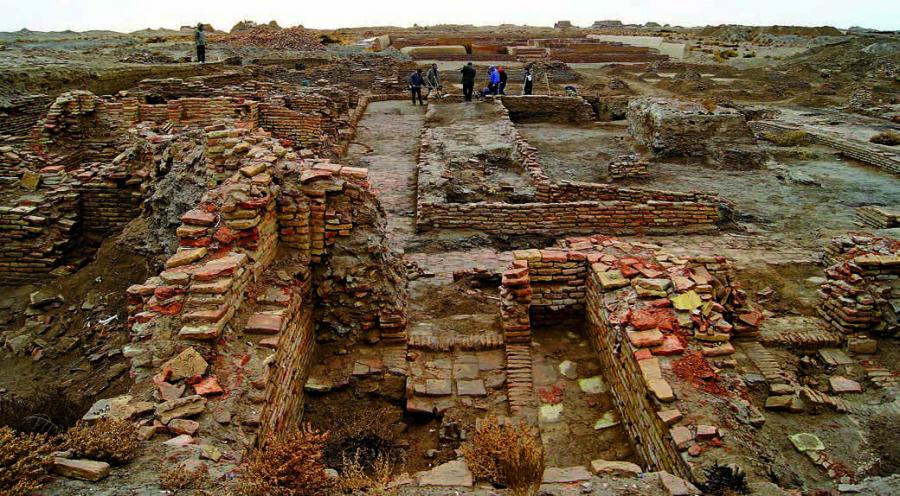
Hillfort Sauran is an archaeological site of the famous medieval city, which played an outstanding role in the history of Kazakhstan. Its significance in the history and scale is comparable with that of such cities as Otrar, Sighnak or Taraz.
Large-scale archeological research on the hillfort was started in 2004 and is aimed at preparing its various architectural monuments for further conservation and restoration, creation of an architectural and archaeological museum-reserve. Various types of monuments have been studied at the hillfort in different parts of the area: the remains of the northern central gate in the fortress wall have been uncovered; the ruins of the mosque "namazgoh" near the city necropolis and the large manor house have been cleared. However, the main archeologically explored monuments are located on the central city square, on the Sauran Registan, where they once formed an impressive architectural ensemble. It is Zhumamechet of the XIV-XV centuries, madrassa of the beginning of the XVI century, building of monumental khanaka...
The central city mosque flanked the square from the western side. During excavations it was established that the building of the mosque had a closed-door layout. The outer contour of the outer walls of the mosque complex forms a rectangle measuring approximately 32.0 x 33.5 m. The central courtyard had a size of 15.3 x 17.8 m, and all the rooms around the perimeter were facing it. The southwest side of the courtyard was enclosed by the main (or mihrab) part of the mosque building, which was facing the courtyard by an arched entrance portal. The plan of this main part of the complex had a five-nave two-row composition with arched-dome ceilings. Buildings of madrassas and khanakas formed "kosh" ensemble, which decorated the square from the north side.
The madrassa is a building of a symmetrical courtyard composition, rectangular in plan (31.5×28 m). The main entrance, highlighted by two minarets, is oriented to the north-west. Along the perimeter of the courtyard there were living rooms-hujras for novices and teachers and rooms for classes. Full opening of this remarkable structure allows to identify it with that madrassa which has been constructed at the end of the XV - beginning of the XVI centuries which minarets still stood in the second half of the XIX century.
Although excavations around "Sauran Registan" are still far from complete, we can say with certainty that in this case we have a magnificent example of an intra-city ensemble of religious buildings of the XIV-XVI centuries.
In 120 m to the east from fortress walls of the Sauran kala there is a sacred place of local population. This is the necropolis of Karakan aulie with the mausoleum of Karakan ata (Turkestan district, Zhibek zholy rural area). It is actually an urban necropolis of medieval Sauran. Here ruins of mausoleums from burnt brick and a tomb without structures have remained. Plots of the necropolis are surrounded by a dual of pakhsa, the total area of which is 40-60×40-80 m. From plough walls now there are only ruins in the form of low ramparts surrounding the territory.
The locals say that Karakan ata is buried in the largest mausoleum. One of these legends says that in ancient times the cattle of the inhabitants of the city of Sauran fell ill with Karakan disease. One of the residents, together with his cattle, spent the night at the necropolis, rescuing the cattle from the disease. Since then, the necropolis has been considered a holy place and has become a place of pilgrimage. The necropolis is regularly used as a place of worship. The locals call it the Karakan ata, the Karakan aulie.
Evidence of the growing popularity of this mazar is the various signs installed on the necropolis. Most recently (in 2013), a large granite obelisk appeared in memory of some heroes - the "ancestors of the Karakhanids",1 who brought Islam here, and an iron arch. N
There's a lot of confusion here. The consequence of changing the word Karakan to Karakhan when writing the text on the new arch. This absurdity is not so harmless, as it may give rise to new historical "discoveries" in the future.