Information
- Location
- Түркістан облысы, Sayram District
- Period
- 1 – 1900
- Category
- Historical and cultural monuments of republican significance
- Type
- city
- Kind
- Archaeological sites
- Authors
- Байтанаев Бауыржан Әбішұлы
Sources
- Қазақстанның киелі орындарының географиясы: Табиғат, археология, этнография және діни сәулет өнері нысандарының тізілімі / Жалпы редакциясын басқарған ҚР ҰҒА академигі Байтанаев Б.Ә. – Алматы: Ә.Х. Марғұлан атындағы Археология институты, 2017. – 1-шығарылым. – 904 б.
Description
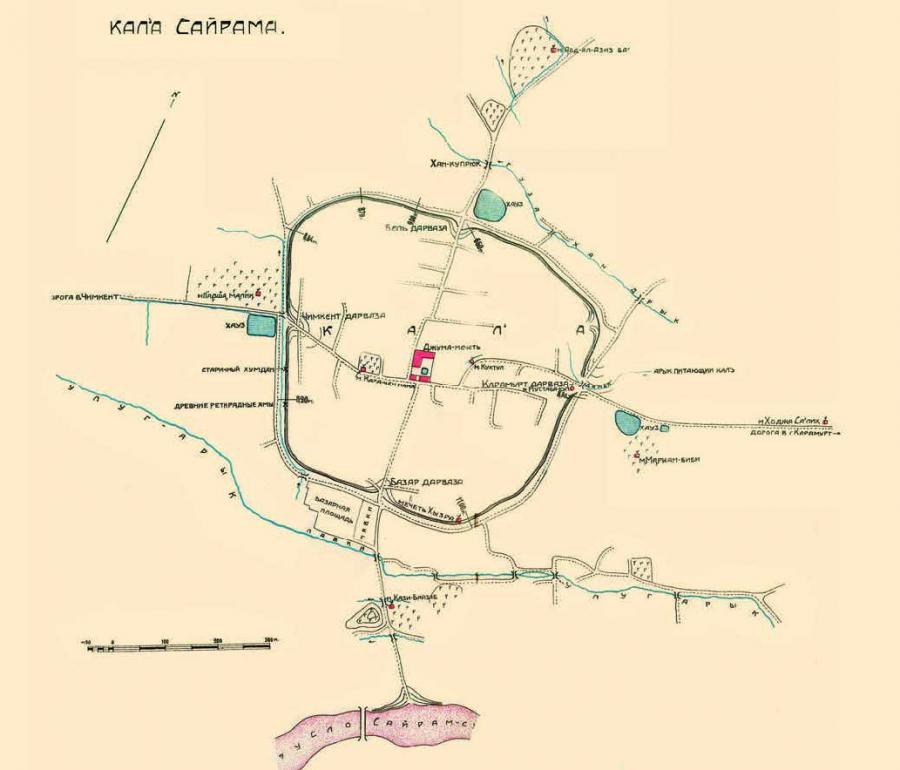
Sairam hillfort is the largest monument of urban culture and modern settlement in the south of Kazakhstan. It is identified with the town of Ispidzhab, known from medieval written sources. Nowadays Sairam is a part of Shymkent city as a separate microdistrict and is located on its territory.
The rise of Ispidzhab, at that time located in the extreme east of the Muslim world, began in the IX century. According to al-Belazuri, this happened after the campaign to the south of Kazakhstan by Samanid Nuh ibn Assad. We read about it: "The capture of the fortress of Isbijab was in the olden days, then the Turks [i.e. Turks] took it and a group of people from the inhabitants of Shash with them, then took it Nuh ibn Assad to the caliphate of the emir of the faithful al-Mutasim Billah and built a wall around it, surrounding the vineyards and crops of its inhabitants".
The composition of al-Belazuri was written in the second half of the IX century and, as it follows from the text, the information about the events related to the conquest of Ispidzhab belongs to the years 833-844, according to which we can state the beginning of the active spread of Islam in Kazakhstan.
After the campaign of Nuh ibn Assad Ispidzhab became a great frontier fortress on the border with the nomadic steppe and a "place of war for faith". Ispijab was the only tax-exempt city at the time, and in fact it received the status of a free economic zone. In this regard, the greatest Arab geographer of the X century al-Makdisi said: "This is a glorious border district and a country of war for the faith. ...They don't know the bad harvests and [don't pay] the kharaj".
Before the adoption of Islam, the Turks had their own gods and cults, which they did not renounce immediately, only centuries later. And even in the beginning of the XIII century Yaqut al-Khamavi in his essay about the city of Ispijab wrote: "There was neither in Khorasan nor in Maverannahr a city on which there was no haraj, except for Asfidzhab, because it was a great frontier fortress and was freed from the kharaj because of this, so that its inhabitants spent their kharaj on weapons and costs of staying in this country".
The tax-free policy and convenient location of the city on the Great Silk Road have a positive impact on the economy of the region. Ispijab is beginning to develop and expand. From the whole territory of Maverannahr, and not only, it is inhabited by different population, which forms around it the rabads and rural district. It is no coincidence that a medieval anonymous geographical composition by Hududud al-alem wrote that Ispijab is a "mine" for merchants around the world.
Sacred function Sairam had originally. Mahmoud Kashgarsky pointed out: "Sairam is the name of a white city (al-Medinat al-Bayda), which is called Ispijab. Saryam is a modification of this. Here the white color was not important as a color definition. Al-Medinat al-Bayda, literally White City/Blessed City, is a sacred city.
In Sairam, a significant number of monuments of cult architecture are concentrated, which can be divided into the following groups:
- monuments associated with the names of Islamic missionaries (Abdel-Aziz-Bab, Mir-Ali-Bab, Padshah-Malik-Bab);
- monuments associated with the name of Khoja Ahmed Yasawi (Ibrahim ata, Karashash ana, Mahmudhan ata, Mustafakuli ata/Suzik ata, etc.). Monuments bearing the names of biblical and Koranic prophets;
- burials of figures (scientists and historians, poets and theologians), historical and legendary persons who left a trace in the history of Sayram, also endowed with sacral significance and became holy places (Kazi Baizawi, Khoja Hamid ata Baizawi, Kuibiddin-vali Gulama, Hasan Baizawi, Zhusip Sayrami, Ahmet al-Ispidjabi and others).
Based on the survey data, V.V. Bartold, P.P. Ivanov, M.E. Masson pointed to the belonging of some saints of Sairam to the Bible, and with all certainty - to the Christian origin of Mazar Mariam-Bibi. Idris, Josh, Khyzyr, Salih - these names are lined up in a definite semantic row. The name Bibigias-ana, the mother of the legendary Khyzyr, is also "asked" here.
The small list of Sairam saints under consideration is divided into four groups of prophet names:
1) Both in the Bible and in the Koran (the prophet Idris, identified with the Enoch of the Bible);
2) Salih, to whom the whole surahs are dedicated in the Koran, but his name is not in the Bible;
3) Josh is identified with the biblical prophet Joshua, the author of one of the books of the Old Testament, but his name is not in the Koran;
4) Kyzyr-Paigambar, a prophet not known to the Bible, is mentioned in the Koran as an anonymous companion of Musa (Moses).
Although the identification of the Saints of the Sairam with biblical characters is not absolute, there is a certain semantic connection between them, which is determined by many factors - first of all, by the unity of their location in the sacred city of Sairam. One can name a number of parallels in the names of biblical and Koranic prophets: Nuh - Noah, Ibrahim - Abraham, Yakub - Jacob, Musa - Moses, Daud - David, Zakaria - Zachariah, Yahya - John the Baptist, etc. There is even harmony in the spelling of some names, for example: Jabrail is Gabriel. These agionims could appear in Sairam in different ways:
1) from the Koran and Muslim legends; they, in their turn, assimilated and processed many moments of Arab and Jewish-Christian mythology quite easily and quickly, because their origins had much in common. It is known that "...Mohammed operated with the information from Christianity and Judaism, known to him in the oral transmission" (let us add that these information he drew primarily from Nestorians);
2) directly from the Bible, introduced by Christians; given the multi-ethnicity of Sairam (Ispijab), it is easy to suppose that it is inhabited by a number of different faiths, not excluding Christianity of one kind or another.
Sairam biblical and Koranic mythologies, which are closely intertwined, forming a single complicated complex, undoubtedly, have a real historical ground.
To some extent, it sheds light on the religious and ethnic situation in Ispijab on the eve of the Arab conquest of Safi al-Din Oryn Koylaky "Nasabname", dated the second half of the XIII century. In particular, it says that when Iskhak-Bab (Syrian military leader and perhaps the first Islamic missionary in southern Kazakhstan) came to Sairam, there was one ruler. His name was Korkoz, nicknamed Nakhibdar. There were 160 thousand tarsus houses in Sairam. And there were 300 thousand rustaks. All of them were tarsus. Nakhibdar has declared to Iskhak-Bab, that 70 generations of his ancestors were tarsus. There is no doubt that many of the information in this essay is exclusively legendary, and the numbers are clearly exaggerated. Nevertheless, the data from the text on tarsus are noteworthy and indicate the possibility of existence of Christian communities in Sairam. According to the majority of scholars, the term tarsus is a designation of groups of Christians who were widely spread in Asia.
Let us point out that the presence in Sairam of the tomb of Maryam-Bibi, identified with the Virgin Mary of the New Testament, the mother of Jesus Christ, may be another confirmation of the Christian community (or communities) that existed before in Ispijab.
What character could pre-Islamic cults be in Ispijab? Biblical themes are not excluded in their names, and not only. It is known that the spread of Christianity in the Middle East and the Central Asian region began even before Islam became a world religion. Later, pre-Islamic cults were intertwined both among themselves and with orthodox Islam, where even the cult of Khyzyr took a distinct Sufi hue.
The status of the "sacred" city of Sairam has been preserved till nowadays, being a large object of pilgrimage of Kazakhstan. It is no coincidence that the people of Sairam pronounce it: "Sairamda bar sansyz bab" - "Saints in Sairam are countless".