Information
- Location
- Түркістан облысы, Sayram District
- Period
- 1850 – 1900
- Type
- Mausoleum
- Kind
- Buildings of monumental art
Sources
- Қазақстанның киелі орындарының географиясы: Табиғат, археология, этнография және діни сәулет өнері нысандарының тізілімі / Жалпы редакциясын басқарған ҚР ҰҒА академигі Байтанаев Б.Ә. – Алматы: Ә.Х. Марғұлан атындағы Археология институты, 2017. – 1-шығарылым. – 904 б.
Description
Located in the center of Sairam, 300 m from the intersection of the two main highways of medieval Ispijab-Sairam. The main, southern facade overlooks the street leading to Karamurt (Amir Temir Street).
In the sacred history of Sairam the mausoleum of Khoja-Talig (in common the distorted name was fixed), along with the mosque of Khyzyr-Paigambar and the mausoleum of Bibigias-ana, is a material evidence of the presence in Sairam of the legendary prophet Khyzyr, who is considered a native of the city and his patron. According to local legends, his father was Khoja-Salih (phonetic variants of Salyk-Khoja, Khoja-Talig, Khoja-i-Taliyata). According to local belief, every Friday at dusk Khyzyr-Paigambar appears in Sairam to worship the graves of mother Bibigias-ana (near the Mausoleum of Padshah-Malik-Baba) and father Khoja-Salih. This fact puts the monument on a par with Sairam's biblical and Koranic agionyms. According to the genealogy in Sairam and reflected in "Nasab-nama", Khoja-Salih (Shalyk/Shalukh) is the son of Sam, the son of Noah (Biblical Noah). Salih is not mentioned in the Bible, but in the Koran he is in line with the pre-flooded prophets and his name appears nine times. Salih was the prophet of the Koranic Samudite people living in the north of Arabia, sent by the Lord with a sermon. But the Samudites rejected him. "And their concussion befell them, and in the morning they remained in their dwelling downhill" [Koran, 7:76]. But Salih was saved by grace from the punishing earthquake. The story shows the allusion to the Old Testament cities of Sodom and Gomorrah, which had been punished by the Lord. Thus, the legendary tradition concerning a Koranic legend, testifies to very ancient roots of the cult connected with occurrence of a mausoleum of Khoja-Talig.
In 1963, by order of the Chimkent Regional Museum, an architectural measurement of the mausoleum was made (T. Podnebesnaya). In 1981-1983 it was examined in the course of certification of architectural monuments by the expedition of the Kazprojectrestoration Institute of the Ministry of Culture of the Kazakh SSR. The mausoleum is included in the Code of Historical and Cultural Monuments of Kazakhstan. In the 1990s, a partial restoration of the remaining volume of the building was carried out. In 2004, the archeological expedition of the South Kazakhstan State University named after A.O. Auezov (B.A. Baitanayev) in the protective zone of the mausoleum, 2 meters from its eastern facade was laid excavation, the materials of which allowed to judge that the legend does not quite unreasonably refer to the time of the monument to the Karakhanid period. In the second half of 1980-2000s the monument was considered in special publications in connection with the genesis and compositional features of Sairam's memorial constructions (B.A. Baitanayev, Yu.A. Yelgin).
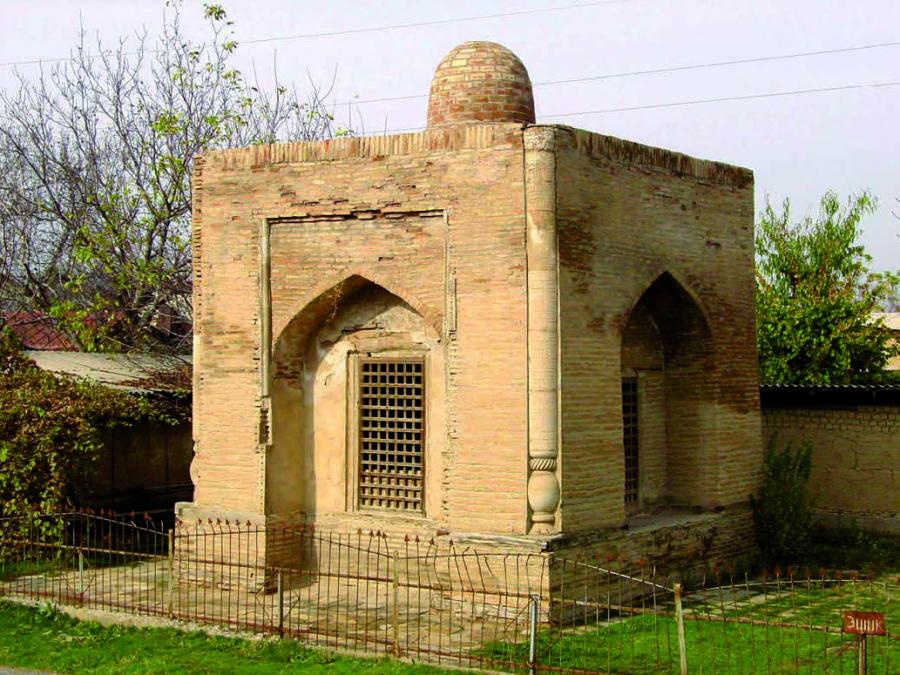
It was believed that the mausoleum was built in the XVI-XVII centuries, and the modern building was erected in the second half of the XIX century. In a laying of walls the multiformat and multi-temporal brick of the Central Asian type on a clay solution is used; arches and domes are laid out of a square brick on a ganche solution. The sacred content of the Khoja-Talig mausoleum, which is related to the Biblical and Koranic tradition, may have indirectly influenced the unusual structure of the construction. Initially, the mausoleum was covered by a double dome - internal, flat, and external, spherical, on which top a small minaret was installed. In 1928, the crowning part of the building was dismantled. In terms of the mausoleums it approaches the square (6.4×6.2 m). The room is square, measuring 3.37 x 3.3.9 m. From the original double dome remained only the inner, spherical shape of the low rise dome, now hidden by ridiculous layers of the 2000s. Archaic type of arched sails serve as a transition from the square room to the dome. In the southeast corner there is a spiral staircase leading to the roof. Closer to the entrance there is a simple tombstone oriented on the north-south axis.
The monument belongs to the type of central single-chamber mausoleum. The three-dimensional composition of the monument dates back to the four-arch chortacas, opened on four sides. The Khoja-Talig Mausoleum is also oriented by four almost identical facades with pointed arches on the sides of the world. A rectangular doorway was made in the western facade. The rest of the arches have low window apertures equal in height to the entrance, with wooden lattices (panjars). The arches in the western and southern facades are enclosed in U-shaped frames and architecturally designed unlike the other two, which do not have any decor. Probably, that is why they are called "portals", although architecturally they are not, not acting from the main volume neither in height nor in width. Attention was paid to them with the help of decor, now almost lost. It was based on three-quarter corrugated columns on jug-shaped bases, folk ornament is made in the technique of contour carving on gunch. In the 1960s one could see traces of primitive paintings in the form of "tea trays". At the top of the facades was a dandana in the form of a series of bricks placed on the edge (lost). The separation of the western and southern facades shows a certain tendency connected with Sufi ideology and practice, which has its roots in the Karakhanid and Samanid times. Currently, the mausoleum is "restored" without taking into account historical and iconographic data.
Architectural monument of republican importance. Since 1982 it has been protected by the state. The object of pilgrimage and religious tourism.