Information
- Location
- Түркістан облысы, Otyrar District
- Period
- 1 – 1500
- Type
- City
- Kind
- Archaeological sites
- Authors
- Байпақов Карл Молдахметұлы
Sources
- Қазақстанның киелі орындарының географиясы: Табиғат, археология, этнография және діни сәулет өнері нысандарының тізілімі / Жалпы редакциясын басқарған ҚР ҰҒА академигі Байтанаев Б.Ә. – Алматы: Ә.Х. Марғұлан атындағы Археология институты, 2017. – 1-шығарылым. – 904 б.
Description
In 1900 was surveyed by N.I. Rudnev, in 1947 - by South Kazakhstan archeological expedition (A.N. Bernstam), in 1975 - by South Kazakhstan complex archeological expedition (K.A. Akishev, K.M. Baipakov).
In the scientific literature the ancient hillfort of Oksus (Oksyz) is identified with the medieval town of Vesidzh, known as the crossing of Syr Darya River. In the XIII century the city was called Zernuk, it was mentioned in the description of the birthplace of the outstanding scientist and encyclopedist Abu Nasr Al-Farabi. The hillfort of Oksus and agricultural settlements around it were supplied with water from the main canal Ak aryk, the source of which was located 7 km south-east of Oksus on the Syr Darya.
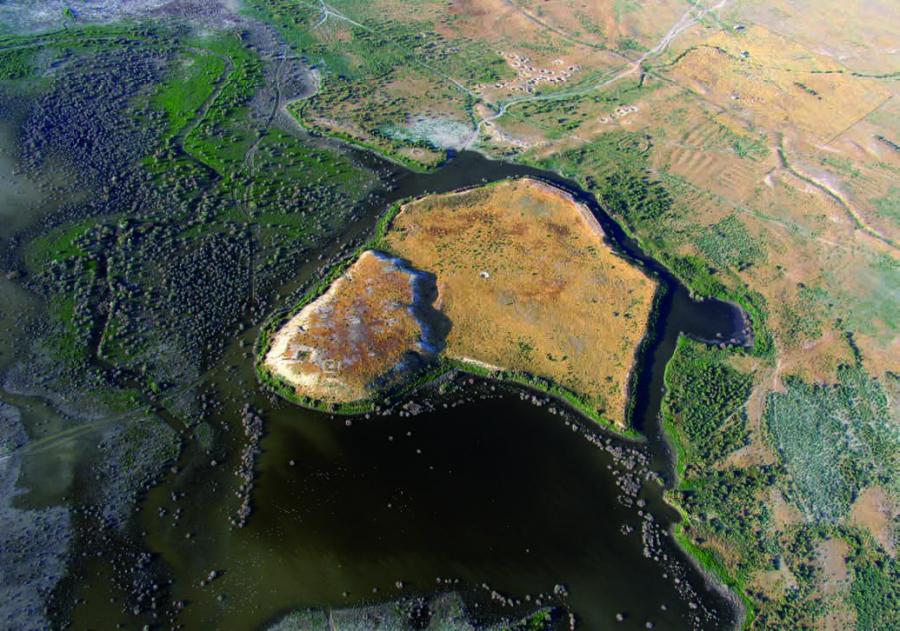
The hillfort is a two-story hillock. The citadel is fixed in the form of a 13.5 m high hillock with sides: northeast - 90 m, northwest - 75 m, southeast - 180 m and southwest - 150 m, which is located in the northeast part. The lower part - Shakhrestan - has sides with length from 150 to 200 m. The height of the Shakhrestan hillock is 3-5 m. Along the perimeter, Shakhrestan was surrounded by a wall with towers at the corners and perimeter every 30-40 m. The remains of the towers can be traced in the form of 1.5 m high hills. Around the hillfort there is a moat, the depth of which is now 2-3 m. Inside the hillfort there are two entrances located in the eastern and south-western walls. From the south and west to the central ruins adjoins the unstrengthened rabad, on the territory of which the channel of the main canal passes. The area of rabad is about 20 hectares. Excavations were carried out at the citadel of the hillfort. On the area of 25 m2 it was possible to deepen on 1,5-2 m. It turned out that in the XIII-XIV centuries the abandoned citadel was used as a necropolis.
In 2017, a palace was opened at the citadel of the hillfort. Nine rooms were identified, including a ceremonial hall of 12.5 x 7 m. Its walls, 1.2 m thick, are made of mud bricks and the floors are paved with burnt bricks. It was adjoined by service rooms, the floors of which were also paved with burnt brick 26×26×5 cm in size. They were connected to the main hall by passageways. In one of the rooms (7) there is a cobblestone - tashnau. The entrance was decorated with pylons, and there were two equal-sized rooms (4 and 6) on the sides of the entrance, the entrances to which were also decorated with pylons. Ceramics, including watering ceramics, were collected: fragments of bowls, cups, chiragas, bronze cups for paint, probably for cosmetic purposes. Room 8 under the floor was probably buried after the palace was abandoned in the early 13th century, a small treasure of bronze jagataid coins.
The city of Vesidzh acquires special importance in connection with the name of Abu Nasr Al-Farabi. Al-Farabi's way of life is linked to the development of spiritual knowledge. He sought to grasp the postulates of ancient philosophy and the knowledge of his era to cover the entire range of sciences and their problems. As he progressed spiritually, he became more and more aware of his involvement in the society of all people in the world. He went from a small society, represented by the inhabitants of one city, to the middle one, represented by a separate people, and from him to the great one, representing the totality of all peoples.
The city of Vesidzh is undoubtedly one of the spiritual and sacral centers of our country.