Information
- Location
- Astana city, Esil District
- Period
- 700 – 1599
- Category
- Historical and cultural monuments of republican significance
- Type
- City
- Kind
- Archaeological sites
- Protected zone
- ✓
Sources
- Қазақстанның киелі орындарының географиясы: Табиғат, археология, этнография және діни сәулет өнері нысандарының тізілімі / Жалпы редакциясын басқарған ҚР ҰҒА академигі Байтанаев Б.Ә. – Алматы: Ә.Х. Марғұлан атындағы Археология институты, 2017. – 1-шығарылым. – 904 б.
Description
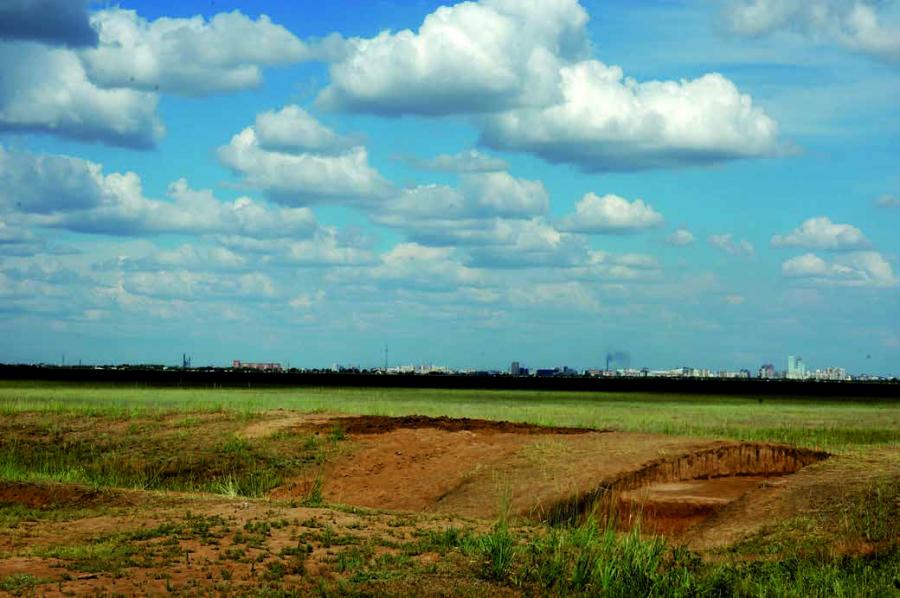
Located on the southern outskirts of Nur-Sultan (Astana), on the eastern shore of Buzykty lake, located in the floodplain valley of the left bank of the Ishim river, 5 km south-west of the ford of Karaotkel.
The first information about the monument was received from a member of the Russian expedition of 1816 in the Steppe Territory I.P. Shangin, whose travel notes include information about the ruins of the monument. More than a hundred years later, the object was examined by the director of the Akmola regional museum, L.F. Semenov. The first mapping was performed by the Central Kazakhstan archaeological expedition under the leadership of A.Kh. Margulan. The true discovery and study of the monument began in 1998 and is associated with the name of K.A. Akishev.
The area of the monument is 800 × 400 m. In compositional terms, it consists of four parts. In its center there are three sites, the so-called “blocks”, measuring 35 × 35 m. Each block has a shaft and an internal moat. The fourth structural part represents the remains of the irrigation system surrounding the ruins of the hillfort from east to north.
Archaeological studies of the monument were carried out for over 10 years, as a result of which more than 8000 m2 were uncovered. 10 dwellings, five mausoleums, two brick-burning kilns, over 60 burial structures and a unique fortification of the hillfort were discovered.
The results of the study of Bozok showed its special status, it is in many respects a unique object, providing the most diverse information about the life of the steppe population of Eurasia and first of all about the features of its sacral practice for over a thousand years.
The history of Bozok can be divided into several stages. The initial period is associated with the formation of the object as a cult in the early Middle Ages. The system of sites of various geometric (circle, square) forms, surrounded first by a moat, then by a shaft, reveals analogies in the religious buildings of the ancient Turkic period of Mongolia. The dating of the remains of a bridled horse, found during the clearing of the moat, also testifies in favor of this chronology. Details of horse equipment date back to the VIII – IX centuries. Square platforms of practically the same shape are grouped around the elevation in the center and form a three-lobe rosette in plan. The next period covers the time of the existence of the Kypchak Khanate. The hillfort Bozok receives the status of the Kypchak stakes. At this time, settlement complexes are developing in the hllfort Bozok, the irrigation system reaches its greatest development. The final stage of the existence of Bozok falls on the period of the Golden Horde. At this time, the elite necropolis functions here, and for several centuries it has again been a sacred place for the population of the Nura-Ishim region.
The results of the study of the late medieval necropolis are of considerable interest. Ground burials have the earliest chronology, where the dead were accompanied to the ancestral world by various weapons, horse equipment, and jewelery were found, providing valuable information about the costume of that time.
In 2002, a ground burial of a woman of the Golden Horde time was discovered in the southern part of the necropolis. The fact that the funeral inventory combined elements that were traditional for the real world of women of that time, as well as elements of the male military culture, is of interest. An analysis of the features of the funeral rite made it possible to come to the conclusion about the Mongolian ethnicity of the buried woman. The burial dates from the XIII - the beginning of the XIV centuries. The dead woman was 40–50 years old.
The woman was buried, accompanied by significant grave goods. Under the wrist of her right hand laid a silver bowl. To the left of the body were iron lance (?) and dagger. Iron ring bands were placed close to the western corner of the pit. An interesting feature of the ceremony is the presence of a blanket of felt (?) located on top of the tomb. The preserved details of the costume are of great interest. At the head there was a cylindrical bark object, which is the basis of the headdress. Three cowrie shells were attached to it. In the area of the temporal bones were clusters of pearls and silver earrings. In the neck were glass and silver beads. Silver bracelets were worn on the wrists, the ends of which were decorated with stylized lion's faces.
The costume of women, formed during the formation of the imperial culture of the Mongolian state, became a kind of text, where the prestige and special status of the Mongols, the new leaders of the steppe of that era, were asserted at various levels of information.
The next period of the functioning of the necropolis vividly illustrates the process of Islamization of the steppe population of Eurasia. Five square and rectangular mausoleums of mud or baked bricks, various fences made of mud bricks, ground burials date back to this time. It is interesting to note that a significant part of these structures is located in the central, elevated part of the monument. The funeral rite of the population who left this necropolis demonstrates the preservation of traditional elements of rituals, manifested primarily in the accompaniment of the dead by parts of carcasses of sacrificial animals and personal items (mirror, pendant of a coin, etc.). In turn, the penetration of Islam is evidenced by the observance of the following norms: the orientation of the body of the dead to the west, and his face to the south, an inventory-free way of burial. Mausoleums of burnt bricks, which, unfortunately, only remnants of the lower rows remained at the time of the excavations, originally represented monumental structures, they were erected with portals, and gravestones were decorated with painted ganch. Undoubtedly, they carried the function of structural elements in the sacred space of the necropolis.
This period of the Middle Ages also includes dwellings of the earthy type, consisting of two to five rooms. They are made in the traditions of Central Asian house-building (sufas, hearths in the walls and in the center of the rooms).
For thousands of years, this place due to its unique location (elevation on the shore of a small lake that is dominant in the locality) again and again became sacred to the population of the region. So reproduced the most important feature of the steppe world view - an appeal to the ancestors in order to ensure the stable functioning of society.
The persistence of historical memory also demonstrates hydronym, successfully reproduced in the designation of the monument. The word "Buzuk" is of Turkic-Oguz origin, as it denoted the eastern wing of the administrative structure in the military headquarters of medieval nomads. The tradition of the spatial organization of military headquarters with the allocation of the center and two wings, according to written sources, is fixed at the Hun and Usuns. The center was called the horde, the hordu, the eastern possession - buzuk, the western - uchuk. Also, the basis of "Boz" has several meanings, among which there are concepts: virgin land, virgin soil, feather grass.
Bozok was also a strategic center of the steppe segment of the Great Silk Road. It is located in the center of Saryarka, and numerous tributaries flowing into the Ishim, both from the south and from the north, created many convenient ramifications for the caravan routes. The convenient location of the monument made it possible to control the flow of trade caravans and gave the hillfort a status of a military-administrative center. The hillfort Bozok has an important historical and cultural significance, and the rate that arose more than a thousand years ago is the forerunner of the modern capital of independent Kazakhstan.