Information
- Location
- Маңғыстау облысы, Karakiya District
- Period
- 901 – 1999
- Category
- Historical and cultural monuments of republican significance
- Type
- Necropolis
- Kind
- Sacred objects
- Authors
- Ажигали Серик Ескендирулы
Sources
- Қазақстанның киелі орындарының географиясы: Табиғат, археология, этнография және діни сәулет өнері нысандарының тізілімі / Жалпы редакциясын басқарған ҚР ҰҒА академигі Байтанаев Б.Ә. – Алматы: Ә.Х. Марғұлан атындағы Археология институты, 2017. – 1-шығарылым. – 904 б.
Description
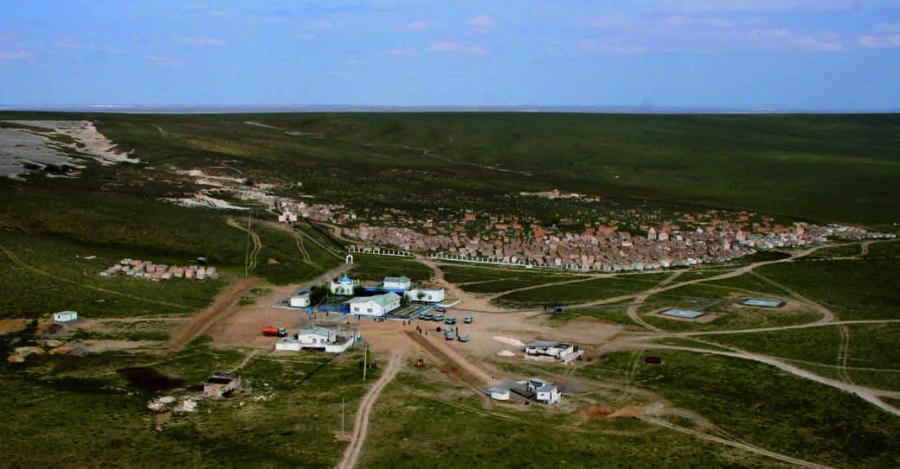
It is in 21 km to the north from the village Senek and is placed on a gentle slope of a plateau cut by ravines (Karakiyan district, Mangystau region).
The complex, located, in fact, in a desert area, on the ancient caravan route from the eastern coast of the Caspian Sea to Khorezm, is the object of deep respect for the Kazakh, Turkmen, Karakalpak population of Ustyurt, Mangyshlak and adjacent areas. According to legend, the name of the necropolis is derived from the legendary patron saint of shepherds, Shopan ata, who was a student of Turkestan Sheikh Khoja Ahmed Yasawi. Legends about him were recorded back in the 1870s by A.K. (apparently, A.V. Komarov - head to the headquarters of the Dagestani region troops, then head to the Trans-Caspian region), and later by the Kazakh ethnographer Kh.Argynbayev. According to one of them, Akhmed Yasawi throws his stick (asa) through the window of the mosque (or through the upper opening of the yurt) to check his novices (murids) and asks them to find it. When everybody rushed in search, Shopan ata sat quietly in his place, explaining that it is impossible to find the teacher's stick at once, because it is far away and must prepare for a long journey. In search of the stick he came to Mangyshlak, where he found it. A large mulberry tree grew out of the stick. Here, too, Shopan ata met a respectable old man, whose daughter he married. At the site of the stick he built a mosque, around which a huge cemetery grew.
According to another legend of the Kazakhs of Mankystau, Musa dzhigit helped the two girls to drink sheep by raising the heavy stone cover of the well, and they invited him to the house of his blind father, where Musa stayed to work as a shepherd of sheep. After 9 years in the herd all the lambs were born white, and the next year they were born peggy. Seeing this, the old man married Musa to his youngest daughter and called him the patron of sheep - Shopan ata. According to ethnographer G.P. Snesarev, the image of Musa in the legend is a "legalized" in Islam biblical prophet Moses", who was also a shepherd before his revelation. There are other variants of the legend: Shopan ata studied not in Turkestan, but in Beskala ("Pyatigradye", i.e. Khorezm) and came in search of a stick to Mangyshlak. Here he found a stick stuck in a stone from which no one could pull it out. Shopan ata pulled the asa, and then stuck it back into the stone, where the spring came from. Here he built a mosque. The story of the legend about the spring, which made its way through with a "crutch in the rock", is given by G.S. Karelin (1883) too. One of the legends connects Shopan ata with the Turkmen (?) saint Temir-Baba. The latter comes to visit Shopan ata, who cuts the sheep. They eat meat, but do not touch the bones. Shopan ata, wishing to show his supernatural power, wraps the bones in the skin and enlivens the sheep. Temir Baba, who also has magical qualities, in response turns his turban on the water surface of the Caspian Sea, resulting in the formation of an Isthmus road. However, Shopan ata, dissatisfied with it, says that one should not make the road for kaafirs ("Kapirlerge zhol zhasama!").
Despite the fact that now it is difficult to prove the historicity of some of these legends, which are echoes of the widespread in the Middle Ages cult of Yasawi and Shopan ata among the Kazakhs, it should be noted that the mosque on the necropolis is quite ancient. Initially, it, or one of its premises, was probably the home of a Sufi hermit. After the death of the Sufi desert hermit, the Turkmen and then Kazakh cemeteries gradually grew around his grave. It is quite indicative that for centuries the cult of the mosque/grave of Shopan ata did not fade away among the population of the region, and now there is a large memorial-cult, pilgrimage and tourist complex. The necropolis as an architectural ensemble has the status of a monument of history and culture of republican importance and is an outstanding object of sacral importance in the Aral-Caspian region. The Shopan ata complex was purposefully explored by expeditions led by M.M. Mendikulov (1951-1952); as well as by the Ministry of Culture (1977-1978) and the Society for the Protection of Monuments of Kazakhstan (1982), with the participation of the author of the article (S.E. Azhigali - Editor). The huge necropolis is quite characteristic both in terms of genesis, topography and types of monuments. It is clearly divided into two parts - Kazakh (Aday) and Turkmen, and by area, the number of preserved, visible monuments (more than 2 thousand) is the largest in Western Kazakhstan and, apparently, in steppe Eurasia in general. During the II millennium AD here, apparently, there were not less than 2.5 thousand gravestone structures. The cult center of the complex is a rock-subterranean mosque, which consists of several offices located in a semicircle (cells for prayer, rest, hudjras) and facing the "yard", where there is a sacred mulberry tree and a stone reservoir for ablutions. The main one is a group of northeastern adjoining rooms, in the central one there is a pole with horns of argali hanging on it. In the adjoining rooms, the old-timers have been showing tombstones belonging to Shopan ata's daughter and a certain "holy" Sultan-Azar for a long time. Four other rooms have separate entrances: all of them are currently renovated. The "Shopan-ata's grave" is connected to the mosque complex - to the west of it, on the terrace there is a small hill with a fence of stones, marked by dry branches stuck in the ground with votive rags and stone chandeliers-shiraks. When worshipping the shrine, the mosque and the tomb of Shopan ata are consistently visited.
The territory to the west and northwest of the mosque is occupied by medieval Turkmen monuments, among which there are a huge number of tombstones such as koitas, archaic fences, sarcophagus boxes, and steles-features. Tombstones-koytases, made of short-lived limestone, which differ in variety: from small steps to giant ones, height up to 1,5-1,8 m, are especially notable here. Surfaces of the monuments are often covered with relief and contour decoration, "drawings" of weapons, household items, horses and other animals. The elements of a warrior-rider are characteristic - road bags (Korzhyn), swords, quivers with arrows, combat axes; Arabic epitaphs and tamgas are not uncommon.
In the eastern part of the complex, where the late Kazakh monuments are concentrated (up to 1 thousand objects are fixed), there are a lot of monumental structures - mausoleums, saganates, as well as steles and gravestones, various in terms of architectural and compositional design and decoration. The material is sawn blocks of limestone and sandstone. Among the first ones are numerous saganatams and separate samples of dome mausoleums. Saganatams are diverse in architecture, layout and gradation: many large structures are family memorials (up to 10 tombstones in the cell). The necropolis is saturated with small forms of architecture, which include sarcophagi boxes (sandyktases), ushtases tombstones, bestsases, kulpytases with koytases. Many monuments of the XVIII-XIX centuries are of special interest from the point of view of genesis and semantics of architectural forms. In particular, steles and tombstones with relict images of a horse, riding accessories, etc.
In the area of the Shopan ata necropolis there are several other small cemeteries located on the edge of the plateau. On one of them, 1.5 km to the north-east, there is the "mazar Kuyeubalatam", a mausoleum above the grave of Shopan ata's son-in-law, who was buried far from his father-in-law's grave for disobedience. The monument is one of the characteristic types of tiled mausoleums of Mankystau in the XVI-XVII centuries. The walls of the mazar are covered with expressive contouring and incised drawings of animals, open palms (penje), Arabic inscriptions, tamgas of the Adai family.
The stylistic and compositional diversity of the architectural monuments of the Shopan ata complex testifies to the participation of stone-cutting architects of various schools and directions in their creation. In particular, well-known folk architects of the middle of XIX - early XX centuries worked here: Esentemir Dutbai, Nurniyaz Zhandauletuly and others. It is indicative that centuries-old traditions were not completely outdated in the Soviet period (later kulpytases of the master Nazarkhan Bekmenbetuly). Under the influence of these traditions and such unique precedents as the necropolis of Shopan ata, over the past 20-25 years in the memorial construction of Mankystau and Ustyurt, a "new traditional style" of stone-carving architecture was formed. But it should be noted that this fairly widespread phenomenon is now often accompanied by not always justified "invasion" of new monuments in the established structure of ancient memorial-cult ensembles, such as the remarkable necropolis Shopan ata. In general, this grandiose complex should be considered a key object of "sacred geography" of the southern part of the Aral-Caspian region.