Information
- Location
- Маңғыстау облысы, Tupkaragan District
- Period
- 1101 – 1950
- Category
- Historical and cultural monuments of republican significance
- Type
- Сomplex
- Kind
- Archaeological sites
- Authors
- Ажигали Серик Ескендирулы
Sources
- Қазақстанның киелі орындарының географиясы: Табиғат, археология, этнография және діни сәулет өнері нысандарының тізілімі / Жалпы редакциясын басқарған ҚР ҰҒА академигі Байтанаев Б.Ә. – Алматы: Ә.Х. Марғұлан атындағы Археология институты, 2017. – 1-шығарылым. – 904 б.
Description
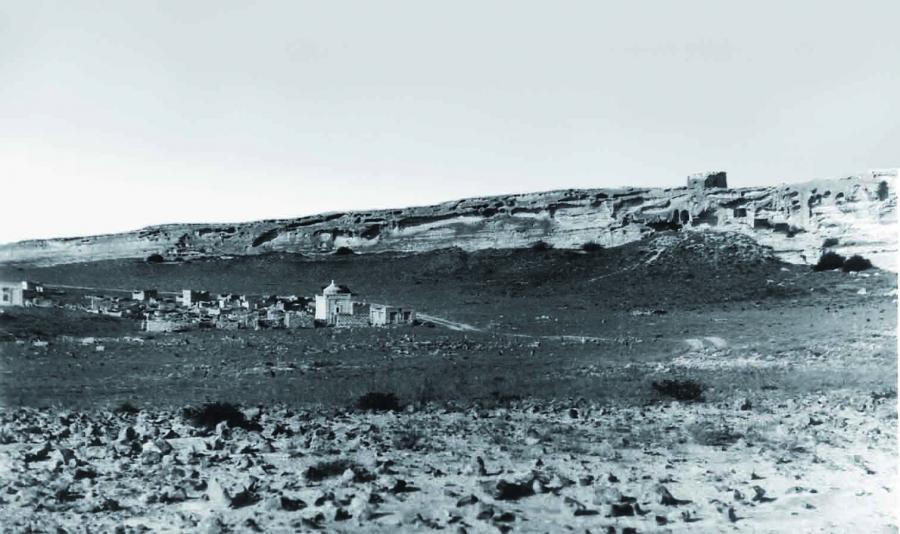
It is located in 20 km to the west-northwest from Taushyk village (Tupkaragan district, Mangystau region). The complex, located to the south of the shore of Sarytas Bay, consists of the mosque of the same name, a sanctuary, carved in an array of rocky cape, a large necropolis, located in the lowlands, to the west of the mosque, as well as individual clusters of stone industries / camps of the Paleolithic and Neolithic epoch, found within the monument.
According to the legends of the Mankystau Kazakhs recorded by A.K. in the second half of the XIX century, Shakpak ata (Shah-Mardan) was the grandson of one of the murids of Khoja Ahmed Yasawi Shopan ata, who came to Mangyshlak in search of his teacher's staff. He became famous for his ability to carve fire (shakpak - flint, fire) by touching one fingernail to another. Characteristically, in the Shakpak ata area there are plenty of flint exits, which could be one of the reasons for the legend. He is also believed to have fled from enemies with his head cut off, and in the area of Kunansu, traces of his feet on the stones are believed to have been preserved. The story about the "saint" with the severed head is very popular in the agiology of Central Asia and Kazakhstan, including Mankystau - Masat ata].
The Shakpak ata complex, which has the status of an architectural monument of republican importance, belongs to the well known, popular historical and cultural sites, "sacred places" of the Eastern Caspian Sea, has long been the object of pilgrimage. This is evidenced by numerous visitor inscriptions of the Middle Ages and modern times, preserved on the walls of the mosque: in the portal part and in the interior. And now the monument is actively visited by the local population, tourists, including foreign ones. In this connection, since the mid-1980s it has been periodically improving, repairing and restoring the monument. In recent years, a house for pilgrims - tileuhana ("mosque" of Yerzhan Hazyret Tolegenuly) - has been arranged in some distance from the ancient complex. Thus, nowadays this monument is a rather large cult-memorial, image tourist complex.
The monument was opened and studied by geologist and archaeologist A.G. Medoyev in 1966-1968: he conducted a detailed study of the rocky mosque, examination of the necropolis, archaeological collections. [But perhaps for the first time he is mentioned by the head of the Russian Embassy in Bukhara in 1620-1622 Ivan Khokhlov, who reports on the location of the "White Mosque" on the Tupkaragan Peninsula]. In the 1970s and 1980s, the Shakpak ata complex was visited and studied by a number of expeditions, including those led by M.M. Mendikulov (1973), M.S. Nurkabayev (1979), an expeditionary group of the Society for the Protection of Monuments of Kazakhstan (1982), etc. In 2008, the Arabic epigraphy of the monument was purposefully studied by specialists in oriental studies:
A.K. Muminov, A.S. Nurmanova* [*Orientalist V.P. Yudin also dealt with translations of separate texts of the complex]. In the same year archeological and accompanying researches have been carried out by archeologist A.E.Astafyev.
The Shakpak ata complex is first of all known as a remarkable cult monument of the XII-XIII centuries. - A multi-chamber mosque, which is usually not quite rightly defined as an "underground mosque": in fact, it is a rocky or rock-subterranean structure. It should be noted that it is dated to a fairly wide range: IX-X centuries. - A.G. Medoyev; first half of the XIV century - M.M. Mendikulov, A.Ye. Astafyev. Undoubtedly, it is an outstanding architectural and landscape monument, characterized by bright compositional and planning features and technical and construction characteristics. Cruciform in the plan, the hidden part of the mosque has a portal entrance in the western side of the rock, as well as the exit to the surface of the plateau from the opposite side. The central hall (crossroads) is decorated for the first time in the architecture of nomads of the region with elements of the order system in the form of three-quarter corner columns with various capitals; the top of the hall is carved in a dome with a light hole in the top. Upstairs, the "underground" complex is marked by a prominent from afar square in terms of building, planted on the axis of the skylight-air and erected from the old stone blocks and slabs - a domeless kiosk, including those that played the role of a minaret for local residents. The building is opened on the facades with arched openings, inside it has a spiral staircase upstairs. Shakpak ata rock mosque is a unique construction, which, according to experts, was built using engineering knowledge and experience in creating cave towns that are known in Ustyurt. According to the fair comment of the discoverer of the mosque Shakpak ata A.G. Medoyev, its creators "...acted more as sculptors than builders".
A rather large necropolis is located in a valley to the west of the mosque and stretches along the N-S line. Its southern and south-western parts are occupied by medieval ( XIII-XVII centuries) Turkmen monuments, among which are small fences with rough steles, tombstones such as koitas, and boxes of sarcophagi. Made of soft limestone rock, they are mostly ruined. Among the tombstones there are realistically executed sculptures of rams. Kazakh monuments located in the northern half of the beyit are mainly dated to the XVIII-XIX centuries. They are represented by more monumental structures: saganatams, large fences made of blocks with steles-kulpytases at the western walls, etc. The kulpytases of Shakpak ata are notable for their simplicity and archaism of the flat relief and contour decor. Modern burials are made on the edges of the Kazakh beyit.