Information
- Location
- Маңғыстау облысы, Mangystau District
- Period
- 1250 – 2010
- Category
- Historical and cultural monuments of republican significance
- Type
- Necropolis
- Kind
- Archaeological sites
- Authors
- Ажигали Серик Ескендирулы
Sources
- Қазақстанның киелі орындарының географиясы: Табиғат, археология, этнография және діни сәулет өнері нысандарының тізілімі / Жалпы редакциясын басқарған ҚР ҰҒА академигі Байтанаев Б.Ә. – Алматы: Ә.Х. Марғұлан атындағы Археология институты, 2017. – 1-шығарылым. – 904 б.
Description
XIII-XIV centuries - beginning of XX century. It is located 34 km north of the village (railway station) Sayotes (Mangystau district, Mangystau region). The monument is located in the northwestern part of the Ustyurt plateau, on a flat terrain 2.25 km from the plateau edge.
The appearance of the memorial complex should be attributed to the Golden Horde period of the history of Western Kazakhstan and, apparently, to the beginning of the Salor stage in the ethno-history of the Eastern Caspian Sea: by the end / second half of XIII - beginning of XIV century. This is evidenced by the recent archaeological and ethnoarchaeological research on the necropolis, where archaic types of monuments - stela-ferts, tombstones with "wrenches", and in its district with the ruins of ancient monuments with tamgas of Oghuz-Turkmen tribes.* [*Early dating of the complex is problematic, including the absence of the necropolis eponymous "Sisem ata" in the main version of the legend about "Akhmed Yasawi's disciples" and their descendants in Mangyshlak, recorded by A.K. in the 1870s - Editor's note].
The information about the eponymous necropolis is rather vague and uncertain: maybe it was the head of the local religious community of the end of XIII-XIV centuries, buried here when a small cemetery (or cemeteries) already existed. At the same time, it should be noted that in the oral tradition of the Mankystau Kazakhs (surveys of informants in 1980-1990s), the name of the necropolis eponymous appears quite definitely as "Sisem ata". However, the question of the location of the "grave of the eponymous" is quite complicated and confusing - there are two main options: The modern, "approved" in recent years version of its location on the northern edge of the ancient part of the necropolis, on the canopy of the burial mound (elongated tombstone above the inlet? burial); and to the south, in the center of the same part of the cemetery (stone fence with tombstones, stems and remnants of poles; now marked as the grave of a certain "Sanazar ata"). The latter variant corresponds to the early information of G.S. Karelin, who visited the cemetery in the 1930s accompanied by local Turkmens and Kazakhs, and to the surveys of M.M. Mendikulov in the early 1950s. The topography of the old part of the necropolis also speaks in favor of this version: certain observance of the principle of "gonam bashi" ("closer to the holy grave") when placing graves/tombstones. The Sisem ata necropolis is an outstanding memorial-cult, architectural and historical-cultural complex of the Aral-Caspian region, Kazakhstan as a whole and is one of the largest in steppe Eurasia. The monument, where many outstanding personalities of the region are buried, is of special importance for the history and culture of Mankystau and Ustyurt, is a unique focus of the achievements of folk architecture and stone-cutting art of Kazakhs. The complex, which has the status of a monument of history and culture of national importance, should be considered one of the most important objects of "sacred geography". The Eastern Caspian Sea.
The Sisem ata necropolis is actively visited by the local population, pilgrims, domestic and foreign tourists; it has significant prospects for further development as a key cultural tourism destination in the region. At the same time, under certain conditions, an outstanding monument together with other unique complexes of the Mankystau-Ustyurt zone deserves international recognition (including as a World Heritage site).
The Sisem ata necropolis was first visited and described by G.S. Karelin in 1832 in connection with the construction of the NovoAlexandrovsky fortification in this part of Ustyurt, in 1851-1852. The "holy cemetery" was briefly described by Lieutenant Alexeyev-2, a topographer. The systematic study of the monument was carried out by a group of well-known architects, historians, ethnographers, among whom are M.M. Mendikulov, A. Itenov, M.S. Nurkabayev, the expeditions of the "Kazprojectrestoration" Institute (head T.Janysbekov), the Institute of Oriental Studies named after R.B. Suleimenov, the Committee of Science of the Ministry of Education and Science of the Republic of Kazakhstan (headed by A.K. Muminov), the group of T. Turekulov, A. Astafyev, the expedition of the Institute of History and Ethnology named after Sh.Sh. Ualikhanov of CS of the MoES of the RK (headed by S.E. Azhigali).
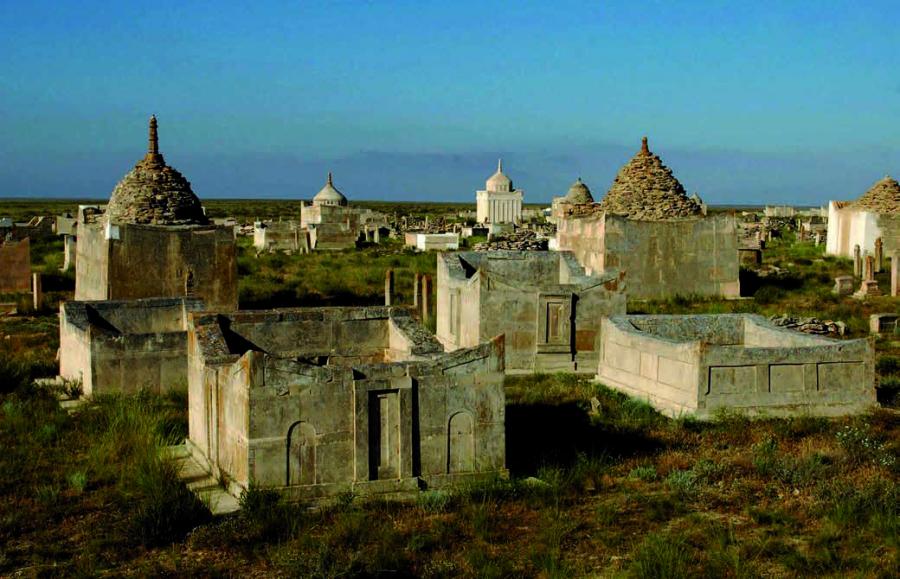
The Sisem ata necropolis, despite its small size (430×250 m), is an exceptionally rich architectural memorial complex with about 2,000 monuments. It consists of two main parts - the early, Turkmen (XIII-XIV - XVIII centuries), and Kazakh, Aday (end or second part of the XVIII - beginning of the XX centuries). In the north, another small, early Turkmen cemetery (XIII?-XIV-XV centuries) adjoins them. Initially, two "ancient" cemeteries were functioning, of which the southern cemetery, due to the presence of the eponymous grave there, became the main one during the Middle Ages, now it occupies the WSW part of the entire complex. In new times, the Kazakh part of the necropolis, which occupies 2/3 of its modern territory, was developed from the east, partly from the south and especially from the north of the old cemetery. In the perimeter zone of the early and late parts of the complex there is an intermediate "diffuse band" of monuments, up to 20-30 m wide, where the late Turkmen and early Aday gravestones are located.
The early part of the Sisem ata necropolis is mainly represented by small forms of stone-cutting memorial monuments: small steles, paired steles, tombstones of the Koytas type, archaic, semi-destroyed sarcophagus boxes - sandyktases, etc. (In the northern cemetery there are also stela-ferts). Many of them are carved with medieval tamgas of Oguz-Turkmen tribes: chowdor, tuger, afshar, jebni, yomut (baga, jafarbai), baiyndyr; monuments are often placed in small areas, except for Salor tombstones - in different places. Apparently, the medieval necropolis was formed according to two principles: the maximum approach to the tomb of the eponymous and small cemeteries ("kaums", "elats"). Tombstones of this part of the complex contain relief images of saber, less often of swept sums and very rarely of Arabic epitaphs.
Of great architectural and artistic interest is the intermediate strip of monuments of the XVII-XVIII centuries and the adjacent zone of Kazakh tombstones until the middle of the XIX century, which in some places "fit" into the old part of the cemetery. These are mainly small forms of memorial structures: archaic appearance of sandyktases, gravestones, stela-kulpytases and their combinations, among which there are many original monuments and outstanding examples of stone-cutting art. The surfaces of many of them are covered with contour, flat relief and volumetric decor, "drawings" of weapons, household items, animals, and often unique scenes of panels. A significant part of the early Kazakh monuments is accompanied by images of the tamga of the Adai family, less often with lapidary epitaphs. Among the monumental constructions, a special attention should be paid to the original mausoleum of Bay Kozhanazar Zhanayuly of the late XVIII century.
The Kazakh part of the necropolis was especially intensively developing in the middle of the XIX - beginning of the XX centuries, during the period of the highest development of memorial architecture of the region, when in the vast "framing" zone of the complex monumental sites such as dome mausoleums and saganatams gained specific distribution. As a result, the Sisem ata necropolis was formed as a unique architectural ensemble, which includes about 30 mausoleums, more than 100 saganatams, several hundred small architectural forms: sandyktases, koytas' gravestones and steles-kulpytases. Many of them are bright examples of folk architecture and monumental glyptic of Kazakhs. Among them is a special group of facade mausoleums of the second half of the XIX century; remarkable monuments of the end of XIX - beginning of XX centuries.Hexagonal mausoleum of Ermek Tenizbayuly ("Ergali"), elegant mausoleum of Agatai Tokabayuly (built by architects from the school of Satybaldy - Turlymurat), saganatam of Akmyrza-sopa ("Akhmet Zhanalin"), Sugir Akhmedzhanuly and many others.
Along with this, the necropolis of Sisem ata is an outstanding historical and cultural complex of the Eastern Caspian Sea, which was named "Aday pantheon" by the people. Here are buried many historical personalities who contributed to the development of the Kazakh severe Mankystau-Ustyurt region: batyrs Esekmergen, Labak, Shonai, Konai Kenzheuly, Anet Tekeyuly, Tolep Anetuly, Suyunkara Urgenishbayuly, Shonen bi, Karzhau Tolekeuly, Matai Zhanbozuly and others. In this regard, the Arabic epigraphy of the necropolis, represented by inscriptions on more than 150 monuments, has a special attribute value, and it is also important in historical and philological terms. Undoubtedly, the outstanding ethnographic and art history significance of the Sisem ata complex as a phenomenal focus of the achievements of stone-cutting art, original art ("drawings") and unique ornamental and decorative style of the Kazakhs is also indisputable.
It should be noted that the historical and cultural district of the Sisem ata necropolis - the northern part of the Ustyurt Western Cliff - is very rich in various monuments: Archaeological (ancient barrows, sanctuaries, "arans" drive-in structures); architectural (medieval and modern burial complexes, including ancient mausoleums in the beyit of Karagozy-Kostam/"Kosmola"); settlement (cult residential complexes of Besbulak and Kyzyltas); historical (remains of the Novo-Alexandrovsky fortification). All this creates considerable prospects for further cultural development and use of the memorial complex and adjacent territories, development of tourist routes. Undoubtedly, the necropolis of Sisem ata is a national treasure and requires a special careful attitude, including in terms of preventing new burials and buildings, distorting the appearance of a unique ensemble, exceptionally thought-out, responsible and highly professional implementation of security and restoration activities, etc.