Information
- Location
- Маңғыстау облысы, Tupkaragan District
- Period
- 500 BCE – 301 BCE
- Type
- Temple
- Kind
- Archaeological sites
- Authors
- Ақан Онғар
Sources
- Қазақстанның киелі орындарының географиясы: Табиғат, археология, этнография және діни сәулет өнері нысандарының тізілімі / Жалпы редакциясын басқарған ҚР ҰҒА академигі Байтанаев Б.Ә. – Алматы: Ә.Х. Марғұлан атындағы Археология институты, 2017. – 1-шығарылым. – 904 б.
Description
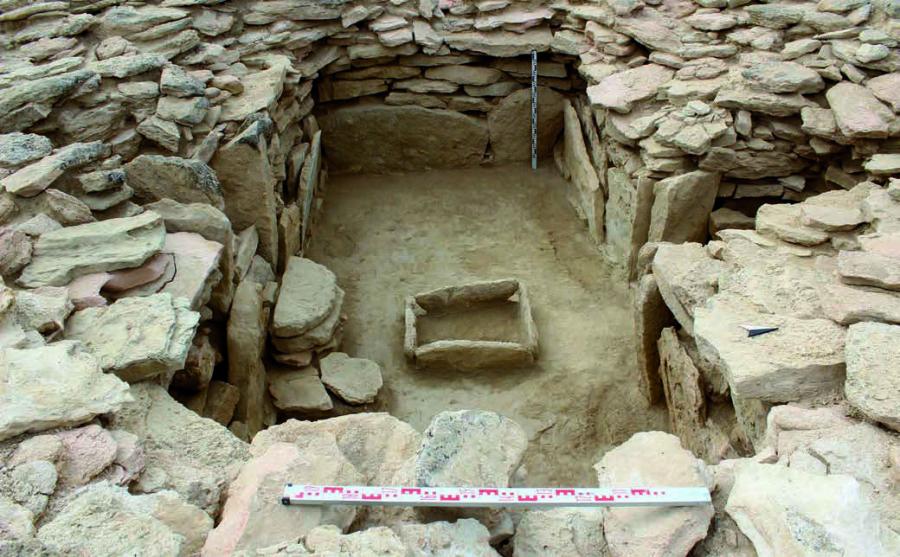
It is located 17.5 km to the west of Taushyk village (Tupkaragan district, Mangystau region). The sanctuary consists of a cult structure and extra-territorial objects. The initial diameter of the cult construction, the temple, was 14,5-15,1 m, height more than 4 m. The ancient temple, apparently, had a three-stage structure, formed by two circular stone walls of different diameters and a dome. In the space between the outer and inner walls another wall, 11.6×12 m in diameter, was fixed. It is possible that the inner room had a vaulted ceiling. Taking all this into account, it can be assumed that the height of the external walls reached 1.8 and 2.5 m, and the height of the dome - at least 4 m.
The inner room has the shape of a cross and is oriented on the sides of the world. Its dimensions are 5.1×6.3 m. The southern beam of the cross is elongated and combined with the entrance shaft-well. Preserved height of internal walls - 1.3-1.5 m. In the center of the cult building there is a square altar in the plan from the slabs placed on the edge. In the southern wall of the temple, at a height of 1 m from the ancient day surface, the entrance to the room was fixed. The entrance corridor is filled with a layer of horizontally laid stones and soil, the long axis is oriented along the N-S line, length - 2.5 m, width - 0.5-0.6 m. The entrance opening is marked by two vertically installed large slabs. The eastern and western walls of the corridor are formed by horizontally laid slabs. Below the threshold line to the floor of the inner temple were traced the remains of collapsible stone steps installed, perhaps later, during the burial of people.
On the territory of the sanctuary seven objects of different shapes and sizes were fixed. It is difficult to determine the chronological belonging of the excavated off-chamber objects because of the lack of dating finds. Obviously, the studied clusters were sacrificially memorable structures. In the course of the study of the northern part of the facility № 3 a stone altar was identified.
The analysis of the received materials allows to conclude that the ancient temple after a certain period of time was reused as a place for burial of people. This is indicated by the bone remains of two or three people, fragments of stucco and easel ceramic vessels, beads, bronze arrowheads, spindles, roasted round stones, bones of small cattle, etc. People were buried here before the structure collapsed, as indicated by the sedimentary layer of soil up to 0.2 m thick. The nature of the bones indicates that the burials were looted.
The object has a sacral character as a sanctuary that operated in the early nomadic epoch, a cult monument, where rituals were performed in the era of formation of the foundations of steppe civilization. The study of the monument makes it possible to reconstruct some aspects of the religious and mythological views of the population of the Scythian-Saka era, spiritual and material culture. It is a monument of archeology of republican importance. Object of tourism.