Information
- Location
- Kyzylorda Region, Shieli District
- Period
- 2300 BCE – 1200
- Category
- Historical and cultural monuments of republican significance
- Type
- Petroglyph
- Kind
- Archaeological sites
- Authors
- Железняков Борис Анатольевич
Sources
- Қазақстанның киелі орындарының географиясы: Табиғат, археология, этнография және діни сәулет өнері нысандарының тізілімі / Жалпы редакциясын басқарған ҚР ҰҒА академигі Байтанаев Б.Ә. – Алматы: Ә.Х. Марғұлан атындағы Археология институты, 2017. – 1-шығарылым. – 904 б.
Description
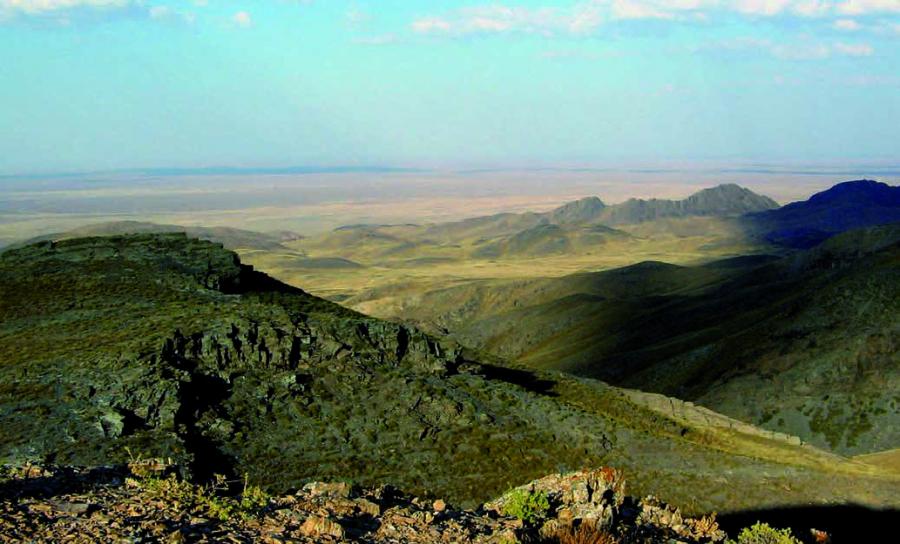
Early Bronze Age (from the XXIII century BC) - later Middle Ages. The complex is located 50-60 km away from Enbekshi village of Shieli district of Kyzylorda region, on the westernmost extremity of Big Karatau ridge. Included in the Tentative List of World Cultural Heritage in 2016.
In 2003-2004, as a result of archeological exploration in the Bala-Sauyskandyk Mountains, located in the north-western part of the Big Karatau Ridge, S. Murgabayev recorded a large congestion of petroglyphs on the banks of the Sauyskandyk River. In 2005-2006, short reports on this discovery were published, in which the authors of the articles (S. Murgabayev, Z. Samashev) reported the presence of five large groups of rock paintings in this area. Z. Samashev called it one of the most promising and interesting in the history of studying petroglyphs of Kazakhstan. In 2007-2009 I.N. Shvets and M.V. Bedelbayev joined the study of Sauyskandyk.
These researchers put forward a possible dating of some images on the basis of large sizes (2-4 m) and other features, such as the degree of surface destruction, the Age of Stone (Neolithic - Eneolithic). There is an assumption of Z. Samashev that mass depictions of petroglyphs are connected with the migrations of speakers of Indo-European languages to the east.
Several thousand petroglyphs on the right bank and left bank of the river Sauyskandyk for 7 km of the length of its bed are undoubtedly unique. The largest zoomorphic images by area, number and species composition is group III. Most of the petroglyphs are characterised by a naturalistic image style - the images are easily recognizable and realistic. Anthropomorphic and zoomorphic figures are basically devoid of syncretism and "rowiness". The accompanying attributes are identified by their parallels in the archaeological material. The images of the masked Palicenosans, the "roundabout of women with tambourines" (?), the woman in labor, the scenes of "holy marriage", the chariot and the wagon are recorded.
The bulk of the drawings are images of the Bronze Age. They are embossed on convenient planes with dense patina and most often make multi-figure compositions. Widely spread is the image of a common man, shown in a tailed animal suit and in a special headdress. Wild bullfighters, two- and four-wheeled carts, figures of ordinary anthropomorphic characters are widely represented; they date from the beginning - the first half of the II millennium BC. A special layer of drawings are images of "many-sided" horses, stylistically close to the monuments of the Seimas circle. In the late Bronze Age, especially in the transition period to the early Iron Age, in the petroglyphs of Kazakhstan there appeared images of deer with a peculiar treatment of the muzzle in the form of a bird's beak, which to some extent is an undeniable evidence of the migration of the bearers of this fine tradition from the depths of the Central Asian steppes to the west.
The main repertoire of Sauyskandyk petroglyphs finds clear iconographic and stylistic parallels in the rock art of Kazakhstan, Turkmenistan, Uzbekistan, Altai and Siberia. In Sauyskandyk, drawings were also made later, in ancient Turkic and New times, up to the present day. They constitute a legacy of this unique monument along with older and more massive layers of petroglyphs.
In the scientific literature, the approach to their interpretation as sanctuaries, i.e. open-air temples, prevails with respect to large rock art monuments. In the western part of Eurasia, the tradition of depicting and honoring such "saints" - sacral places - ceased on the threshold of the Middle Ages. In Central Asia, both the veneration of rock paintings and the veneration of places in general, continues to this day. With the advent of architectural constructions, the sacred nature of the buildings is acquired by specially designed temples with specified parameters. However, the ability to appreciate the primordial nature, its erection in the cult is traced exactly to such sacred objects. Thus, the sacralization of ancient sanctuaries in Central Asia is preserved until our time.